

Britain’s parties are addicted to control – and it’s breaking politics
The tales of Suella Braverman and Andy Burnham are two sides of the same coin.


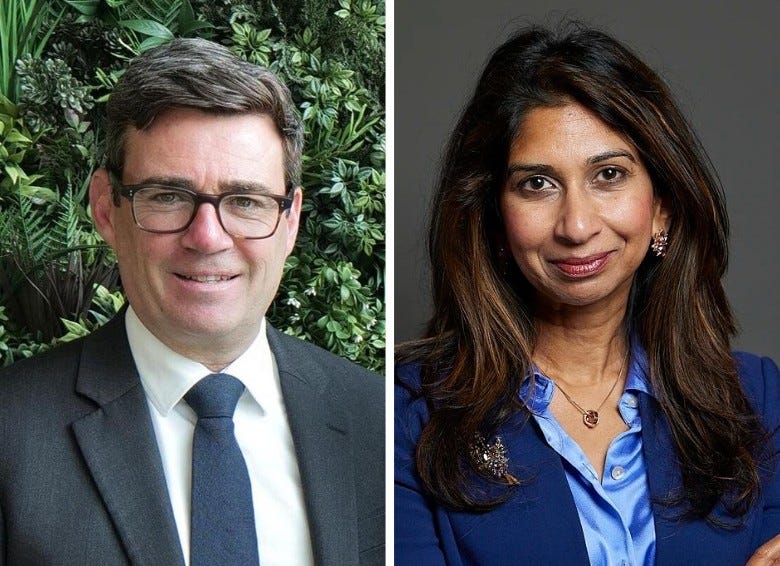
Welcome to British politics: where power is hoarded, managed and protected, but rarely wielded.
The country is in the grip of a dispiriting paradox. At a moment when the public is crying out for delivery and seriousness, the parties that govern them are being eaten alive by their own internal anxieties.
The past few days have offered a neat illustration. On the right, Reform UK continues its steady absorption of disgruntled and deluded Conservative MPs, most recently Suella Braverman, a former Home Secretary twice sacked from the Cabinet, reborn as a rallying voice against the system she once ran. On the left, Labour’s leadership has triggered open fury within its own ranks by blocking Greater Manchester mayor Andy Burnham from standing in the Gorton and Denton byelection, a decision defended on procedural grounds, but widely interpreted as an act of political fear.
Different parties, different circumstances, but all in the grip of the same underlying pathology: a politics obsessed with party management, factional control and threat suppression, at the expense of governing.
Take Reform first. Nigel Farage’s party sells itself as a clean break from the failures of the past 14 years, a vehicle for voters furious with a Conservative Party that, in their view, squandered Brexit and presided over national decline. And yet Reform’s fastest-growing recruitment pool is not disillusioned outsiders, but senior Conservatives (many of them former leadership contenders and secretaries of state) who already held power and abysmally failed.
Braverman’s defection is revealing not because of the familiar chorus of broken promises and betrayal, but for what it exposes. Reform’s unifying principle is grievance. It has pitched itself as a force of destruction against the Tories, the political establishment, and a system it says has failed. But it has set out far less clearly what comes next.
Meanwhile, in government, Labour is displaying a different but related insecurity. The decision to prevent Burnham from standing – ostensibly because his departure would trigger a costly mayoral byelection – may feel sensible: it is reasonable to ask whether a mayor elected for a four-year term should abandon it midway, and whether voters should shoulder the cost. But politics is about judgment as well as rules.
Burnham is one of Labour’s most recognisable politicians, with a proven electoral base and an established connection to hard-to-reach voters. He has a clear vision for the country and a track record of delivering for the people of Greater Manchester. Blocking him does not project strength, but a leadership deeply insecure about voices it cannot fully control.
This has gone down badly inside the party. Most Labour MPs are certainly not itching for a civil war for its own sake, but the decision has fed a growing sense that the party is slipping into defence, prioritising control over vision.
Political scientists have a name for this drift. Academic Andrew Hindmoor describes it as “partyocracy” – a condition in which political parties become inward-facing machines, increasingly focused on self-preservation and brand protection, allowing the business of governing to recede quietly into the background. Policy becomes secondary to process, and voters an afterthought. (If this sounds familiar, Andrew and I discussed it in an episode of The Bunker last year).
Seen through that lens, the Burnham and Braverman stories are not separate scandals but parallel symptoms. On one side, Reform welcomes figures who contradict its founding myth because it is more concerned with sticking a knife into its opponents than setting out a coherent governing vision. On the other, Labour sidelines a popular and trusted figure simply because he poses an internal inconvenience at a moment when the leadership is acutely sensitive to challenge.
For voters already cynical about politics, this confirms their worst suspicions: that parties care more about themselves than about the country. While politicians sink their teeth into one another, the country carries on regardless. Groceries get more expensive, the NHS struggles to balance its books. Schools crumble. Councils go bust. People grow unhappier, lonelier, angrier. The world becomes more dangerous. But don’t worry: a blow has been struck in some internal war. And that, apparently, is news.
Starmer may be right that Labour’s real fight is with Reform, but that fight will not be won by turning inward or failing to recognise talented figures as valuable assets. Governing parties do not demonstrate strength by simply neutralising internal threats; they demonstrate it by projecting confidence in their programme and people.
If Labour wants to be a serious governing force rather than a nervous machine, it must learn to tolerate plurality without seeing it as an existential risk. It must trust popular figures, not fear them, and focus less on who controls the party – and more on what the party is for.■
About the author: Zoë Grünewald is Westminster Editor at The Lead and a freelance political journalist and broadcaster. Zoë then worked as a policy and politics reporter at the New Statesman, before joining the Independent as a political correspondent. When not writing about politics and policy, she is a regular commentator on TV and radio and a panellist on the Oh God What Now podcast.
👫Agree with Zoë? Share this story with your friends, family and colleagues to help us reach more people with our independent journalism, always with a focus on people, policy and place.
Our January sale is live now – you can get 26 per cent off an annual subscription to The Lead for full access and a way to support our independent progressive journalism too. It means it’s exactly £36.26 for the year, which is equivalent of just £3.02 per month, instead of £49. Bargain!
Thank you so much for this Zoe. This week my local council failed to pass its audit, same as the last few years. Bin collections and basic services will continue though, we were told, even though our council has no idea what its assets are, not its debts. This is alarming. And yet. At the same time I saw Suella basking in the glee of switching parties and Labour MPs huffing and puffing over Burnham. It sticks in the craw. MPs of all stripes seem to think a new face will fix everything but our problems are deep, structural and require serious engagement. Changing ministers and leaders every 12 months is madness. We can't keep rebooting the system just as ministers getting grips with their jobs. Its is frivolous and does not meet such a perilous national - and global - moment.