


September is the month of new beginnings.
A fresh school year: new pencil cases, new shoes, new teachers. The sense that, whatever happened before, this year might be different. September is a season of possibility.
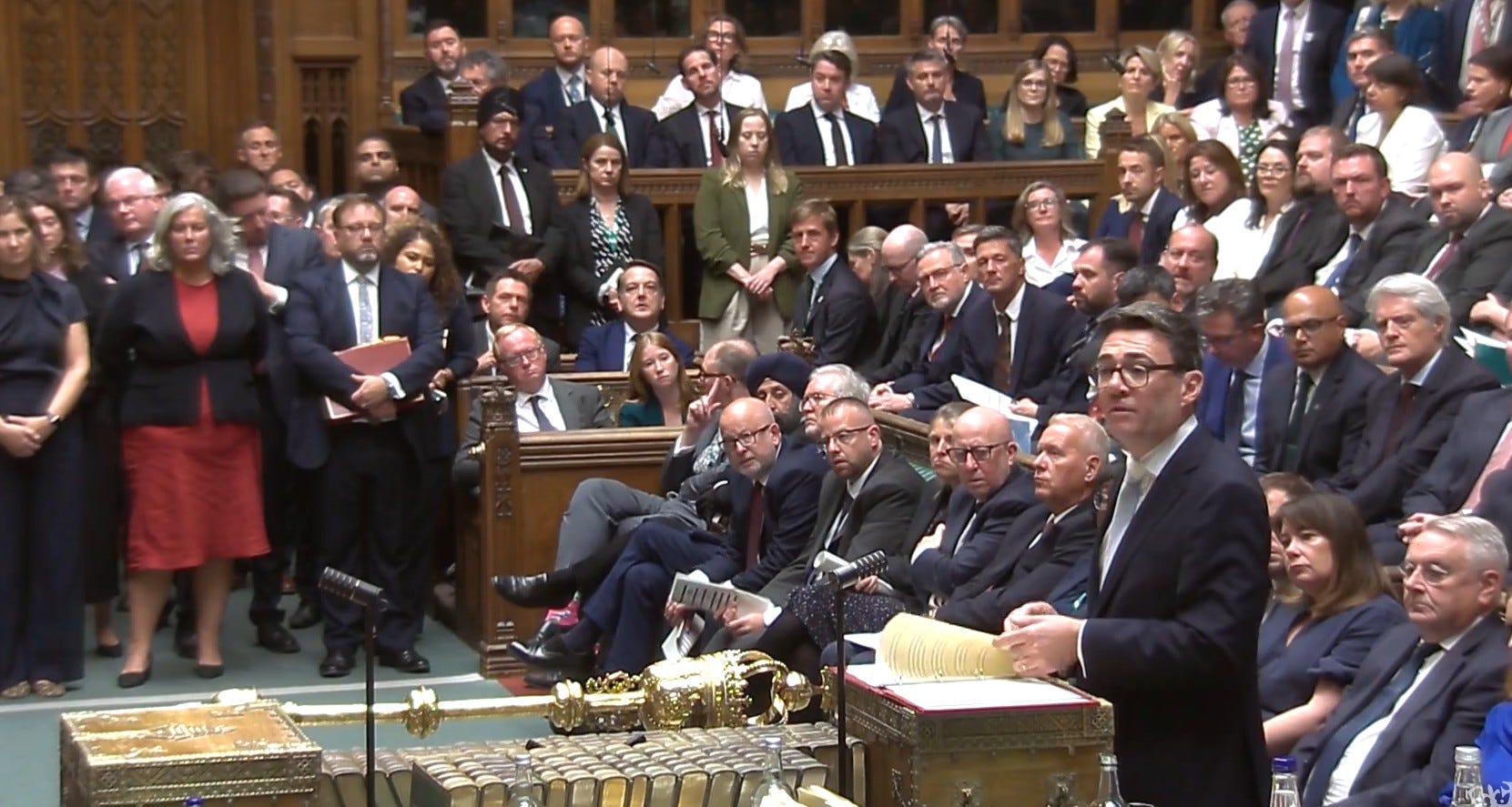
And right on cue, Andy Burnham bounds into Westminster today, full of optimism, to tell us that things really will get better.
But for an increasing number of young people, that sense of possibility is becoming harder to find.
New research from our friends at the IPPR lays the scale of that crisis bare. Young people are becoming dramatically more isolated. One in 20 now says they have no close friends at all, up from one in 100 in 2014. Nearly half of young women aged 16 to 24 meet the threshold for psychological distress, alongside more than a third of young men. And the proportion of young people saying their mental health has prevented them from accomplishing what they otherwise would have has more than quadrupled since the early 2010s.
These extraordinary numbers should make us question the creeping political tendency to talk about young people as if they were a problem to be solved.
The debate around NEETs and the welfare bill is the sharpest example. There are of course legitimate questions about why so many young people are economically inactive and how we get them into work, but it is striking how often the conversation stops there. Successive governments have spent years dismantling the institutions and circumstances that allow young people to flourish in the first place. In England, spending on youth clubs has fallen by 73 per cent since 2010, with the YMCA charity, the most established provider of youth services in England and Wales, pointing to a real-term cut of more than £1.2bn pounds between 2010 and 2024.
In the absence of places to gather and grow, and priced out of cafes, cinemas and leisure centres, young people flock to their phones and computers; an unregulated wild west of algorithmic manipulation and data harvesting. Add to that the usual suspects: austerity, Covid, insecure work, expensive rents and unaffordable homes, and here lies a generation disconnected from themselves, each other and wider society.
Look at what has happened in places such as Middlesbrough over the summer, where industrial decline, poverty and years of underinvestment have helped create the conditions in which organised crime can take root. Recent violence there has been horrific, but it is not simply a story about bad individuals making bad choices. Local politicians have pointed to the loss of youth provision and the impact of austerity, while one former mayor described the decline of the youth clubs that once brought together “the good and the bad lads”.
That is why, while creating good jobs for young people should be an important part of Burnham’s offer, it cannot be the entirety of his youth policy. They need work, but they also need places to go, communities to belong to and institutions that help them build confidence and connection. They need decent housing, functioning public services and an education system that gives them a sense of possibility. And they need to believe that the world they are being asked to build a life in is worth investing in.
That last question is becoming harder to ignore.
This summer has offered a particularly brutal preview of the climate young people will inherit: drought, wildfires, extreme heat and the increasingly obvious health consequences of a changing climate. Meanwhile, politicians on the right are engaged in an extraordinary exercise in cognitive dissonance, with Kemi Badenoch purging her frontbench of so-called “eco-zealots” while Richard Tice celebrates the prospect of warmer temperatures for fizzy wine.
Burnham, meanwhile, is reportedly considering further North Sea drilling as part of his efforts to bring down the cost of living. There is an entirely legitimate political imperative to make people’s lives more affordable now, but he must resist the trap that has caught governments for decades: sacrificing the long-term interests of the young to relieve the immediate pressures of the present.
Has there ever been a more dominant thread stringing together the patchwork of modern British politics? Again and again, younger generations have been asked to carry the consequences of decisions made by people with more wealth, assets and political power.
Burnham has an opportunity to do something different. Today he will make optimism the centrepiece of his pitch to Britain. That optimism must mean hope for the future – not just tomorrow or at the next election, but the country in five, twenty or fifty years time.
That means building affordable homes and investing in communities, something that Burnham already pledged to do. But it also means treating this epidemic of loneliness and disconnection as symptoms of a wider social problem, and it means making decisions on everything from welfare to energy to climate with an eye not just to the next election, but to the people who will still be living with them decades from now.
The kids are going back to school this week. Let’s give them something to look forward to. ■
About the author: Zoë Grünewald is Westminster Editor at The Lead and a freelance political journalist and broadcaster.
👫Agree with Zoë? Share this story with your friends, family and colleagues to help us reach more people with our independent journalism, always with a focus on people, policy and place.
If you’re enjoying our Burnham’s Britain series, as we unpick the difficult decisions he will need to make as Prime Minister and more become a subscriber to support us to tell more stories from beyond the Westminster bubble.
He can't spend money he hasn't got.
Fairer tax for the wealthy / very wealthy would be a small help, but for me the biggest benefit to doing it would be social cohesion by reducing income/wealth inequality a bit, and perhaps slightly reducing the strong impression most of us have that people with more cash than us are paying lower, or no, taxes because they can afford lawyers and accountants and do things offshore &c. The actual income it would raise would go a lot less far than people often assume, I think; it's certainly not a magic wand that can make everything alright again.
The two biggest problems are demographics and 40 of propaganda firmly convincing everyone that Immigration Is A Problem (rather than, say, "the only thing that keeps the NHS lights on", or "payers of 30% more tax than the average UK-born Brit". Hmmm, actually that number would be interesting to work out, it's bound to be higher because the cohort of people working who weren't born in the UK will obviously skew strongly towards younger, healthier and more economically active.
Any economists in the house? Is there an immigration multiplier numbers for the two groups? ... ... I'm drifting... /Prof Nebulous