


What do you picture when you think of England?
Cobbled streets, rolling hills or a country pub? England is still seen as a green and pleasant land, and rural images remain central to how many people understand Englishness.
It’s unsurprising, then, that a Labour MP quoted as saying idealised views of rural life were a figment of the imagination came in for online criticism.
What Jenny Riddell-Carpenter actually argued was narrower. She warned that the far right wants to weaponise a nostalgic vision of the countryside in the next election, one that paints rural areas as a monolith and glosses over real issues in those communities.
But within hours, her remarks had been clipped, stripped of context and fed into an online ecosystem that has spent years turning rural issues like inheritance tax, shooting, fertiliser and land into culture-war battlegrounds. The far right is using that ecosystem to fight for the countryside vote. Here’s how it happened.
The timeline
On 29 September, Riddell-Carpenter, Labour MP for Suffolk Coastal and Parliamentary Under-Secretary of State for Nature, was recorded at a fringe meeting at the Labour conference in Liverpool. She said: “It’ll be that warm ale, a black Labrador by your feet in a pub that doesn’t exist, and with symbolism of fox hunting all around them. It’ll be a very far-right nostalgic vision of Britain that we don’t want to have, [and] never really existed.”
The Conservatives shared a recording of the remarks as an Instagram Reel the same day. They captioned the video, which featured the sound overlaying Riddell-Carpenter’s face: “SHOCKING: Labour Minister thinks beer, black labs and pubs are a ‘very far-Right nostalgic vision of Britain’ that ‘we don’t want to have’.”
The clip was then shared as an Instagram sound, a background track, which was used in other videos by several rural and conservative accounts. The comments then spread among rural influencers.
29 September
The next day, Nigel Farage posted a response on X: a video of him in his wax jacket and flat cap, walking a black Lab towards a country pub. He captioned the video: “My vision of Britain.”
“This is the Britain we want back,” replied Ben Graham, a political commentator and Reform UK member.

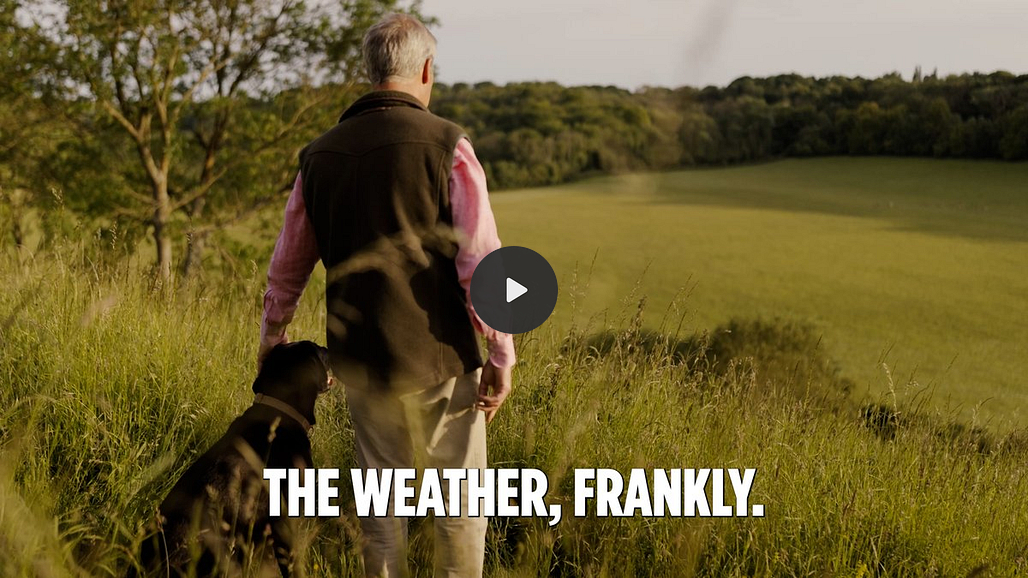
“Black Labs matter” began to trend on X, a reference to Black Lives Matter. “Black Labs Matter. All Labradors Matter. Labour can take our money and our freedom, but they’ll never take our dogs,” posted journalist and former MEP Annunziata Rees-Mogg.
The reaction spread across Instagram and TikTok. In a video, countryside influencer Ana Boulter mused whether the comments marked the beginning of the “extermination of the nation’s black Labs”. Boulter hashtagged her video “Black Labs Matter”. GB News invited Boulter on to its talk show.
Vicky Richter, a German self-styled conservative libertarian journalist who previously produced a documentary for Tommy Robinson, also posted about Riddell-Carpenter’s comments.
30 September
By 30 September, the audio and the hashtag “Black Labs matter” were being shared widely. People shared clips of their black Labs or local rural pubs using the sound. The most popular, posted jointly by Claire Sadler and Jack Sadler, garnered two million views after being cross-posted by conservative and rural accounts. They also posted it to their TikTok account.
No Farmers, No Food, a campaign group founded by GB News pundit James Melville, posted: “One can only imagine the official replacement vision being workshopped right now” The group has been criticised for its anti-net zero stance and links to far right politics.
1 October
Riddell-Carpenter responded to the backlash by trying to clarify her comments on social media. Over a picture of her own black Lab, Pepe, Riddell-Carpenter wrote: “Do I think country pubs and black labs are far right? No way hosay!
“I was talking about how rural life isn’t always rosy, and there are challenges government can help fix. And how our progressive Labour vision under this government will bring more opportunity for everyone in rural Britain.
“So yes to pubs, pints and Labradors! I love all of these things and so much more than rural Britain is.”
Media coverage peaked on 2-4 October.
7 October
A week later, the backlash had died down – until Riddell-Carpenter’s words were referenced multiple times at the Conservative conference in Liverpool.
Conservative Party chair Kevin Hollinrake brought his black Lab on stage to a large cheer, telling the audience: “Everywhere I go, people tell me how much they love Kemi, including in my local pub, that place where I go to drink my far-right fantasy pint. With my far-right fantasy black Lab.”
Jeremy Clarkson appeared at the conference and referenced Riddell-Carpenter’s comments, saying farmers were being attacked “from everywhere”. Clarkson has previously been accused of amplifying conspiracies linked to the farmers’ protests in Westminster in 2024. In a column for the Sun he claimed Labour wanted to “carpet bomb our farmland with new towns for immigrants and net zero windfarms. But before they can do that, they have to ethnically cleanse the countryside of farmers.”
8 October
By 8 October, media coverage had died down significantly, but GB News and the Daily Express continued to publish pieces, including a news story about a rural pub offering free pints to anyone with a black Lab.
The Sadlers’ video continued to circulate and inspired many similar posts from people with imaginary black Labs. A number of far-right accounts, including Bolton Patriots, shared the video.
Although some rural affairs groups, such as the Countryside Alliance, engaged genuinely with Riddell-Carpenter’s remarks, her words had been taken out of context and turned into a meme by far-right actors to appeal to rural communities.
A very traditional scandal
Reform and Restore have made rural affairs and protecting farmers a core rallying cry since the farmers’ protests. Last year, Reform deputy leader Richard Tice told Politico that rural constituencies would be a “massive” target for the party.
Beatriz Lopes Buarque, a researcher who focuses on disinformation and misinformation, says the trajectory of Riddell-Carpenter’s comments across the internet followed a well-worn path, taken out of context and framed as a threat to a specific way of life. This played into economic and identity-based anxieties that elicit strong emotional reactions.
Social media algorithms “play a massive role because these conspiracy theories express strong, affective investments because they satisfy our desire for an explanation. They point out an enemy,” says Buarque.
Analysis by DeSmog found that farmers’ protests were exploited by a number of high-profile individuals and groups, spreading conspiracy theories about a “left-wing government plot to take away people’s freedoms under the guise of climate action”.
DeSmog, an investigative journalism organisation focusing on climate issues, also found that conspiracies are often framed as an existential threat to rural ways of life. Desmog cites the No Farmers, No Food claim on X that farmers were the last defence against ministers and climate activists enforcing policies in which people would have to “eat bugs” – a sentiment that Clarkson amplified on his X account during farmers’ inheritance tax protests.
The reaction to Riddell-Carpenter’s comments followed the same pattern. “Remember, they hate you and your way of life,” posted James Price, a former Conservative government special adviser, while resharing another post about Riddell-Carpenter’s comments.
Buarque calls these “paranoid-style conspiracy theories” marked by absolutist and apocalyptic language. “They establish this antagonism in absolute terms. So it is pure good against pure evil. You don’t negotiate with evil. Either you destroy evil, or evil destroys you,” she says.
An idealised past
Far right parties have incorporated rural iconography into their campaigns. Rupert Lowe launched his Restore party earlier this year on his Gloucester farm, saying in a video: “I’ve chosen to speak to you today from the farm because places like this represent what proper Britain is about: hard work, responsibility, effort, duty, stewardship.”
Images of rural Britain are important to the far right’s construction of a mythic past, according to the philosopher Jason Stanley To the far right, the countryside represents tradition and an authentic, uncorrupted national identity, contrasted to the city, which is “full of alleged materialism and decadence”, says Bernhard Forchtner, associate professor in the School of Media, Communication and Sociology at Leicester University.
“You have this spatial separation, but it’s also a separation in terms of time, because the countryside is the idealised past, peaceful, and nostalgic. The city is the present and the future,” he says.
Both Forchtner and Buarque note that the countryside is represented as a place of simplicity, where there would be less anxiety about economics and identity. Outsiders are seen as a corrupting force that challenges this idealistic way of life.
The backlash to a Defra-commissioned study in February this year, which urged action to make rural locations more accessible to racial minorities, is a case in point. Several right-wing publications, including the Telegraph, GB News, and Spiked, ran with headlines suggesting that Defra had claimed the countryside was “too white and middle class”.
Which countryside?
Rural Britain is still largely misunderstood by outsiders, and rural communities are often patronised.
“Very few people have a good understanding of what rural life is about,” says Forchtner, noting that most people of influence, such as politicians and journalists, live in cities, so may be taken in by idyllic representations of country life while ignoring the real issues in those areas.
This discrepancy has led to what Michael Woods, geography professor at Aberystwyth University, calls “rural discontent”, which he claims can contribute to support for “disruptive politics”, such as far-right parties like Restore or Reform.
Nor is “rural England” a single place. Although rural areas face many overlapping issues, the problems of northern rural communities and southern ones may differ drastically. As Woods points out, far-right politicians and influencers tend to use southern rural imagery.
“The irony is that actually many of those rural areas in southern England are relatively prosperous, and in some cases, farming isn’t particularly significant to the local area anymore,” says Woods. “These are not the areas which are turning to Reform or Restore. But there are farmers who feel threatened, and those are the farmers in more marginalised areas like the northern uplands. They do feel that their culture is under threat. That’s where those protest groups and actors on the right seeking to exploit [their fear] are getting their support from.”
Despite this, he notes that far-right parties use imagery more associated with the South because of its nationalist connotations: pastoral southern fields and chocolate box towns in the Cotswolds are easier to sell as a nostalgic vision of Britain. Farage is often seen in his wax jacket and flat cap despite living in Essex.
But the message still travels North. “They don’t want to sell the image of a rundown farm and the Yorkshire Moors, which are struggling to survive,” says Woods. “But then saying to that farmer: ‘Well, actually, you’re important because you stand up for the essence of Britain, and you’re being threatened.’ That message still resonates.”
That worked for the far right in last year’s local elections, when Labour lost several rural northern seats, including three in Lancashire. “People mentioned all sorts of things in the campaign. The state of roads with potholes. Farming and inheritance tax. Farmland being bought for solar farms. These are big issues,” Reform county councillor Ian Duxbury told LancsLive following his win.
To combat disinformation and discontent in rural communities, Woods and Buarque suggest more needs to be done to build bridges between local people and the political class. “It’s very, very important that we engage in dialogue,” says Buarque. “By dialogue, I mean actively listening to these people… That’s how we can restore trust.”
Tim Bonner, chief executive of the Countryside Alliance, says the reaction to Riddell-Carpenter’s comments highlights the challenge of political discussion in the social media age.
“My immediate reaction to her comments was that she was trying to highlight a stereotypical view of rural communities that can and does mask many of the challenges of poverty and deprivation,” he says. “However, by denying the existence of one part of the rural community in order to champion another, she allowed those who felt that they had been cancelled to dominate the media and social media response.” ■
About the author: Lois Shearing is a bi activist, freelance journalist and writer
👫Enjoyed this investigation by Lois? Share this story with your friends, family and colleagues to help us reach more people with our independent journalism, always with a focus on people, policy and place.
This is the latest part in our series aiming to tackle the misinformation ecosystem being built in Britain, and digging into the dark forces behind it. If you missed it, Katherine Denkinson went inside the ecosystem that is turning silence into conspiracy. Subscribe to The Lead today to support our reporting and until the end of November it’s half-price thanks to our Black Friday deal.
Urban foxes are smarter than rural foxes. They have more complex problems to solve. Rural foxes tend to vote Tory and more recently, Reform. Presumably they appreciate the simple life resulting from the loss of rural jobs, post offices, pubs, village schools, bus routes, and housing.