


A year ago, I wrote that I was glad I wasn’t Rachel Reeves.
Twelve months, one Prime Minister and a Chancellor later, I’m perhaps even more glad I’m not John Healey.
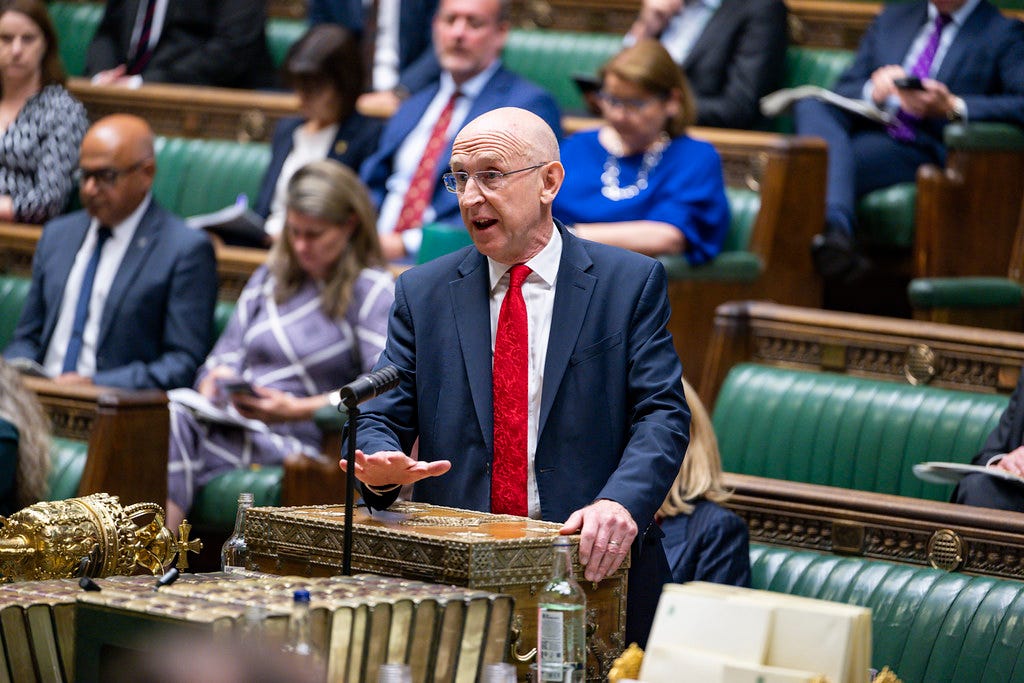
Next Wednesday, Healey will stand up to deliver his first budget, barely three months into the Burnham government. He is, of course, the surprise Chancellor: the loyalist Secretary of State who plunged the final nail into Keir Starmer’s coffin, resigning over holes in defence spending. Now — perhaps as some kind of karmic retribution — he’s the one who has to plug them.
Reeves had left him roughly £24bn of headroom against the fiscal rules. But as the war in Iran wages on, energy prices and inflation have spiked, and borrowing costs went have too: 30-year gilt yields topped six per cent this month, a level not seen since 1998.
Economists warn that his headroom may already have been halved, and in a bad scenario — more Trump tantrums, a longer war, a gloomier OBR — it disappears entirely. I can’t imagine anyone in the Treasury is sleeping well this week.
The pressures are not only economic, but political too. Burnham is well aware that his entrance into Downing Street came with high expectations. Tinkering is not an option. Over the past few weeks, we at The Lead have been closely examining the many challenges of the prime minister’s big plans for the nation. A “new social contract”, a national care service that is free at the point of use, more social housing, a route off the streets for every rough sleeper by Christmas, and defence spending.
None of these come cheap, and all with a straitjacket. Labour’s 2024 manifesto pledges: no rises in income tax, VAT or employee NICs have survived the change of leader, and Healey has already ruled out a much anticipated capital gains rise, to the irritation of the Labour left. That leaves a chancellor who needs billions, with the four biggest levers taped down.
The Conservatives have a helpful answer: don’t spend it. Kemi Badenoch is out today, imploring Healey to “live within our means”. She believes she can find £70bn of savings, largely from welfare as well as cuts to the civil service and foreign aid.
It’s a curious prescription: a plan that relies on taking the most from the people least able to give it, and a convenient rewriting of history from the party whose last experiment with austerity left Britain poorer, sicker and with a welfare bill that never shrank the way it promised. Nonetheless, Burnham has already said there’ll be no welfare cuts in this budget. That’s a defensible political choice; but it does mean the money has to come from somewhere else.
Last autumn, we asked economists, campaigners and thinkers for bold, credible ways to raise revenue without stealth taxes or mass cuts. Most of them are still sitting on the table. From scrapping council tax to a wealth tax, from a levy on ultra-frequent fliers to the banks, there were fairer options than the ones Reeves reached for.
The question for Healey next week is who he asks to pay for Burnham’s Britain. Reeves spent two budgets reaching for the stealth taxes and threshold freezes that hit working people hardest while leaving wealth largely untouched. Today’s promises require something different. This budget will test whether the ambition matches the bravery,
So: Here they are again, Chancellor. Have a look.
Plugging the gap: Nine bold ideas for Rachel Reeves’ Autumn Budget (part 1)

Well, I don’t know about you, but I’m glad I’m not Rachel Reeves.
And part two…
Plugging the gap: Nine bold ideas for Rachel Reeves' Autumn budget (part 2)

On Thursday, we published five bold ideas to help the Chancellor raise revenue in this autumn’s budget. From scrapping Council Tax to a new wealth tax, our contributors showed there are credible, fair alternatives to stealth taxes or cuts.
About the author: Zoë Grünewald is Westminster Editor at The Lead and a freelance political journalist and broadcaster.
👫Agree with Zoë? Share this story with your friends, family and colleagues to help us reach more people with our independent journalism, always with a focus on people, policy and place.
We’ll be keeping a close eye on the Budget next week, make sure you’re signed up so you get Zoe’s analysis direct in the hours after the Chancellor takes to the dispatch box. And let’s see what ideas Mr Healey has…