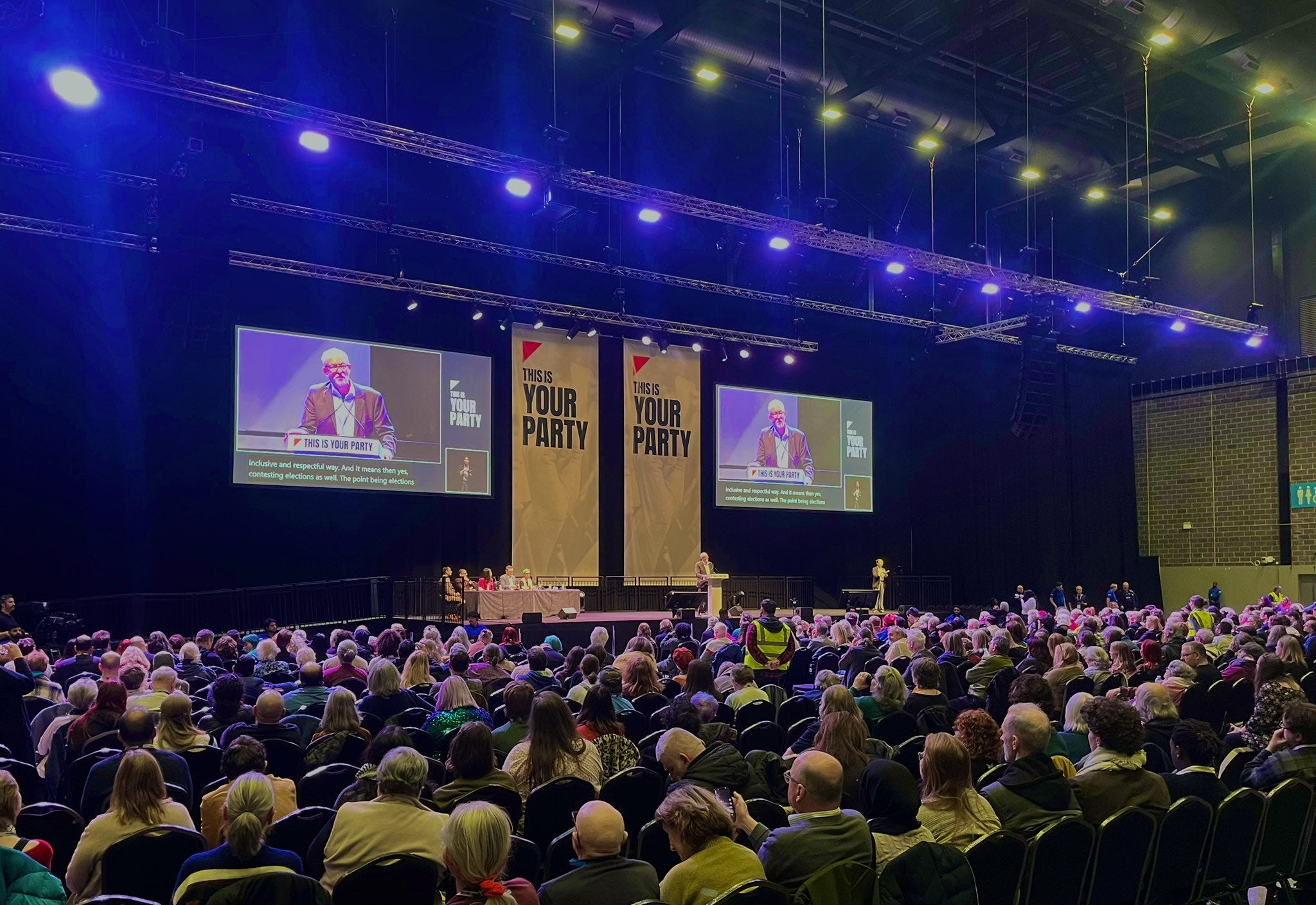
Did Your Party's conference do enough to turn the tide of its disastrous beginnings?
Corbyn and Sultana's new party is likely to benefit from factors for which it can claim no credit.
The first time the forerunners of the Labour Party attended an international conference, it was a disaster. Unions and delegates from 15 British socialist groups met in Paris in July 1889 promising to unite the world’s radicals. On the far side of the city, a separate left-wing conference brought together 500 delegates from European parties. They didn’t want to be dominated by the British. For six days, the two conferences discussed a merger. Commentators found the split laughable. On the seventh day, negotiations having collapsed, the Europeans launched the Socialist International. For the next 30 years, that movement led the left.
When evaluating the conference of a new party, in other words, the occasion doesn’t have to be perfect. A new group can survive some early amateurism, if the context is favourable. The launch event just needs to be “good enough”.
The first four months of Your Party had been a disaster, right up to Jeremy Corbyn and Zarah Sultana reporting each other to the legal authorities. That battle continued in Liverpool, with Sultana boycotting the conference’s first day and Corbyn’s team banning Sultana’s allies in the various Marxist groups from membership. GB News hosted a livestream of Corbyn’s speech on Youtube – they expected the conference to implode while he was talking.
Your Party’s fortunes improved when the conference began. Many delegates were young or disabled. They were perhaps a little earnest. But the message behind every speech was their determination to make Your Party work. Over the last 18 months, Labour’s support in opinion polls has fallen from 35 to 20 per cent. You could see on the floor of the conference the former Starmer voters in search of a new home: renters, Muslims, trade unionists.
Several speakers came from “proto-branches”, areas where people have begun meeting and have ignored the splits at the top. Those delegates were practical and spoke well.
Around 1,000 people were watching the livestream of the conference at any time. Some may have been members of Your Party who were not invited to attend the conference (delegates were chosen by sortition). Other listeners will have been wavering, potential, joiners. People in that latter group are likely to take heart from the delegates’ votes to keep MPs out of the leadership of Your Party, and to prioritise trans rights (72 per cent approval).
The last time the left launched an electoral party, the Respect coalition, the leaders wouldn’t include LGBTQ+ rights in its manifesto. Things are improving on this score, at last.
Jeremy Corbyn and his allies wanted the conference to vote to exclude the Socialist Workers Party. Their reasoning is opaque. When questioned, Corbyn has said that the reason to exclude the SWP is that it is registered with the Electoral Commission and might stand against Your Party; but the SWP is not registered.
The most obvious reason for Corbyn’s allies to support exclusion is that the SWP is unpopular, secretive, and attracts press interest. On the other hand, Corbyn himself loves an underdog, and has repeatedly accepted invitations to be the lead public speaker at the SWP’s annual recruitment conference “Marxism”. He spoke there this July.
Corbyn’s inner core – particularly Karie Murphy, who was in charge of organisational arrangements for the conference – were schooled in the union movement. Murphy has been through multiple bruising political battles of her own: accusations of bullying and corruption, which she denies. The SWP, with around 2,500 subs-paying members, is large enough to be a presence in Your Party elections, especially those for what will be its Coordinating and Executive Committee. Corbyn’s allies won’t give up control of their party to anybody.
Outside Your Party, many people find it strange that Sultana has allied with the Socialist Workers Party. That group is well-known for its record of taking over campaigns. People recall how it treated rape allegations in 2013. Among those who the SWP pushed forward last weekend were members who had investigated the complaints, and people who had signed letters supporting the leadership’s handling of the crisis.
Delegates voted, rightly, to reject proposals to automatically ban dual carding – the latter proposal from the Corbyn camp was premature and overreach. But delegates also voted to allow the organisation to ban individual groups of infiltrators, and the likelihood is that the SWP will be excluded from early next year.
There is one further reason why readers should expect Your Party to have a better next six months. The May 2026 local elections involve a group of seats which, in certain respects, are unlike Britain as a whole. The cohort is predominantly urban. Almost all the elections are in the centre of the country, or in the west. Hardly any are in the eastern seats which have been Reform’s voting base. Several of these contested wards have universities. The last time these areas were up for election, Labour won more than 3,000 of the 4,400 contested seats.
Some councils already have groups of left-wing independent councillors – four in Newham, four in Islington, about 40 across the country. Those groups predate Your Party, and will continue to survive, whatever happens to the organisation. They are, almost all of them, in places which will see elections in 2026.
Your Party is likely to be the beneficiary of two factors for which it can claim no credit: the continuing electoral decline of Labour, and a uniquely favourable set of seats for its first election challenge. While the leaders of Your Party are showing few signs of rising to the challenge, the desire for unity emerging from the ordinary delegates at conference will probably be enough to keep the organisation going until next spring.■
About the author: David Renton is a barrister, historian, and member of Your Party living in London.
From bizarre proclamations to all the detail of how their attempts to run councils are going – we’re keeping a close eye on what Reform are up to.
Reform Watch: Why did Lancashire's County Council leader miss Remembrance Day, and is Reform UK pro Russia?
The Lead is keeping an eye on Reform UK and their fellow travellers. Get in touch on X, Bluesky and Instagram or email ella@thelead.uk with tips and stories. We especially want to hear from readers whose local council is now run by Farage’s followers. In today’s edition:
All the latest from our agenda-setting award-winning team in the North of England, The Lead North, including the crucial Blackpool food bank facing closure and brazen fraud in Southport.
Notes from the North: Arena talk, local government reorganisation, and a rare apology
If you want to watch a big gig and you live in Lancashire, you have to go to Manchester or Liverpool.
And our latest edition of The Lead Digest from Stranger Things to the rising loss of hope infecting Britain – here’s everything our team has been reading, watching and listening to this week.
The Lead Digest: Nigeria's art scene, NHS nightmares and a dispatch from the States
Here at The Lead, we like to consume just as much as we create, which is why we spend a little time each week rounding up our favourite stories, books, podcasts and films to offer our readers a sample of the work that informs our world.
Thank you for reading today’s edition. Become a paid subscriber to The Lead today to support our work covering underreported stories and the issues that matter to you.
🎁Want to get ahead of the Christmas rush? Buy a gift subscription to The Lead for a friend, family member of colleague, and give the gift of nuanced, independent journalism. There’s 20% off gift subscriptions for December and you can order right up to and including Christmas Day!
If you enjoyed reading today’s newsletter, share it with your friends, family and colleagues to help us reach more people with our independent journalism, always with a focus on people, policy and place.
Ed, Zoë, Luke, Padraig, Ella, Natalie and The Lead team.


Enjoyed reading this article; frustrated to read the conclusion. Discussing local elections and not Welsh or Scottish elections, where Labour are expected to tank, effectively saying these are inconsequential when they will result in the formation of national governments, is misguided. Labour are set to lose the Welsh government for the first time in 25 years, and lose an election in Wales for the first time in 100 years. Wales are moving to a totally proportional voting system, where, if your party had any sense - they would target and make gains in the Welsh Valleys. Instead they’re ignoring wales and leaving us to reform.
The left can’t win in Westminster on English seats alone, because England - as identified in the article - will vote reform or conservative consistently across the rural middle-upper class areas. We would do well if English political commentators recognised the risk of abandoning the working class communities in Wales and Scotland.
"Your Party" is definitely not my party. Like squabbling children, stroppy teenager at the Centre! More seriously, if they can't organise themselves there's not much hope of them organising anyone or anything else.