


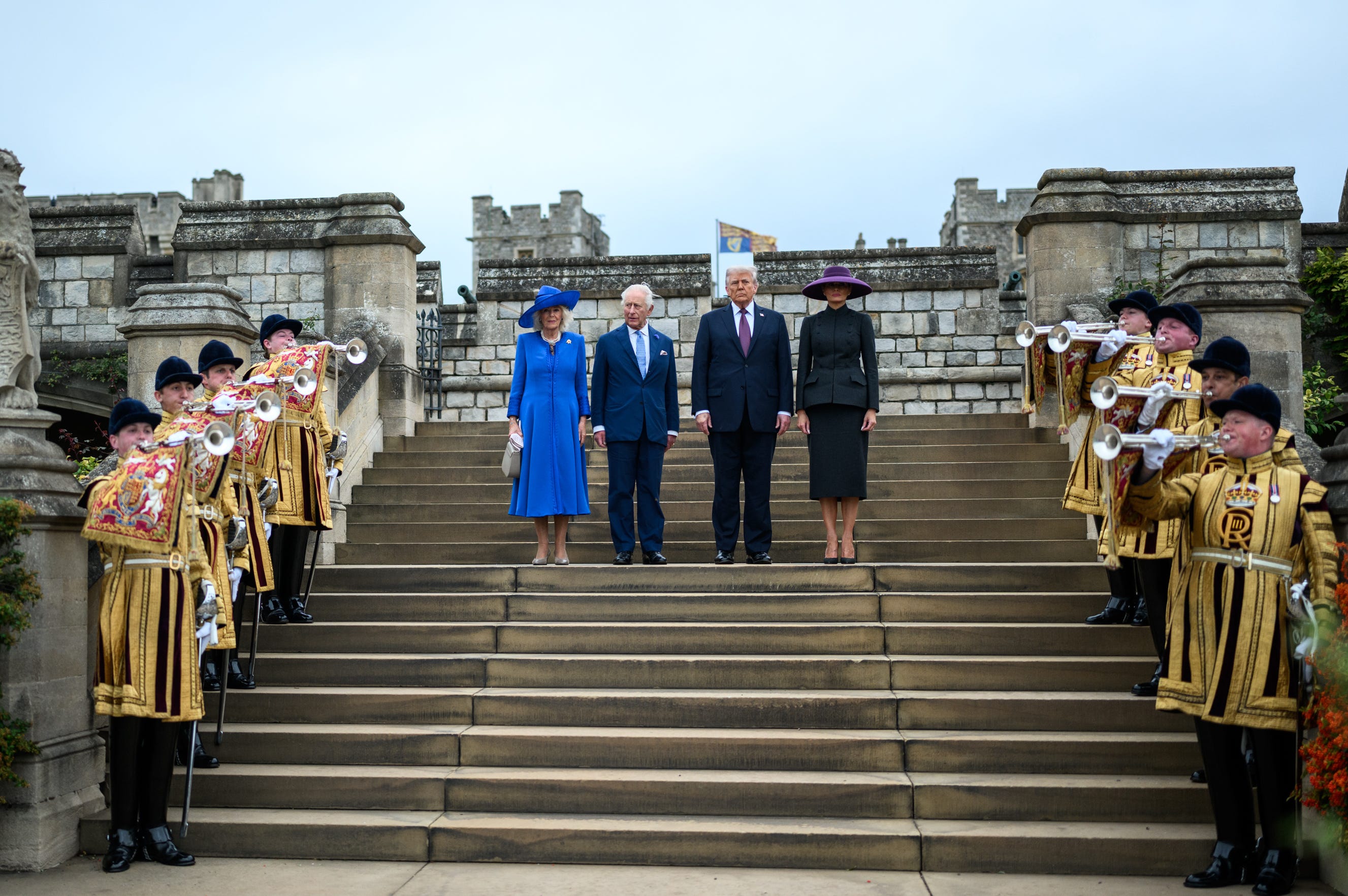
You will hear varying analyses of the importance of the King’s visit to Washington this week.
Some will tell you King Charles III is taking on a high-stakes diplomatic role, smoothing tensions and placating the doddery toddler in the White House with a dose of old-fashioned pomp and ceremony.
Others will argue the whole pursuit is pointless, perhaps even dangerous – the diplomatic equivalent of throwing a chew toy to a barking dog: a brief distraction, quickly abandoned the moment something louder comes along.
Either way, there is a particular tone that takes over political analysis at moments like this. It is serious, measured, pragmatic, weighing risk against reward. It presents itself as the language of grown-ups in the room; statecraft that cannot be understood without a certain level of experience.
Yet it has a glaring omission. Because while Westminster and Washington pore over strategy and optics, something else slips out of frame. Largely absent from the language of state visits and special relationships are the people who rarely get to shape these narratives at all.
The women abused and trafficked by Epstein have still received nothing resembling justice. The long shadow cast by his network – one that touched this president, billionaires and, unavoidably, the British Royal Family itself through Prince Andrew – persists. Notably, the King and Queen have declined to meet the survivors of Epstein during this visit, with a Buckingham Palace source claiming it could compromise ongoing investigations. For survivors, this is a bitter disappointment.
Instead of centring their reality, we revert to abstract debate. The visit becomes a “challenge”, and the scandal becomes a “complication”. It is a deliberate way of talking about power that quietly removes the people it hurts.
This is not confined to royal diplomacy. Take the furore around Mandelson’s appointment, and the appearance today of the prime minister’s former chief adviser, Morgan McSweeney, before the Foreign Affairs Committee. It may seem like an entirely different arena, proper parliamentary scrutiny rather than royal diplomacy, but the framing is strikingly similar. Peter Mandelson’s defenders have never argued that he was an uncontroversial appointment, just that he was necessary. He understood Washington in a way that can only benefit the British state; he had the networks, instincts and fluency of power required for this new, hyper-masculine and dangerous world.
What is not being said – but tacitly admitted – is that morality does not feature in these decisions. It may count for something, sometimes, but in certain moments, it may need to be quietly set aside for something more fitting for the moment.
We are told the King must go to Washington and make nice with a president who has set armed officers on his own people, trampled on international norms, used economic and military coercion to achieve his aims, and taken little meaningful accountability, because the stakes are too high, relationships must be maintained, and influence must be preserved.
We are also told certain political appointments must be made because the world is dangerous, because experience matters and this is not the moment for idealism.
In both cases, the conclusion is that the system must be protected at all costs. What rarely follows is the second question: protected for whom?
Because for the victims of Epstein’s abuse – and for those who have spent years watching powerful men evade meaningful consequences – this reads as closing ranks. Sending members of the Royal Family, themselves shadowed by their association with Epstein, to shake hands with Trump, named 38,000 times in the files, is as striking an illustration of how power protects itself as you may ever need.
This instinct to close ranks, to reframe uncomfortable truths as strategic dilemmas, is the thread that connects a royal visit to Washington and a committee hearing in Westminster.
And looming over all of it – still, stubbornly – is Epstein. Not simply as an individual, but as a system; a world of untouchable, back-slapping networks of power, where reputations are laundered collectively. He has become less a figure than a pattern, the name we reach for when we are really describing how power behaves when it believes itself unaccountable.
The consequences, of course, are no longer abstract. Trump – the epitome of Epsteinism – continues to test the boundaries of international law, emboldened by a political culture that has chosen expediency over accountability. In Britain, Keir Starmer faces growing unrest from his own MPs, who are no longer willing to defend decisions that feel politically strategic but morally thin. A fresh row over whether Parliament was misled on Mandelson’s vetting – now heading for a possible Commons vote on an inquiry – has only sharpened that sense of drift. The sad fact is that another prime ministerial resignation would hardly feel exceptional anymore, more an increasingly familiar quality of our parliamentary democracy.
There is, of course, always a case for pragmatism in politics. But pragmatism without principle hasn’t done us very well thus far. And that is how you end up with your King dragged to Washington – and a revolving door in Downing Street.■
About the author: Zoë Grünewald is Westminster Editor at The Lead and a freelance political journalist and broadcaster.
👫Agree with Zoë? Share this story with your friends, family and colleagues to help us reach more people with our independent journalism, always with a focus on people, policy and place.
🗳️Ahead of the upcoming local elections, Zoë will be diving into what to expect in England’s council elections along with Wales and Scotland’s Parliamentary elections in a special report published on Saturday 2 May and across our Lead Local network we’ll be covering what’s to come and all the fall-out with a focus on the Valleys of South Wales, Calderdale Council elections, the battle for Sefton and Lancashire district council elections. We’ve also been out on the streets speaking to voters – so keep an eye on our TikTok and Instagram to see what people had to say ahead of the 7 May polls.
The country with the smallest Epstein exposure has done more to process it than the country with the largest. That asymmetry should be central to how this story is being told, and almost nowhere is it being told that way.
A royal (The King's brother), stripped of titles, military ranks, royal duties and the use of his styles, still under active investigation. A senior diplomat removed from Washington and now under Foreign Affairs Committee scrutiny. A Prime Minister facing the Commons today over the vetting failures, with civil service witnesses on the record and the Cabinet Secretary's evidence already given. None of this is full accountability. All of it is more than has happened anywhere else.
In the United States, where the network was based, where the crimes occurred, where the man named 38,000 times in the files now sits in the Oval Office, almost nothing has happened. No senior figures stripped of position. No equivalent Congressional inquiries. No serving officials facing scrutiny.
Britain's response, however incomplete and however much it remains a story of power closing ranks, is functionally the only response anywhere. The system protecting itself in Westminster looks very different from the system not even being asked the question in Washington. Both are failures. They are different failures, and the difference matters.
Which raises the question. If the strongest accountability mechanism on earth, applied to the Epstein affair, is the British scrutiny architecture as currently constituted, the architecture is the problem. Not because it has gone too far. Because it has not gone nearly far enough — and there is nothing better anywhere to compare it to.
Left-leaning American investigative journalists and commentators (there are several on this platform) demanding full release of the Epstein files and a handing out of justice to Trump and his cronies are incensed that the British dare send their Monarch over to shake hands with Trump and thus lend him some kind of Kingly seal of approval. Especially given his families direct involvement with Epstein.
Given everything Trump has done, what he stands for and what we all know he has very likely done, it disgusts them that Charles sees fit to represent the British in this way and pander to Trump. They are right.
I am embarrassed, disgusted and outraged by it. I hope the entire British public are cringing uncomfortably at this visit.
We should not be trying to ‘smooth things over’ and maintain diplomatic ties with such a person or his supporters.
I don’t understand why so few of the British press are calling this out. Rather they (especially the BBC - which shouldn’t surprise anyone of course) are swooning over the palaces’ amazing speech-writing and Charles ability to crack a joke. It honestly makes you sick.
Hats off to the American substackers for calling this out.