


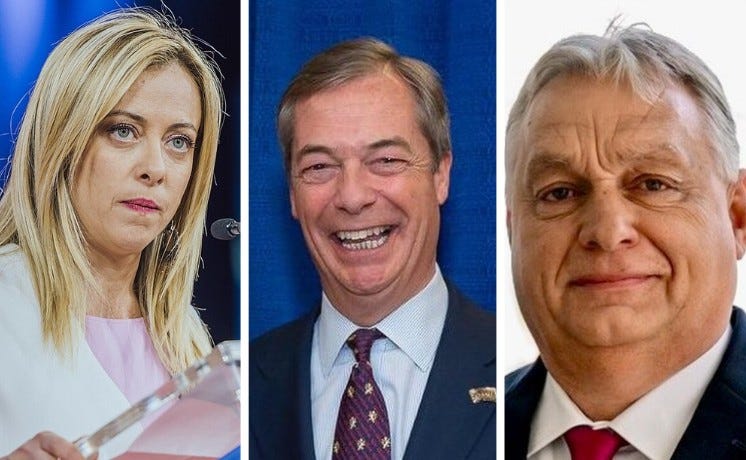
For the past decade, there has been a depressing inevitability to European politics.
Populist right-wing parties, and their sour faced cast of strongmen, have surged, reshaping the agenda and forcing everyone else to respond on their terms. Le Pen, Orbán, Meloni, Farage: different contexts, but a shared model of nationalism, grievance and personality.
But lately, things look a little less inevitable. The populist right certainly remains a powerful force across Europe, but there are tentative signs, uneven and easy to overstate, that things may be changing.
Take Marine Le Pen’s National Rally, now fronted by the young, charismatic Jordan Bardella, which has spent years readying itself for government. Yet recent local elections offered a more mixed picture. The far-right made gains, but not in a way that suggests a decisive breakthrough. In major cities like Paris and Marseille, it continues to struggle, while the centre saw an unexpected lift as it coordinated a fight-back against the far-right.
In Hungary, the picture is different but still significant. Viktor Orbán’s government has long been seen as the most entrenched example of populism in Europe. But even there, the picture is shifting. Economic pressures and a more credible opposition have made the political environment more competitive ahead of the next election. Orbán may hold on, but the fact that his position looks far less secure than it once did is notable in itself.
Elsewhere, the right is encountering friction. In Italy, Giorgia Meloni remains strong, but the limits of her promises are apparent. Economic constraints, EU rules and the trade-offs of policy force have put the brakes on her disruption. In Denmark, the far-right is not so much defeated as absorbed, its core arguments now echoed by the government, limiting its room to grow. So, is populism actually slowing down, or simply evolving?
In many cases, it is the latter. Even where populist parties fall short electorally, their influence can’t be ignored. Debates on borders, identity, and sovereignty have become widespread across Europe. In countries like Denmark, and increasingly here in the UK, mainstream parties have adopted tougher rhetoric and policies around immigration, blurring the dividing lines.
But there are also signs that the conditions which once gave the populist right political energy are changing. One is the challenge of delivery. As seen in Italy and Hungary, it is easier to campaign against a broken system than to fix it. Parties that built their appeal on disruption are now having to explain economic performance, public services and the limits of the state.
Another is fragmentation. Discontent with the status quo is widespread, but it doesn’t necessarily flow in one direction. Here, Reform has been highly effective at shaping the political agenda, but there are signs of a ceiling. In the Gorton and Denton by-election, it was the Greens that took the seat, not Reform. In Caerphilly, Plaid Cymru’s victory over Farage’s party showed anti-establishment energy can be mobilised around material concerns like public services and the cost of living, rather than channelled exclusively through the right. The result is a more splintered political landscape.
Third, and this is where we must whisper, the populist ecosystem is becoming more volatile. For this, we have the President of the United States to thank.
What made Brand Trump so potent was its immunity to contradiction: strength paired with instability, isolationism with escalation, control through chaos. For a time, that incoherence worked. But as tensions rise and economic shocks reverberate globally, its limits are becoming harder to ignore.
This is the flaw at the heart of the movement. Nationalists can promise control, but in an interconnected world, they cannot deliver it alone. For European figures who have drawn on that model, this creates a new tension. When the prototype starts to look erratic, the idea becomes harder to sell.
The populist right is no longer advancing everywhere, all at once. In some places, it is hitting electoral limits. In others, it is being brought into the mainstream. Increasingly, it is facing competition for voters and ideas.
Crucially, this is no time for complacency. The forces that drove the populist right — insecurity, anger, distrust — are still very much with us. But something important may be shifting. For years, its greatest asset was momentum: the sense that resistance was futile.
That confidence now looks shakier. The breakthroughs are less decisive, the contradictions harder to ignore, and the coalition more fragile. For now, the populist right isn’t disappearing. But perhaps it is no longer unstoppable. ■
About the author: Zoë Grünewald is Westminster Editor at The Lead and a freelance political journalist and broadcaster.
👫Agree with Zoë? Share this story with your friends, family and colleagues to help us reach more people with our independent journalism, always with a focus on people, policy and place.
Many thanks for that excellent piece. One extra worrying factor to consider though is the support and money they are getting from Trump/MAGA (and in some cases Putin).
On the other hand, the far-right parties across Europe are actually quite divided on a number of key issues and on strategy, which impedes them from working together. For instance, they've never managed to create a single parliamentary Group in the European Parliament. I wrote this piece just before the last European Parliament elections, looking at their divisions and splits:
https://encompass-europe.com/comment/the-far-right-in-the-european-parliament-fragmented-and-divided
And of course Meloni just lost her attempt to skew the Italian judiciary in her direction. Apparently opposition to her was strongest in young people which bodes well for the future.