


For decades, the Green Party has occupied a curious space in British politics.
Highly visible, broadly liked, yet rarely treated as a serious contender for power, the party has long been cast as a voice of conscience on climate and inequality, rather than a party seriously capable of governing.
That may well be changing. Since Zack Polanski’s election as the punky, outspoken leader of the Greens in September 2025, the party has seen a sharp rise in support. Membership has now passed 100,000 – a more than 45 per cent increase since his election – and several polls have placed the Greens on around 15 per cent nationally, suddenly within spitting distance of Labour.
For the Greens, mainstreaming isn’t just about vote share. It means becoming a credible second choice to Labour in key urban constituencies, winning seats in Parliament consistently, and being seen as a governing party that can deliver on both environmental and broader social and economic policy.
The Greens apparent momentum will face its first real electoral test next week in Gorton and Denton, where voters head to the polls in a closely fought by-election. With Labour defending an 18,000-vote majority and Reform UK surging, the Greens see the contest as an opportunity to prove their rise can translate into real-world gains.
The Polanski effect
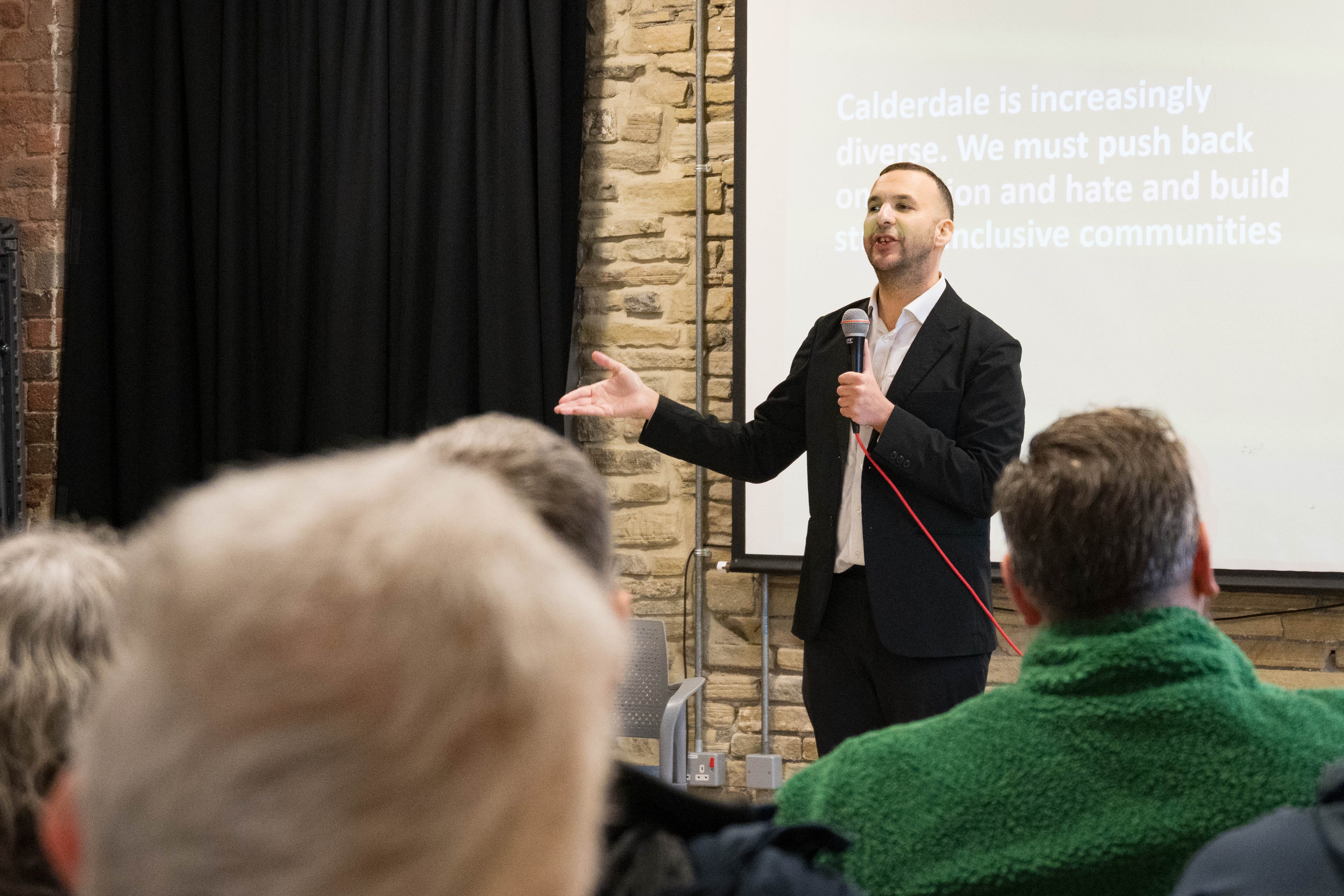
Much of the Greens’ recent growth is credited to Polanski himself, whose media visibility has captured national attention. As Andrew Greaves reported for The Calderdale Lead, Polanski combines his social media savvy with traditional grassroots campaigning. On the trail in Halifax, he told attendees: “What we can do on social media is inspire people, excite people, give people a sense of solidarity… but actually elections are won on the doorstep.”
Members chat excitedly about having a leader who appeals beyond the party’s activist core, occupying national media space without sounding fringe or single-issue. One party councillor told The Lead Polanski’s strength lies in cutting through clearly, a skill previous leaders lacked: “People have had a general warmth about the Green Party, but not a clear sense of what we stood for outside the environment. Zack has been so effective at communicating that [...] It’s been about principled clarity on the issues that matter to people right now.”
Louis O’Geran, research and communications assistant at polling company More in Common confirms the “Polanski effect” is real: “It’s rare to hear people say they’ve been seeing a politician on social media – but Polanski comes up spontaneously.”
Polanski’s rise has given the Greens a level of visibility even former leader Caroline Lucas, at the height of her influence, struggled to convert into sustained momentum. Where Lucas expanded the party’s profile, Polanski has redefined its pitch, sharpening its economic message and framing the party as unapologetically socialist, capitalising on a growing drift among Labour’s progressive voters. As Green party insider and journalist Adam Ramsey notes, Polanski has leaned into confrontation rather than shying away from it: “For Greens, the choice was between being controversial or being ignored.”
But there are limits to what even the most charismatic leader can achieve. Critics have questioned whether Polanski risks falling victim to the so-called “Clegg effect” – where personal appeal and media cut-through fail to translate into lasting electoral success. “The big question is whether Polanski is winning people over, or mobilising the base,” says O’Geran. “Is he bringing in disaffected progressive Labour voters who weren’t sure how they’d vote – or actually poaching Labour voters directly? That will determine his ceiling.”
Constraints on Polanski is reinforced by the Green Party’s own internal design. The role of leader was only created in 2007, and reluctantly, after members concluded a singular figure might boost the party’s profile. As such, powers were deliberately limited, so decisions on policy, candidate selection and strategy remain in the hands of member ballots and elected committees, leaving little scope for top-down direction. Unlike Labour, the Conservatives or the Liberal Democrats, where leaders exert formal authority over messaging, discipline and appointments, a Green leader is as much facilitator as commander. That instinct – rooted in an ideological suspicion of hierarchy – has historically limited how far any one personality can stretch the party’s electoral reach. Lucas transformed its visibility; she did not break its ceiling.
Labour’s love lost
The sharpening of the party message has coincided with Labour’s waning grip on parts of its progressive base. Around 40 per cent of Labour’s 2024 voters say they would consider voting Green in future, while roughly one in ten are reported to have already switched.
“People felt Labour had lost touch with the values they cared about,” O’Geran tells The Lead. “In focus groups, that comes through on cost of living, the NHS and public services – as well as Gaza and climate.”
Labour’s dominance among younger voters, once a cornerstone of its electoral coalition, has weakened markedly. Polling from More in Common shows the Greens now leading among 18–24 year-olds, with Labour trailing in second. For a generation shaped by climate anxiety, housing precarity, and stagnant wages, the Greens’ message feels urgent rather than aspirational. In just a year, support for the governing party has dropped from 47 to 22 per cent among this cohort, while the Greens have risen from 29 to 43 per cent.
Yet youth support does not automatically translate into parliamentary seats. Younger voters are less likely to turn out, and first-past-the-post punishes dispersed enthusiasm. The Greens have historically piled up second-place finishes, including 40 at the last general election, but converting those into victories requires concentrated swings, not just rising national vote share.
That arithmetic explains the party’s increasing focus on specific target constituencies. Rather than chasing broad but shallow growth, the Greens want to deepen support where demographic and political conditions align: university towns and progressive urban districts. In Brighton Pavilion, where the party secured 55 per cent of the vote in 2024, that concentration has already paid off. Replicating it elsewhere remains the challenge.
Still, others question how durable that progress will be if the next election hardens into a binary contest between Labour and Reform UK. As disillusioned voters are forced to choose, some may drift back – reluctantly – to Labour. “A plurality – just under half – of Green voters say they would vote tactically for Labour to keep out Reform,” O’Geran notes. “That dynamic could really hinder the Greens in constituencies where it’s clearly a Labour–Reform marginal.”
The Greens, however, dismiss that threat in their target seats. “It’s just not credible in the places we’re campaigning in,” one Green party councillor argues. “Nobody seriously thinks Hackney North, Brighton or Bristol is going to elect a Reform MP. In those constituencies, everyone knows the insurgent challenge isn’t Reform – it’s the Green Party.”
Refining the message
Traditionally known for climate advocacy, the Greens have increasingly linked environmental breakdown to the economic model underpinning it. As Ramsay explains, the Green party came to understand that “you couldn’t solve the climate crisis without changing the economic system, which was ruining voters’ lives as well as the planet.”
The approach appears to be resonating with voters. YouGov polling confirms the Greens remain the most trusted party on the environment, but that alone had not translated into broader support until climate was tied to cost-of-living and inequality.
But broadening the policy agenda carries risks. Internal pinchpoints remain over housebuilding versus ecologism, and foreign policy positions could attract scrutiny. Polanski has already attracted some scrutiny for his vocal opposition to NATO, which critics say could endanger the UK at a time of heightened global aggression. It is notable that Keir Starmer used his speech at the Munich Security Conference to warn that “the lamps would go out across Europe once again” if the Greens were to gain power.
On housing, while the Greens’ manifesto emphasises building genuinely affordable, energy-efficient homes and insists that new developments come with proper services and community infrastructure, their emphasis on ‘right place, right price’ and strong environmental safeguards has been seized on by critics as evidence of an internal tension between environmental priorities and the need for high-volume housebuilding.
These tensions have already been well documented. In boroughs like Islington, Green councillors have at times opposed developments that would increase the supply of affordable housing, feeding accusations that older, status-quo defenders risk alienating the young voters desperate for more homes and lower rents.
For O’Geran, these policy positions might not matter much now, but could become problematic further down the line. “It’s not cutting through because people don’t interrogate Green policies – they see them as an alternative to mainstream politics. But if their growth is to be sustained, and they want to challenge Labour, NIMBYism and foreign policy positions like NATO could become real liabilities.”
He notes that half the Greens’ MPs sit in areas where NIMBY sentiment is strong, and with the party pivoting toward younger, urban, student-heavy constituencies, maintaining that support may prove particularly difficult.
Here is where internal cohesion remains a challenge. “Perhaps more longstanding activists on the left have firmer views based on what the Green Party was in the 90s or 80s,” one party insider explains. “For younger members, their main experience of the Greens will be Caroline Lucas, Natalie Bennett, the green surge – that’s their formative politics.”
Scaling up
Rapid growth has also exposed structural weaknesses. Insiders bemoan outdated processes, limited professional capacity and a governance model designed for a far smaller organisation – now struggling to keep pace with sudden expansion.
“Green Party software and processes… they’re all right, but they’re not the best,” one former councillor explains. “Some things are creaking at the seams.” In parts of London, local parties have ballooned from 300 or 400 members to around 2,000 in just three or four months. The influx has brought energy and momentum, but also basic logistical and organisational challenges.
This also raises the stakes around candidate vetting. Scaling up quickly increases the risk of controversial past statements or conduct emerging. The problem has been most starkly illustrated by Reform UK, whose attempts to professionalise at speed have repeatedly been undermined by the selection of unsavoury – and at times overtly racist – candidates. Reform UK has on occasion leaned into this, sometimes aligning controversial figures with their base values, but similar missteps would likely undermine credibility rather than energise Green supporters. In Norwich, one Green councillor was forced to resign after it emerged that a property he rented out to tenants was riddled with mould, while Polanski himself has come under repeated fire for his former work as a hypnotherapist, where he offered a session to a reporter that was framed as him claiming he could ‘think’ a woman’s breasts larger – a stunt he has since apologised for and said was misrepresented, but one that opponents have repeatedly resurfaced in attacks on his credibility.
For party insiders, the longer challenge is expanding the party’s influence by increasing the number of seats they hold and using that leverage to pressure Labour on progressive policies. All of this is part of a longer-term vision: translating growing support into genuine governing credibility, with the hope that one day the party could not just influence policy but take responsibility for running government itself.
The question is simple: can the Greens grow up without losing what makes them distinct? The answer is not yet clear, but for the first time in decades, they are in a position to test it as a genuine contender for power.■
About the author: Zoë Grünewald is Westminster Editor at The Lead and a freelance political journalist and broadcaster.
👫Enjoyed this article? Share this story with your friends, family and colleagues to help us reach more people with our independent journalism, always with a focus on people, policy and place.
No mention of the antisemitism which is endemic in the Green Party, not to speak of Polanski's own antisemitic world views. I know he's Jewish, but that doesn't stop him from being an antisemite. The antisemitism won't stop at the Green Party. History has shown that antisemitism is the great cohesive force of all hatred. Tried and tested for millenia antisemitism can be used for all and any ends. And to be clear Anti-Zionism = antisemitism. Denying the rights of Jews to a state of their own is antisemitism. The Land of Israel is the historic homeland of the Jewish people where they have lived continuously since Biblical times. Jerusalem has always had a Jewish majority. Jerusalem is mentioned over 700 times in the Bible, but not even once in the Koran. As a grandchild of a Holocaust survivor, Ms Grunewald should be aware of antisemitism more than most and realize that there may come a time when she or her descendants will probably need to seek refuge in Israel. Don't live in denial. Too many European Jews died because we didn't have anywhere to go.
oh dear, a ‘journalist’.
A curious space in British politics indeed.
They just expelled their co-Chairman of Green Party Wahmen, who was found to have breached diversity rules by making “clearly antagonistic” comments about “fae/faer” pronouns used by people who believe they are mythical beings.
She claimed to have been labelled an “antisemitic, eugenicist, fascist, far-Right bigot”.
They are dangerous antihuman lunatics.