



The question of power is central to understanding the dynamics of the data centre infrastructure boom which underpins the current AI arms race globally.
Data centre operators and the giants of the AI industry alike are scrambling to secure access to power in the literal sense: electricity sources for the megawatts required to keep servers and cooling systems humming.
The government has unveiled a raft of new policies on data centres with this year’s Budget, including a Covenant which “encourages” operators to take action to lower electricity bills, invest in local communities, minimise their impact on the environment, create jobs and strengthen Britain’s security.
But behind these fine words lies a policy framework built on industry claims that don’t stand up to scrutiny, and one that would give the largest projects a fast track past local objections.
The government’s draft National Policy Statement for Data Centres published with the Budget, describes the UK as a “global hub for data centres”, estimating there are around 220 facilities in the sector with a capacity of around 2 GW.
Crucially, the draft would also take the biggest projects — those over 100 MW — out of the hands of local councils altogether, with ministers told to start from a presumption of consent. As the analysis below shows, that is exactly where the pipeline is heading.
The problem is that the government’s own data on these facilities is unpublished and therefore difficult to scrutinise.
The analysis which follows is instead based on a dataset I compiled for Watershed Investigations using similar methods and sources to those likely relied on by government officials. It covers around 2 GW of operational data centres across 154 facilities and nearly 20 GW of planned or announced projects.
It shows that planned data centres’ appetite for power is expanding rapidly, despite a growing protest movement and mounting concern that debt may overwhelm some data centre firms. CoreWeave, an American AI data centre operator, is the only tenant so far announced in the huge data centre being constructed in the government-backed AI Growth Zone in North Lanarkshire. The company would be very vulnerable to a loss of investor confidence in the AI boom.
And far from paving the way for ‘sovereign’ AI capacity, the construction pipeline is dominated by large American tech firms, including the cloud and AI giants Amazon, Google and Microsoft.
The hyperscalers are coming
The backbone of the UK’s data centre sector has traditionally been small to medium-sized facilities, not the hyperscale campuses which have caught the imagination of investors and politicians.
In fact, the vast majority of data centres in the UK have until recently been very small. Watershed’s dataset has been compiled from a variety of public trade directories, open access industry databases, government data and company websites.
It ranks data centres by IT Load, a widely-used metric which the data centre sector uses to compare facilities by estimating the electricity demand of their IT equipment in megawatts (MW). IT Load figures exclude the electricity used by cooling systems, lighting and other building systems, so the total power required to keep the facility running will be higher.
Data centre operators and property developers also estimate the size of data centre capacity across regions or countries using the same measure, publishing an estimated inventory of how many MW are available to prospective customers.
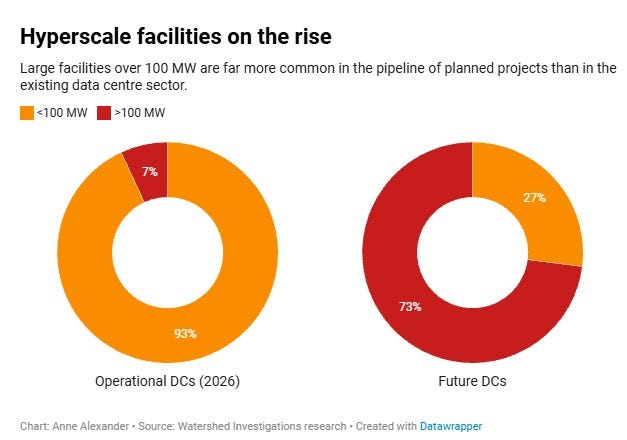
Out of 154 data centres listed in Watershed’s dataset, 93 are under 10 MW. These small data centres account for 324 MW in total out of more than 2,100 MW, or 2.1 GW across the sector (which nearly matches the government’s own estimate). The bulk of the IT Load is concentrated in medium-sized data centres up to 100 MW, with only a single UK facility of over 100 MW (Vantage’s large campus near Cardiff).
The picture changes dramatically in the pipeline of projects announced or planned by data centre operators (this excludes projects proposed by estate agents and infrastructure companies). In the 5,335 MW of future projects in this sector tracked by Watershed, 73 percent of the planned capacity will be in data centres greater than 100 MW, compared to only 7 percent today. That future pipeline is not all guaranteed to be built — some of the projects will hit planning hurdles or face opposition from local authorities — but these projects are all associated with companies already active in the data centre sector, rather than property developers hoping to attract a purchaser or a tenant. Most of them have projected timelines up to 2030 — not decades in the future.
This scale shift will have enormous consequences for the planning system. The government’s draft policy sets a threshold of 100 MW for data centres to gain access to the Nationally Significant Infrastructure Project (NSIP) planning process. This means that the decision will rest with the Secretary of State, rather than locally elected officials, who will be instructed to make a “presumption of consent” in favour of allowing construction to go ahead, according to the draft.
The estate agents’ bonanza
The government says that London was already running out of data centre capacity two years ago, quoting a 2024 report from CBRE, a global property firm. Data centre developers and estate agents use figures on how much electricity data centre servers are expected to use in order to rank facilities and clusters of data centres by size.
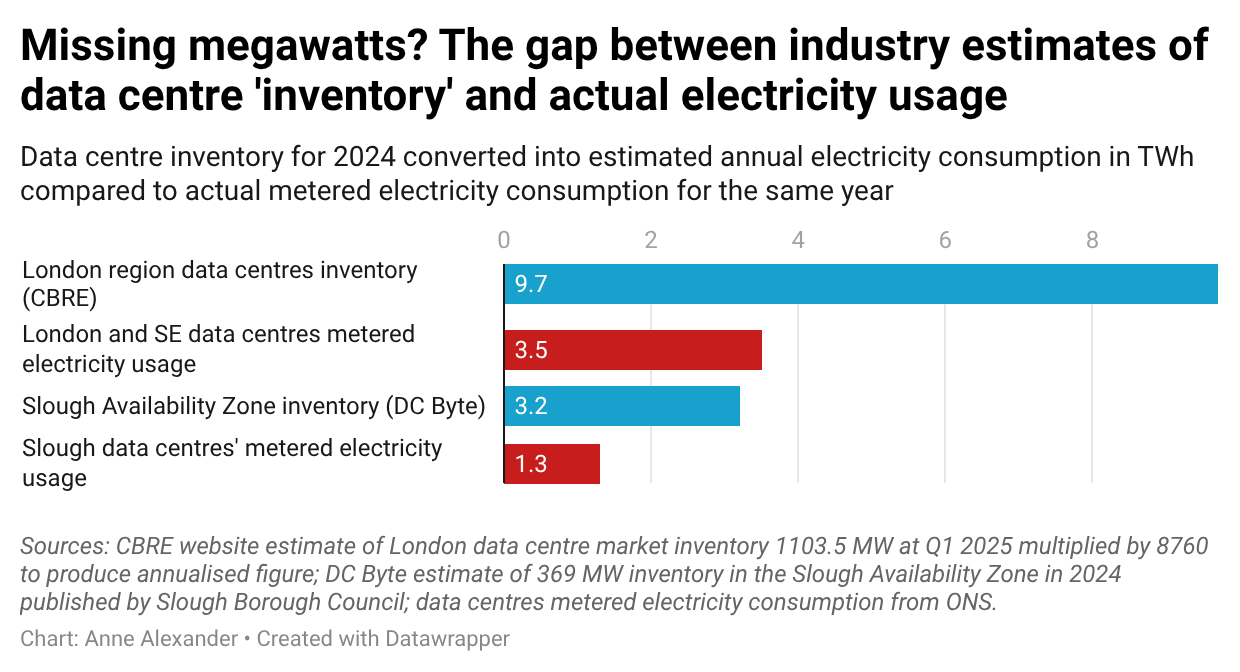
According to the CBRE website, at the start of 2025, the “inventory” of data centre capacity in London was 1103.5 MW. The figure represents the peak amount of power that the servers require at any moment in time.
The government claims that there was a “deficit” in London’s data centre capacity of 51 MW at that exact moment. The implication is that there were more companies seeking space in those servers than could be accommodated by the existing infrastructure.
It turns out, however, that there was a very large gap between the power requirements of the inventory and electricity consumption that year.
According to data released by the Office for National Statistics (ONS) earlier this year, data centres in London and the South East used 3.5 TWh of electricity during 2024.
If data centre servers in London during the same period were really as full as the government claims, CBRE’s estimate for London data centre inventory multiplied by the number of hours in a year ought to approximately match the electricity consumption figures recorded by ONS.
The problem for the government’s argument is that they don’t. Not by a long way.

Using CBRE’s inventory as a starting point would give a figure of at least 9.7 TWh of electricity used in 2024 (in fact it would be even larger than this because data centre inventory usually only measures electricity used by the servers and other IT equipment, not the cooling systems).
That means the electricity actually used by data centres in 2024 was only 36 percent of the electricity demand predicted by the industry’s estimate of its inventory.
None of this would be surprising to anyone in the industry itself. Another industry analyst, DC Byte published an estimate of data centre capacity in the Slough Availability Zone in 2024 which also turned out to be much more than the actual electricity usage.
The difference between industry figures for data centre inventory and actual electricity consumption raises many questions about the pipeline of future projects — and about the two-year-old figures the government is relying on to make the case for breakneck expansion.
How much of the planned capacity could end up sitting idle, allocated to companies which are not going to make any use of it? What will happen if data centres are allowed to fill their inventory with power they don’t use in areas where they are competing with homes and other industries for grid connections?
And how much of that pipeline is purely speculative, where inflated figures for gigawatts of IT Load serve as marketing gimmick rather than evidence of genuine future need?
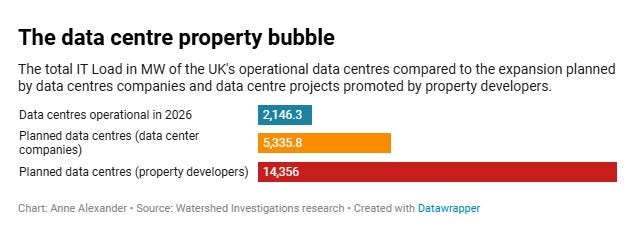
The largest group of potential future data centres in Watershed’s dataset are not those associated with data centre companies, but with estate agents, property developers and infrastructure companies.
They make up a huge 14,356 MW of projects including at least 13 campuses over 500 MW, a large proportion from Scotland. This is unlikely to capture the true scale of the boom at the top end of the scale, however. Electricity regulator Ofgem is consulting on measures to eject non-viable and speculative proposals from the grid connection queue, which is currently clogged with 80 GW (80,000MW) of data centre projects – almost twice the peak daily demand from the entire UK grid.
It is not just in the UK that is suffering from a glut of exceptionally large data centre projects. The epicentre of the data centre infrastructure boom lies in the US. Texas is widely regarded as the second largest data centre market in the US, after northern Virginia. But the state’s Republican governor Greg Abbott has lost patience with data centre developers. This August he announced a temporary moratorium on all data centres in the queue to connect to the Texas grid after the size of prospective projects’ peak electricity demand ballooned to five times the current peak load of the entire state grid.
From London to the regions
Data centre markets are often associated with cities, rather than countries or regions. This is because one of the factors which drives data centre clustering is the availability of good fibre connections allowing operators to give customers the option to seamlessly switch workloads between facilities. The UK’s data centre landscape has historically been concentrated in a gigantic ‘London’ cluster sprawling across large areas of the South East. The most important cluster within the ‘London’ region is located in Slough, but there are others in Docklands and the Park Royal area of West London . One notable exception however is what was until recently the UK’s largest operational facility, the 148 MW campus operated by Vantage near Cardiff.
That picture is now changing, however. New clusters may be emerging in Scotland, Yorkshire and the Humber, while the greater London market continues to expand. The scale of some of the proposed projects now looming on the horizon for local communities in rural areas is breathtaking. The largest of these is the giant 1.5 GW data centre and battery storage facility announced by energy infrastructure developer Xlinks in North Devon.


Tap to explore where data centres are now and where they are planned for
Most of the larger projects may never materialise, as many are backed by landowners in search of exceptionally wealthy tenants able to mobilise the eye-watering sums required to build and fit-out a hyperscale data centre. Just building the shell of a 50 MW data centre in London before a single server rack is wired in place will set back operators up to £700 million, according to global estate agent JLL. This is a small group of companies to start with, and if the overheated market falls sharply and investor confidence evaporates, many data centre projects will be abandoned.
Expanding US corporate footprint
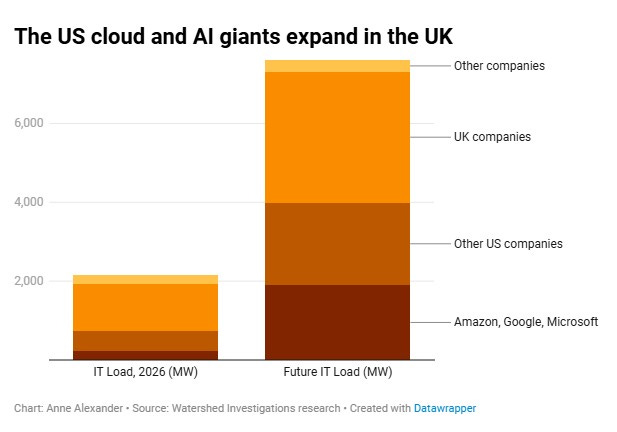
The nationality of the companies behind data centres in the UK is also changing. The proportion of UK-headquartered companies is shrinking as the sector grows in overall size and facilities scale up. Long-established British players in the sector are facing rising competition from incoming US data centre operators and the cloud and AI giants: Amazon, Google and Microsoft.
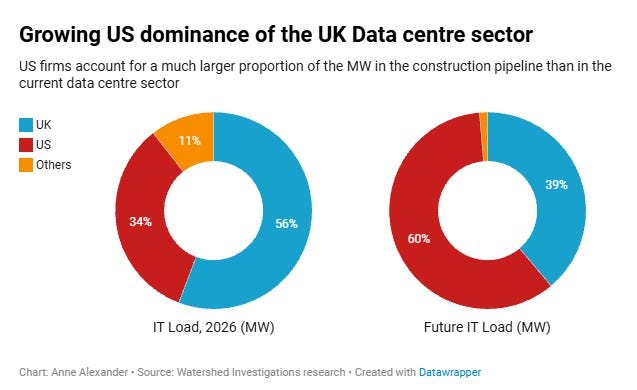
These future data centres represent investment by data centre operators, rather than the property developer segment of the industry. Once combined with the existing data centre infrastructure, the overall percent of total IT Load under the control of US-headquartered companies in Watershed’s dataset rises to 52 percent, up from 34 percent today.
‘Sovereignty’ in the world of data centres is much more complicated than simply the location of a company’s headquarters of course. Like the vaults of a Swiss bank, data centre server racks often host a multinational crowd of clients. Sometimes, however, a single company books the space, bringing in their own IT equipment and leaving the data centre operator managing only the building shell. A UK company providing the bricks, mortar and air conditioners, while a US tech giant owns the chips and servers inside, and makes the bulk of profits from the data centre’s operation is unlikely to meet many people’s definition of economic ‘sovereignty’.
Behind the new 500 MW campus which Scottish operator DataVita is building in North Lanarkshire with the help of government-backed loans lies a story like this: the sole long-term tenant for the first 80 MW data hall is US company CoreWeave.
Tech giants on the march
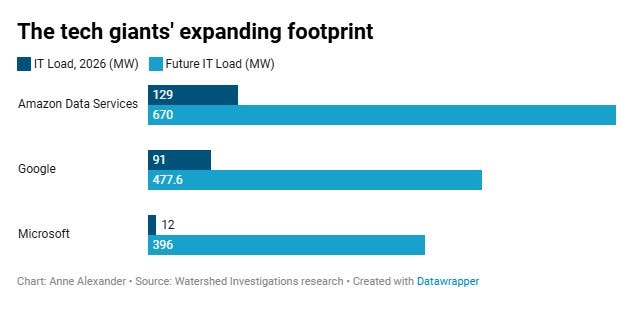
The most significant US expansion in the UK market is coming from the cloud and AI giants: Amazon, Google and Microsoft. Unlike colocation data centre operators which lease space to other companies, the Big Tech giants often operate their own facilities. All three have been major customers of the colocation data centre operators in the UK for many years, but the pipeline of their future projects shows an accelerating shift towards large-scale operations in their self-built facilities.
Unlike data centre companies aiming to attract business from tenants looking to lease space, the cloud and AI giants rarely advertise how much power and water they consume. The IT Load on their facilities tracked in Watershed’s dataset has been calculated by a variety of methods, including using the output of the back-up generators to estimate the approximate electricity consumption of the servers.
All three of the cloud giants have long been active in the UK, often leasing space in other data centre operators’ facilities. This major expansion of data centres which the companies own and operate themselves is significant because it puts them in charge of industrial sites which will collectively consume as much electricity as several large cities.
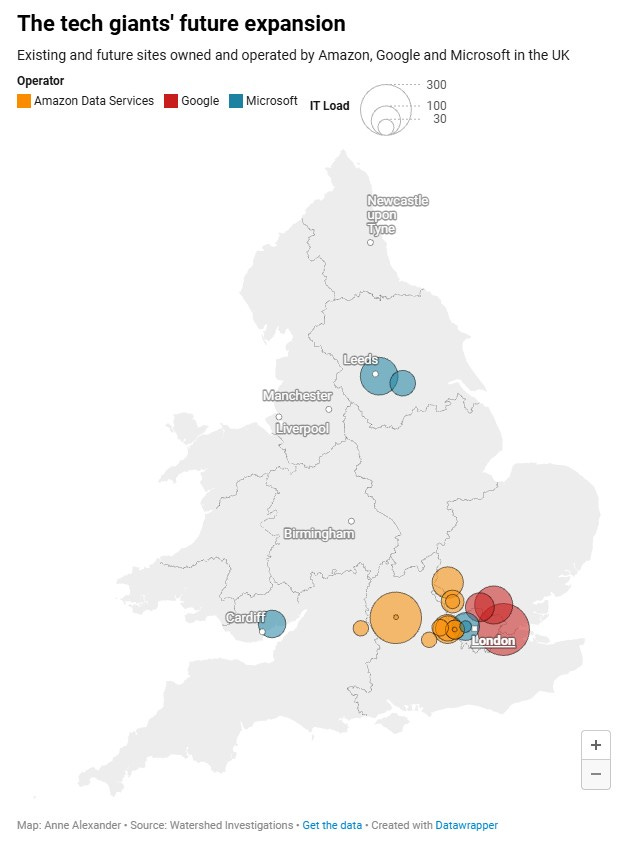
So where are Amazon, Google and Microsoft building in the UK? Amazon and Google’s expansion has so far been concentrated in the South East and London, whereas Microsoft has also expanded north and west investing in two large sites in Yorkshire, one on the edge of Leeds and the other at Eggborough, and another large site at Imperial Park in Newport. These facilities join others in Microsoft’s portfolio in the London region, including in the Park Royal area and a new site in Langley near Slough (not included in the data above or the map).
This geographical concentration should raise concerns over the local impact of London’s mega data-centre cluster. While the three US giants all promise industry-leading efficiency in electricity and water use, the sheer scale of their operations will increase the burdens on already-strained local grids and water systems.
Explore this map in Datawrapper, tap to view
If the government wants to see evidence of what unchecked data centre expansion looks like, Virginia is a good place to start. The US state which incubated the data centre boom and which hosts the largest and densest concentration of data centres anywhere on the planet has just published its Energy Plan.
It makes for uncomfortable reading. The problems documented there show that encouraging data centre operators to invest in very large facilities where the energy infrastructure doesn’t exist to support them is a disastrous approach. Virginia’s report makes clear that data centre expansion warped the entire regional electricity grid, encouraged more intense use of fossil fuels, sent electricity bills skyrocketing for everyone, and created massive air pollution for local communities.
Britain is now being asked to follow the same path, on the strength of capacity figures that don’t match the electricity used, a pipeline increasingly controlled by US tech giants and a planning regime that would take the biggest projects out of local hands.
As the consultation on the draft National Policy Statement gets under way, ministers should publish their own data and halt new large-scale approvals until they can show demand is real and the grid can take it. ■
About the author: Anne Alexander is a journalist and author specialising in reporting on the AI industry. She is currently working on a project investigating the UK’s data centre sector with Watershed Investigations. You can read more of her work on Substack here.

👫Agree with Anne? Share this story with your friends, family and colleagues to help us reach more people with our independent journalism, always with a focus on people, policy and place.