


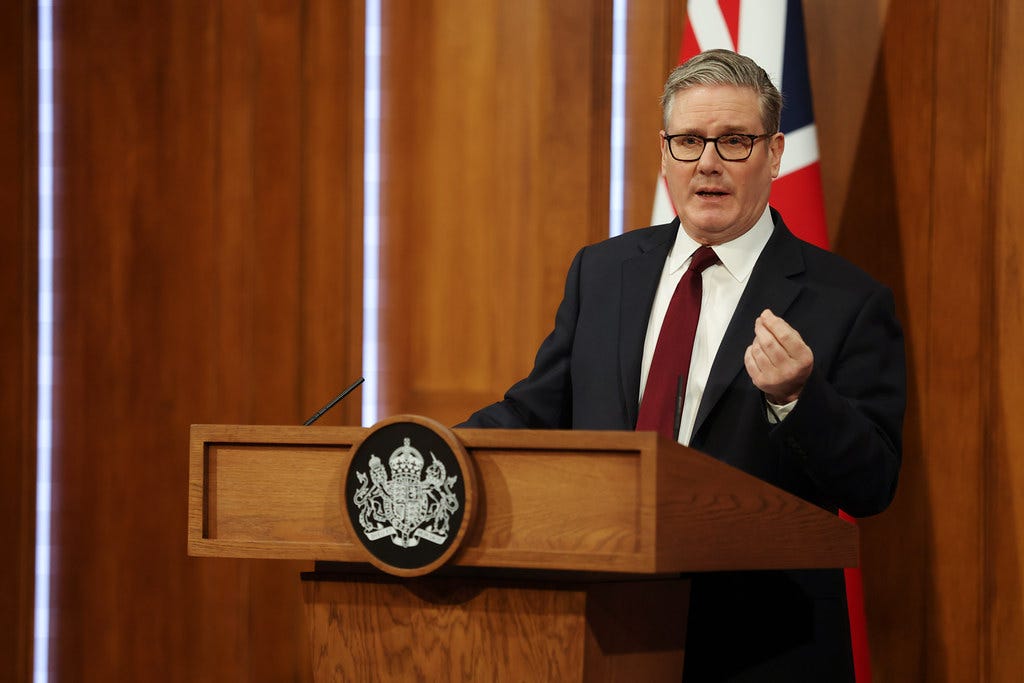
You may have noticed that the prime minister has struggled somewhat to bring the country together.
For much of the past two years of this Labour government, politics has felt like a prolonged exercise in risk management. Little coherent vision, no clear sense of purpose, no common enemies or allegiances. Keir Starmer has inched cautiously from one position to the next, wary of saying anything too clearly or doing anything too boldly.
But occasionally, fate hands you something rare: a win. If Starmer plays his cards right, he could have two of them.
The first is the war in Iran: a conflict so vast, so unnecessary, so destabilising that it threatens to pull the entire global economy into its orbit. In the face of escalation, oil shocks and geopolitical brinkmanship, the smallness of domestic political management is exposed.
The idea that Britain can quietly chart its own course in a stable, post-Brexit world begins to look faintly naïve. We are, once again, subject to the decisions of more powerful actors elsewhere. For a government that clearly wants to bring us closer to Europe and to neutralise the allure of populism, that presents an opportunity. This is what strong men do: they snap decades of alliances in half for a moment of self-serving power. Our best defence is shared values, practices and strength in numbers.
The second moment may feel smaller, but it could prove just as consequential.
Last week’s landmark US ruling against Meta and YouTube is a striking development in the long-running battle over Big Tech. A California jury found that two of the world’s most powerful companies had deliberately designed products that were addictive to children: not harmful by accident, but consciously built to keep users hooked. It is already being described as Big Tech’s “Big Tobacco moment”: a legislated shift in where responsibility lies, and what governments might now feel able to do about it.
For years, social media regulation has been contested. Concern has been widespread, but responsibility has drifted between parents, children, schools and platforms. Policy responses have been paltry: a patchwork of content rules, age limits and parental controls, none of which touch the sides of the problem.
This ruling changes the debate entirely. It makes something long suspected feel concrete: these platforms are not neutral spaces that some people misuse, but systems built with particular incentives, priorities and consequences.
Which means we now have something politics has been missing: clarity. A shared concern, a clear target, and a set of powerful interests shaping the lives of millions. This is exactly the kind of fight Starmer has so far struggled to have.
Successful governments tend, at some point, to define themselves not just by what they are for, but by what they are willing to confront. Not in a crude, populist sense of attacking enemies, but in the sense of identifying where power sits and deciding to challenge it. Big Tech provides that.
This is one of those rare issues where the political conditions are unusually favourable. Public concern is already high, particularly among parents. The harms, from addiction to mental health impacts, are widely documented and increasingly hard to dismiss. Figures across the left and right are united, and globally, governments from Australia to Spain are already moving.
Of course, a ban on its own may not be enough. It risks being a partial answer to a deeper problem, leaving the underlying incentives of these platforms intact. But even this shift in the conversation matters. The balance of power is moving. Now comes the harder part: whether governments are prepared to compel companies to take their duty of care seriously.
From Iran to Silicon Valley, the twin developments of global conflict and a reckoning with the power of Big Tech point to the same question at the heart of this government’s malaise: what will it stand for, and who is it willing to stand up to?
In Iran, the lesson is about alliances, values and the limits of going it alone in a world shaped by erratic strongmen. Britain cannot control events, but it can choose where it stands and who it stands with.
On tech, the question is different but related, not how to manage the effects of power, but how to confront it.
For much of his premiership, Starmer has seemed intent on avoiding defining moments. Now he has been handed two. One is about Britain’s place in an unstable world, the other is about power much closer to home. Both offer him an opportunity to fight. The question is whether he’s prepared to take it. ■
About the author: Zoë Grünewald is Westminster Editor at The Lead and a freelance political journalist and broadcaster.
👫Agree with Zoë? Share this story with your friends, family and colleagues to help us reach more people with our independent journalism, always with a focus on people, policy and place.
It’s difficult to see your point. Starmer has been a catastrophe. Labour has veered to the right. His selection of McSweeney was a disaster. Likewise with Mandelson. He doesn't really deserve to have survived all that. He has been forced into UTurns on key social issues. He pushes on with immigration controls and then, again, he is forced to slow up. He has refused to stop action against Palestine Action (despite being a former human rights lawyer!) and refuses to condemn the US and Israel’s aggressions. Israel’s actions in Gaza and the West Bank and now Lebanon draw little criticism. Israel’s right to defend itself is a catch all justification. Nobody else is allowed that right. Labour is openly Zionist and anyone offering serious criticism is condemned as anti-Semitic. Far from taking a strong position he is giving ground on the war with Iran. The UK defence minister is touring the Gulf states with offers of help. It is hard to see what rights Iran is allowed to defend itself. If it shoots at anything other than a bona fide military target or takes other sensible actions like closing Hormuz it is condemned. What is Iran supposed to do? Wait to be bombed or surrender? Meanwhile its cities are pounded. Now the same in Lebanon. Britain and others act to shoot down missiles fired by Iran but not those aimed at Iran. Of course no-one expects them to do the latter but then that is the fundamental bias in the situation. It is widely reported that Iran offered serious concessions only to be attacked without warning while still negotiating. Starmer offered no comment. Trump threatening to leave NATO will reinforce that tendency. European leaders will be desperate to prevent that happening so there will be more attempts to keep Trump on side. Starmer is stepping up ‘defensive’ action which will simply lead to deeper involvement. Defensive action of this kind is loaded as it actually frees up the aggressors to use more assets to attack Iran. The only European leader taking decisive action on Iran is Sanchez. Labour is going to, and deserves to, lose a lot of council seats. Starmer’s self-interested actions lost Labour their Parliamentary seat to the Greens. Given Starmer and Labour’s inability to tackle the water companies and their sewage stupidity it is hard to see them making serious progress on the tech front. The sooner Labour dumps Starmer the better, for itself and the rest of us.
You say this is Starmer's opportunity to fight. Who do you think he should fight? At present the world seems full of people wanting a fight. Mr. Trump is looking for several as is Mr.Yetanyahu and MrPutin. Mr.Farage also appears to want hostility against lots of immigrants. No doubt Kemi Badenoch and Robert Jenrick would join in. I think what we need is good and strong alliances with for example the EU Mark Carney, Japan Ukraine and the saner Amerucan Democrats who may gain considerable power later this year. I think we are already doing what we can to help Ukraine. Who do you think we should fight?