


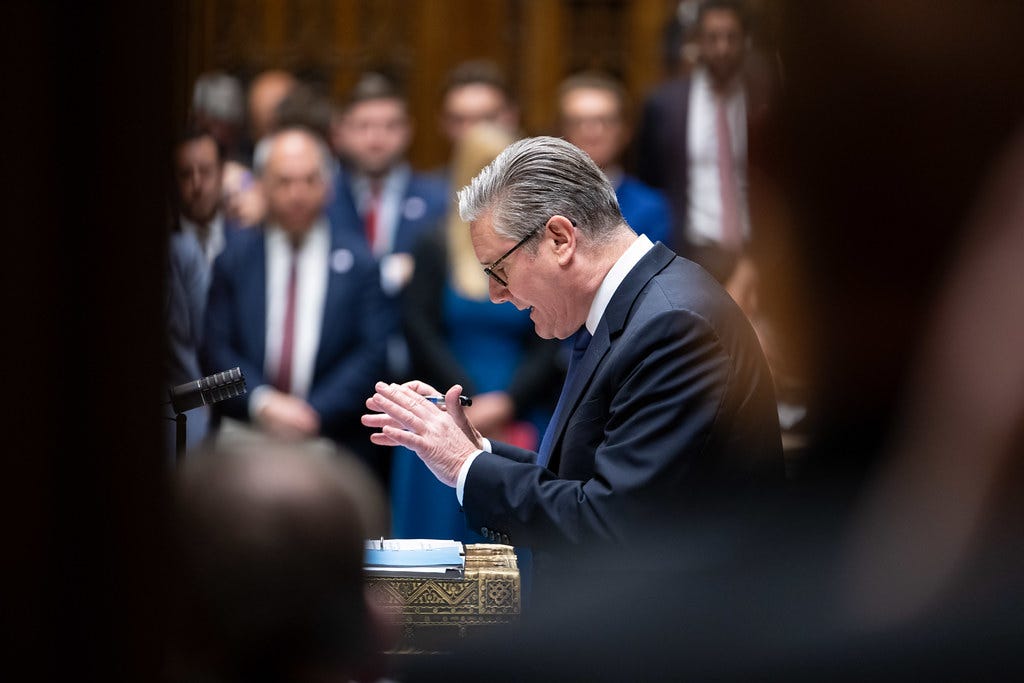
“Trust in politics is so low, so degraded, that nobody believes anyone can make a difference any more […] People think we’re all just in it for ourselves.”
That was Keir Starmer’s diagnosis of politics before he entered office. Then came the important promise that followed: to clean it up and strip out the cronyism. What a difference two-and-a-half years makes.
The prime minister came into office with few defining slogans, but one pledge many believed in: he would dismantle the informal networks and cronyism that had corroded Westminster under the Conservatives. After partygate, peerages for allies, and a revolving door culture around government contracts, Labour’s would be a clean break from the old politics of favour and familiarity.
Yet almost two years in, something familiar has crept up on us. Not the loud, boarding school boys’ club of Westminster cliché, but a quieter, more managerial version: tightly controlled, centralised, but equally as insulated from the Parliament and voters it governs.
This week’s Westminster row has thrown light on this culture. Former Foreign Office chief Sir Olly Robbins has described pressure around the handling of Peter Mandelson’s vetting ahead of his appointment as US ambassador, alongside discussions at senior levels about an ambassadorial role for former No 10 communications chief Matthew Doyle. The reported language — “just f****** approve it” — sits uneasily with Starmer’s mirage of a calm, process-driven centre. Instead, something familiar groans: decisions shaped inside a small inner circle, where informal influence carries real weight.
Here at The Lead we are not in the business of Westminster tittle-tattle or political gossip, which too often distracts from the larger questions of policy, justice and power. But these episodes should not be read as such. They point to something structural that shapes how and why decisions are being made: tight internal networks where proximity and trust matter more than process.
That should concern anyone who believes in accountable government. This is the quieter operating system that now defines the modern political “boys’ club”: not necessarily who is excluded from the room, but how decisions are shaped long before anyone else is allowed to see them.
Unlike the Tories, it is a system defined less by personality than by structure. A small inner circle of trusted advisers, who prefer top-down control over consultation, and a tendency to treat dissent — particularly from backbench MPs or those with lived experience — as friction rather than input.
And this is where the culture reaches beyond Westminster itself. Some in the parliamentary Labour party have long complained of policy being developed and announced with minimal warning, followed by a clear expectation of loyalty, barely earned, rather than debate. Whether on welfare reform, winter fuel payments, or the two-child benefit cap, the pattern has been one where decisions are made centrally, then defended rigidly, with little tolerance for reconsideration. The result is acrimony and flailing: rebellions so unruly the leadership is forced into repeated climbdowns, so much time spent fighting its own MPs that the government begins looks utterly directionless.
This matters to all of us, because this government has wasted too much precious time fighting itself, and made too little use of the expertise on its own backbenches. Governance works best when it is porous — and when a party remembers it is just that: a party of members with different views and interests, where conflict and disagreement are not distractions, but the foundations of better, stronger ideas.
In opposition, Starmer explicitly positioned himself against informal power networks and backstage politics. He lambasted Boris Johnson for his shameless self-interest and the cronyism of his administration. Now, this was meant to be the government that broke with Westminster’s old habits. Instead, it has reproduced them in a more efficient form.
And that is what makes it feel so inevitable. The boys’ club is often imagined as something outdated, but in practice it shape-shifts: from old-boy networks to special adviser circles, from informal drinking cultures to tightly run inner circles. From the exclusion of women in important rooms to their inclusion, but without really caring about what they have to say.
What remains constant is the concentration of power within a small group, and the gradual exclusion of those outside it from shaping decisions while they are still being formed.
The result is governance that can feel disciplined from the inside, but increasingly closed from the outside. As we have seen, debate becomes reactive rather than generative. Those closest to the impact of policy — MPs, frontline services, communities — are left responding to their outcomes rather than shaping them. Eventually, loyalty disintegrates. Energy fades, and motivation disappears. What is left is a party barely united, and a leader thoroughly alone. From this, nothing productive can emerge. The UK deserves better than that.
The most uncomfortable conclusion may be that this is not a deviation from Starmerism at all, but its original sin: in seeking to eliminate the chaos of Westminster politics, it reproduced it in a different form.
The question is now existential: can this government loosen control and reopen itself — to backbenchers, lived experience, and disagreement? If it cannot, then something at the top will have to give: a leadership prepared to loosen the centre, widen the circle, and let consensus in. ■
About the author: Zoë Grünewald is Westminster Editor at The Lead and a freelance political journalist and broadcaster.
👫Agree with Zoë? Share this story with your friends, family and colleagues to help us reach more people with our independent journalism, always with a focus on people, policy and place.
🗳️A heads up too ahead of the upcoming local elections - Zoë will be diving into what to expect in England’s council elections along with Wales and Scotland’s Parliamentary elections in a special report published on Saturday 2 May and across our Lead Local network we’ll be covering what’s to come and all the fall-out with a focus on the Valleys of South Wales, Calderdale Council elections, the battle for Sefton and Lancashire district council elections. We’ve also been out on the streets speaking to voters - so keep an eye on our TikTok and Instagram to see what people had to say ahead of the 7 May polls.
I’m sure Starmer is, in many ways, ‘a nice man’. But, as a leader, arguably, his principle failing is his inability to engage with people. One of the reasons he over-delegates and outsources responsibility is lack of confidence in his own judgement.
But the other is because there’s a wall of non-engagement between him and the groups he’s meant to be getting or keeping on side - he has ignored and taken for granted the needs of a surprisingly broad set of groups, ranging from the progressive voters of the left, minority ethnic communities and women, to his own backbench MPs and the civil service. This broad scope ability to alienate is quite a feat and all to disastrous effect.
But we also have to brace ourselves for a further oddity of Starmer’s character which is that he’s extremely stubborn and he won’t go quietly. He has a vision of himself as PM with a 'job to do' which he'll ruthlessly fight to finish.
Labour doesn't have a 'men in grey suits' arrangement. So, he'll dig his heels in and stay rigidly focussed on the prospect of 'events', particularly international ones, somehow changing his fortunes.
But his defiant determination to 'fulfil his obscure mission promises’ is turning him into something of a dictator, now lashing out at anyone (Robbins et al) who risks undermining him.
Underneath the reasonable man is an unreasonable one. Doesn't bode well.
The latest Labour left plan will mask these problems as their suggested aim is to keep him in situ anyway to give time for Burnham to get back into parliament (assuming such a moment arises). The result, in the meantime, must surely be a deeply demoralised, divided, dysfunctional party being dragged along, as it were, under water, with Labour’s chances of recovery by 2028 diminishing by the day.
Maybe this holding pattern is the only option available to the party but it’s also yet another Reform gift.
Zoë gets closer to the structural point here than most commentary on this government has managed. The line that does the real work is the one near the end; "this is not a deviation from Starmerism at all, but its original sin." That is correct. It is also the moment the diagnosis could have been pushed one further floor down.
The "boys' club" frame is worth interrogating. This is, on almost every demographic measure, the most diverse Parliament and cabinet Britain has ever had. More women. More minority representation. More ministers from backgrounds that were historically locked out. The inclusion has been real. And yet the centralisation, the inner circle, the top-down control, the treating of dissent as friction — all of it has reproduced itself inside a more diverse cast. Which tells us the problem was never really about who was in the room. It was about how few rooms there were.
Starmer's inner circle will not be fixed by widening it. Johnson's inner circle was not fixed by replacing it. Truss's was not fixed by shrinking it to forty-nine days. The pattern repeats across governments of every ideology and composition because the architecture rewards it. A party system that requires tight message discipline to survive an election cycle will produce centralised leadership inside whichever party wins. A parliament where whips determine careers will produce backbench silence regardless of who sits on the benches. A constitution that can be rewritten by whoever holds power this afternoon will produce leaders who spend their first year consolidating and their second defending what they consolidated.
The UK has been rotating prime ministers every year or two for a decade, sometimes in weeks. Nothing gets built because nothing can outlast the cycle. HS2 is the monument to this. So is the absence of a social care settlement. So is the failure to build housing, sovereign energy capacity, or sovereign data infrastructure. The system cannot think beyond an election, because an election is the longest guaranteed horizon any actor inside it has.
Removing Starmer will produce the same instability that removing Johnson produced, and removing Truss, and removing May. The next leader will inherit the same architecture and, with the best intentions in the world, will reproduce the same pattern in a slightly different accent.
The uncomfortable conclusion Zoë names but does not fully follow is the right one. Stronger systems. Codified constitution. A second chamber selected by sortition. State-funded elections. The removal of the whip as a career-defining instrument. These are the architectural changes that would make the "boys' club" structurally impossible, because there would no longer be a small enough room in which to form one.