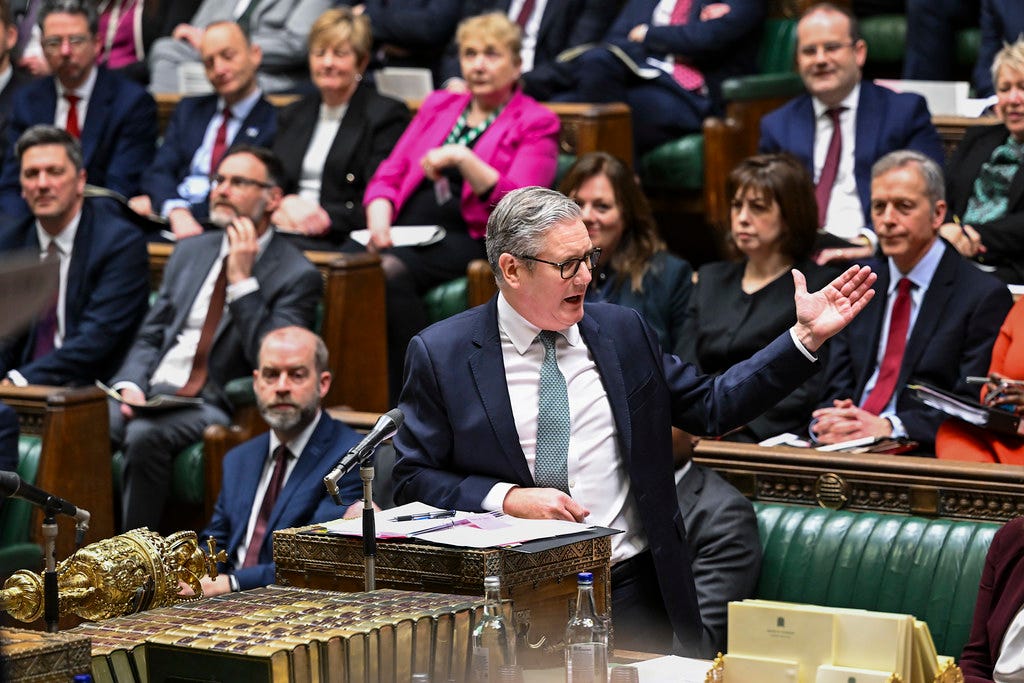
What next, Keir Starmer?
If Starmer can pivot decisively toward a politics of fairness, he may yet turn survival into renewal.
The prime minister may have narrowly dodged political assassination, but lounging in the aftermath is not a strategy. Last week was not some fluke, factional tantrum, or fleeting wobble. It was the product of long-standing unease; inside the parliamentary party, and far more alarmingly, among voters.
Keir Starmer remains in place simply because no obvious successor was ready, and because he acted fast enough to promise a pivot. That gives him breathing room, not a free pass.
Last week’s episode should mark the end of a style of politics that has constrained Labour since it entered office. The corrosive influence of Blue Labour ideology and New Labour managerialism produced a leadership too often focused on control and triangulation. The resignation of Morgan McSweeney and the admonishment of Peter Mandelson signal that Starmer understands the need to loosen that grip. But personnel changes alone are not enough. What is required now is a clearer, animating mission.
So, why not make that mission one of fairness?
For too long, voters have felt the system is stacked against them: their votes diluted, work unrewarded, and the promises of homeownership, holidays, and a modern, democratic capitalism fading into the distance. They see wages stagnate while the rich get richer, as taxes fall heaviest on ordinary workers and the cost of essentials continues to rise. That sense of frustration, of effort unrewarded and opportunity denied, is what this government should confront.
By putting fairness at the centre, this would be a government that actively tackles the barriers holding people back: regional gaps in investment and opportunity, a generation squeezed by housing costs and student debt, persistent racialised poverty and wealth gaps, environmental burdens that fall hardest on the poorest, and an economy where wealth and income are distributed more justly.
It is not a slogan, but a practical, measurable commitment. Where life chances are stacked against people by policy or economic structure, Labour should intervene.
The economic backdrop makes the urgency for change plain. UK unemployment has risen to 5.2 per cent, the highest in nearly five years, as hiring slows and businesses absorb higher costs. The government’s choice to raise national insurance on payroll rather than confront structural inequities in the wider tax system was a lazy solution, illustrative of a Treasury more comfortable taxing work than wealth.
It also raises deeper questions about where pain falls. It has been easier, politically and administratively, to squeeze employees and employers than to challenge the preferential treatment of assets. If Labour wants to reshape the economy, it cannot avoid these harder conversations about who shoulders the burden and how opportunity is distributed.
Mayor of Greater Manchester Andy Burnham, speaking at the Resolution Foundation last week, captured the scale of the problem. He pleaded the case for people in work yet trapped in insecurity, squeezed by housing costs, and tethered to caring responsibilities and ill health. Burnham’s narrative was not simply about unemployment or inflation, but that this model of growth leaves too many households permanently exposed, even when they are doing everything right.
A reset built around fairness would make clear these pressures are interconnected. Regional inequality remains stark: London and the South East thrive while other areas wait for the promised dividends of devolution. Generational inequality has hardened as younger people face high rents, punishing student loans, and dim prospects of home ownership, while asset wealth accumulates among older cohorts. Environmental harms disproportionately affect poorer communities, even as green investment rewards the better off. And as we’ve pointed out before, even poverty is unequally distributed: for Black and Asian families, poverty rates are more than double those of white households.
To talk about fairness is not to recite a slogan, but to identify the thread binding together the failures in housing, tax, public services, labour policy, and regional investment. In practice, it means confronting imbalances, inequalities and injustices wherever they sit: in council tax and capital gains, in planning and spending geography, in those who have and those who do not.
Starmer now faces a choice. He can treat last week as a narrow escape and retreat to cautious managerialism, or he can recognise that the fragility of his position reflects a hunger for something bigger. A reshuffle offers the first chance to signal intent. A Treasury led by someone willing to tackle structural inequality, to revisit how work and wealth are taxed, could be an important first step.
Ultimate responsibility for the success of any reset, of course, lies with the leader. Discipline is not enough; the question is whether Starmer can be the face of an authentic vision for this country, which is prepared to confront how the status quo advantages some while locking others out.
Starmer has been gifted another chance. That is rare in politics. And it makes this moment both precarious and clarifying. If he can pivot decisively toward a politics of fairness, he may yet turn survival into renewal. If he cannot, he may find that the forces that almost unseated him have not disappeared. They simply waited.■
About the author: Zoë Grünewald is Westminster Editor at The Lead and a freelance political journalist and broadcaster.
👫Agree with Zoë? Share this story with your friends, family and colleagues to help us reach more people with our independent journalism, always with a focus on people, policy and place.


Keir Starmer is ill equipped to be able to pivot to the required position, as he is totally lacking in the personality, principles and political nous to be able to make such an adjustment. His whole political career has been based on promising that which is needed to gain promotion and immediately reneging on those promises. He will forever remain a lame duck Premier, merely awaiting others to get their ducks in a row before they launch a coup.
Banning usary as we did in the past would be a great relief for the common folk. The country prospered when this was last in place.
Also when support for people wasn't demonised and the state supported people properly, more often people returned to work at greater capacity. Today, you are just driven to further illness by stress and then in turn called a cheats, liars, useless and beyond.
It's not good enough.