


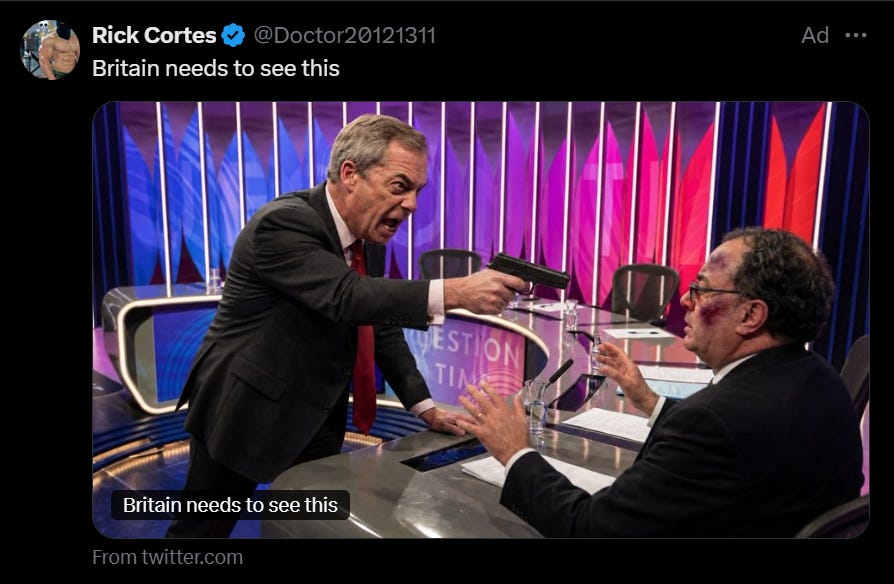
A series of fake, AI-generated advertisements running on X are using Nigel Farage’s likeness to scam people online.
The videos use deepfakes – AI-generated media digitally altered to convincingly manipulate a person’s likeness or voice – of Nigel Farage and Bank of England Governor Andrew Bailey, depicting them in fabricated scenarios on a set resembling BBC Question Time.
Some of the promoted posts falsely depict Farage kicking, grabbing and lunging after Bailey, with some imagery also displaying bruising on their faces.
Farage says he has called on X to remove the adverts, while Bailey urged X users to report them.
What are the ads for and are they legit?
There are numerous ads which appear to lead to different AI-powered cryptocurrency trading platforms which supposedly help users invest their money.
Cases of fraud recorded by the National Fraud Database reached the highest levels last year, with the 6 per cent increase attributed to the use of AI to help accelerate fraud.
The Lead followed the links of numerous ads that all followed the same trail - so you don’t have to.
It starts with one of the ads promoted into your feed by a verified X account, meaning the user pays a subscription to the platform’s Premium tier.
Clicking on the ad leads to another X post with a link, which directs users to a landing page showing a fake BBC news article titled “The BBC Question Time Moment Everyone’s Talking About.”
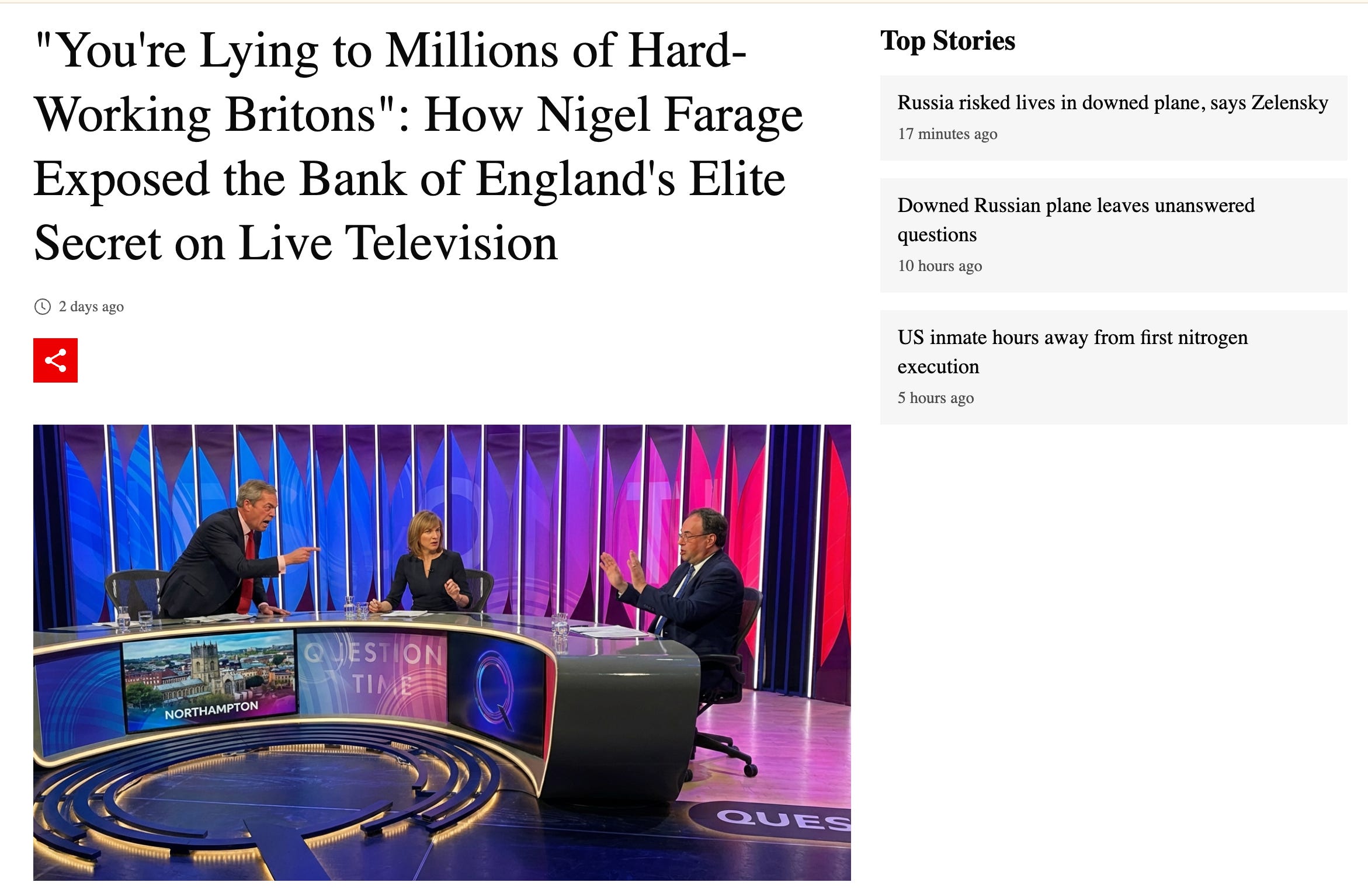
The article details the fake fight between Farage and Bailey and, at the end, features an “editors note” that reviews the trading platform Garlinex.
The article is hosted on a website called apemaars.com, which, at the time of writing, appears to have no publicly accessible website content beyond the specific URL used in the advertisement.
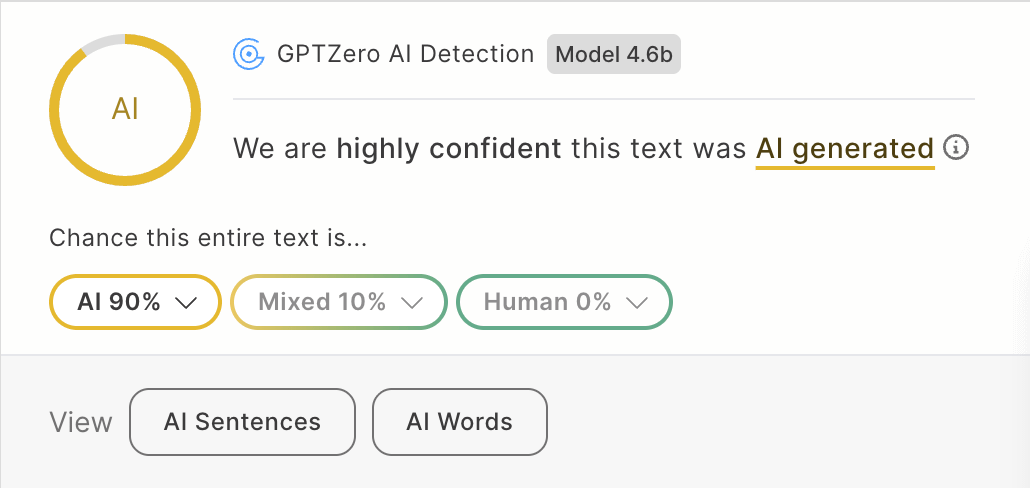
The Lead ran the news article through the AI-detection tool GPTzero, which found it to be 90 per cent AI-generated.
Garlinex markets itself as a tool that “makes AI company investment opportunities easier for regular investors”. While the website is real, it has been marked as a scam website by the cybersecurity tool GrindSoft.
The report says: “This site is classified as a Scam Website based on multiple risk signals, including a very young domain (37 days), no established public user-review history, and heuristic security signals.”
The website also features a case study showing results over a 12-month period, despite the website only existing for just over a month. It also shows a Trustpilot review section that doesn’t match Garlinex’s real Trustpilot page.
Other videos, identified by Cybernews, refer to a different trading platform called Fundektris. Cybernews found that it is not a not a real company, as it has no official registration and isn’t authorised or regulated by any major financial commission, that it has been “vibecoded’, meaning that it’s likely to have been created by someone with little knowledge of website building and needs a site fast, it contains placeholders, buttons to download non-existent apps and is on several cybersecurity blacklists.
Cybernews also checked a blog post about the Farage-Bailey fight, which was also AI-generated. It is also the only post on the blog’s website and was published on the 3rd of June, 2026.
While most of the evidence points towards the ads being used to scam people, Dr Helena Ivanov, Associate Researcher at the Henry Jackson Society told Guido Fawkes that – because the ads are powered by a sophisticated agentic AI-powered bot network, with one IP address based in Belize – it could be a trial for a larger disinformation campaign by foreign actors.
Why Farage?
Most of the ads appear to feature Nigel Farage and the brawl with Andrew Bailey. But some aren’t related to the brawl or Farage at all.
One appears to show a man with his finger on his lips standing in front of a crowd of arguing journalists in front of the Houses of Parliament, with a Union Jack flag in the background.
The accompanying text reads “Everyone should make up their own minds.”
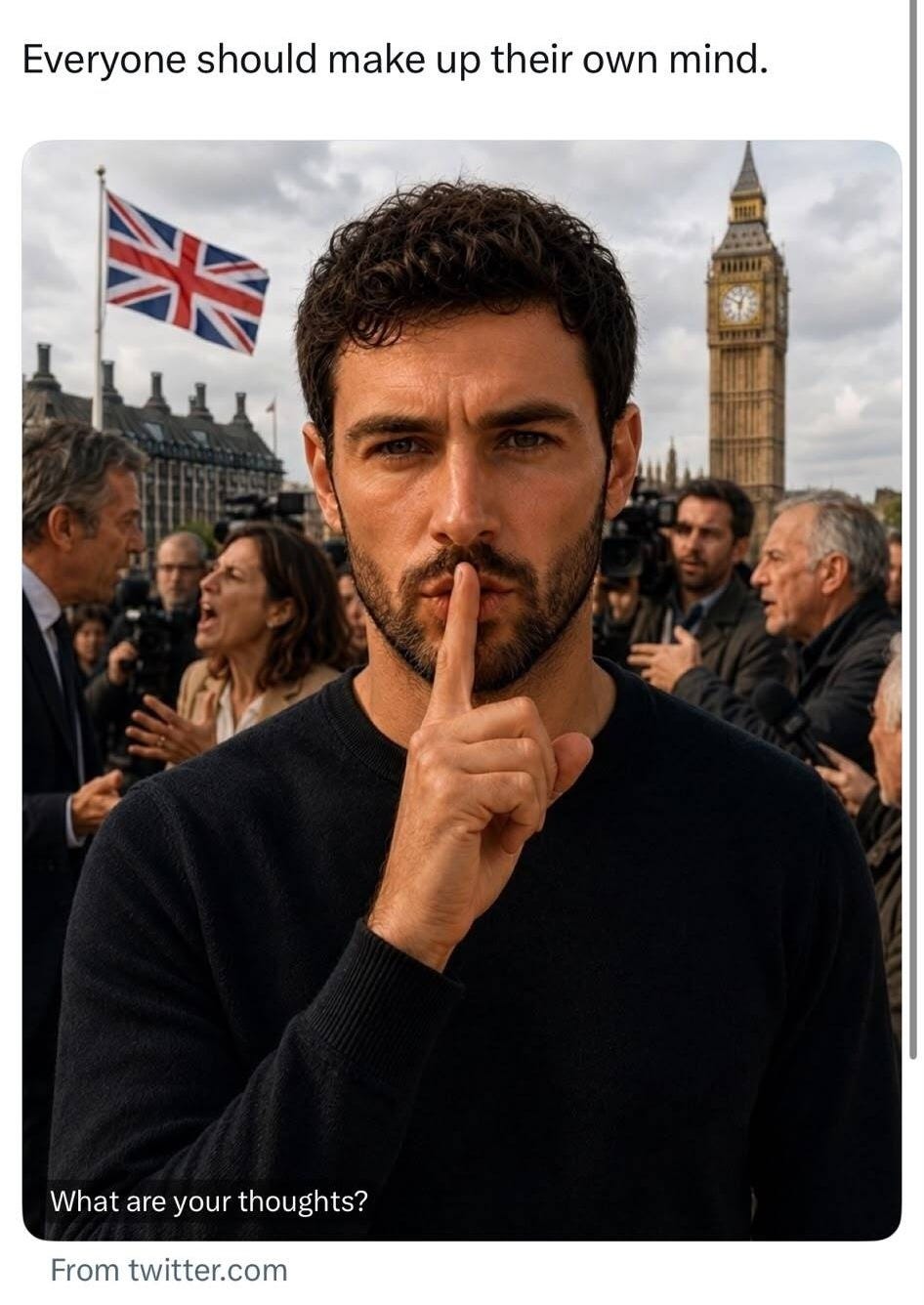
The ads, which are related to cryptocurrency, appear to be targeting people of identity with being anti-establishment.
Given that Farage has positioned himself as the anti-establishment candidate and has repeatedly promoted cryptocurrency, the decision of the scammers to use his likeness in these ads is not surprising.
Farage is still being called to answer questions about the £5 million gift he received from cryptocurrency billionaire Christopher Harborne, who invested heavily in the Brexit Party as well as Reform UK.
He was also paid £50,000 in personal speaking fees by two cryptocurrency businesses in October 2025 in the same month he said he “not aware” of crypto businesses funding his party, according to the Byline Times.
Reform’s Cryptoassets and Digital Finance Bill – a “statement of intent” published the May prior – set out a ‘post-Brexit roadmap to make the United Kingdom the world’s premier hub for cryptocurrency and blockchain innovation.
He also promoted Kwasi Kwarteng’s crypto scheme in April this year.
What was Farage’s response?
While Farage says he has called on X to remove the ads, he isn’t entirely distancing himself from the depiction.
“You may have seen some bizarre AI videos on this platform today,” Farage wrote in a post on the platform on Monday evening. “Whilst Andrew Bailey and I have our disagreements, I would never take it that far!”
Speaking to broadcasters during a visit to Grangemouth on Tuesday, he added that he did not know “whether to laugh or whether to be angry” about the fake ads.
“The trouble is it’s an AI fake but it looks real in every way, and people know that the governor and I have had our disagreements over things over the years,” he said.
What about the Bank of England?
The Bank of England urged X users to report the ads. “Unfortunately, fake adverts impersonating the Bank of England and other central banks are on the rise,” said Andrew Bailey.
“These scams are designed to criminally exploit the public, especially the vulnerable, when they are online.”
He urged the public to stay vigilant and “report these scams”.
“That way authorities can better root out digital deception like this and permanently remove the fraudsters responsible for what is a truly online scourge.”■
About the author: Ella Glover is the audience engagement editor at The Lead. She is also a freelance journalist specialising in workers’ rights, housing, health, harm reduction and lifestyle.
About The Lead Untangles: In an era where misinformation is actively and deliberately used by elected politicians and where advocates and opposers of beliefs state their point of view as fact, sometimes the most useful tool reporters have is to help readers make sense of the world. If there is something you’d like us to untangle, email ella@thelead.uk.
👫Found this edition of The Lead Untangles useful? Share it with your friends, family and colleagues to help us reach more people with our independent journalism, always with a focus on people, policy and place.
🇪🇺 And we’ll be back in your inbox on Saturday morning with the second part in our series examining a decade on from the EU Referendum and the impact Brexit has had on the UK. Make sure you’re subscribed to receive it first.
I don’t use X/Twitter, but came across this ad on Facebook (and reported it immediately). If their systems can’t prevent obvious fakes like this designed to scam people, it doesn’t give you much confidence in everything else…
"The ads, which are related to cryptocurrency, appear to be targeting people of identity with being anti-establishment."
I will say i've seen this ad constantly on every one of my twitter accounts - my own one (which is pretty liberal leaning, though I stopped posting when Musk bought the platform), an alt account I use just to follow close friends (again, very left leaning politically), and several corporate accounts.
As you note all the ads are promoting one tweet, which links to a second tweet. I'm sure this is because the second tweet with the link is clearly a scam and X would not allow this to be promoted (or wouldn't, in the old days, these days I think they just approve almost anything). But they must be spending a fortune on these ads. The only other ads I've seen are for other financial platforms, and in the last few days ITV have been advertising football and betting platforms have popped up with world cup promotions, so yet another money grab.