

Reform UK’s silence on Epstein speaks volumes
A politics that claims to defend women while refusing to confront the systems that harm them is not about protection. It's about strategy.


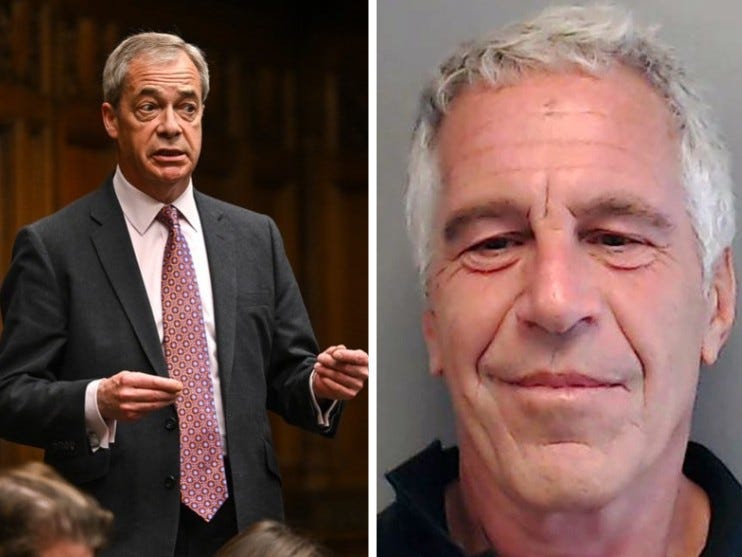
Do you hear that, coming from the right of British politics? An unfamiliar sound: silence.
As the world reels from the vast release of material connected to Jeffrey Epstein – the convicted sex trafficker whose abuse was enabled by wealth, power, and proximity to political elites – one party, in particular, has chosen to say almost nothing. Reform UK, the self-styled anti-establishment movement that claims to stand up for women and girls against the supposed dangers of immigration and liberal elites, has taken a conspicuous leave of absence.
The files name household figures across politics, business and culture: former and sitting presidents, senior advisers, philanthropists and celebrities. The most shocking of these have been Andrew Mountbatten-Windsor, who allegedly invited the convicted paedophile to Buckingham Palace for tea, and Labour grandee Peter Mandelson, who allegedly provided Epstein with confidential UK government information. That is not to say (and it matters to be precise) that everyone named knew about Epstein’s crimes. But in some ways, that caveat only reinforces the point: Here is a global ecosystem in which sexual exploitation flourishes, not because of a ‘broken culture’ in any particular community, but because powerful individuals protect one another and sometimes look the other way.
The sheer respectability of so many of the names illustrates how these networks operate: in plain sight, cloaked in legitimacy, normalised by association. Abuse does not just happen at the margins. It has long been embedded within elite social, political, and financial circles, where scrutiny is discouraged and victims dismissed.
This is precisely the kind of story that ought to ignite the fury of those who claim to care most loudly about safeguarding women and girls, and taking on elite interests. It lays bare how power and sexual violence intersect, how cover-ups function, how brazen and normalised abuse can become, and how victims are shut down to protect reputations. And yet, Britain’s loudest culture warriors have looked the other way. Where are the urgent demands for accountability? The vocal concern for survivors whose testimonies were ignored for decades?
Perhaps this is because Farage’s political project has never truly been about protecting women. Women and girls function as a rhetorical device, wheeled out when useful, discarded when inconvenient. Their suffering is amplified when it can be folded into a narrative about immigration, race, or national decline, and minimised when it points upwards, towards men who look uncomfortably like political allies.
There were grave, repeated failures in how the grooming gangs scandals were handled. But when violence against women and girls is viewed only through this racialised lens, the aim is storytelling, not safeguarding. Violence is located “over there”, in marginalised communities, while the structures that enable abuse at the very top remain untouched.
Epstein inconveniently blows that framing apart. This is a story about money, masculinity, and impunity. Many of the men involved are rich, white, and powerful. It demands an examination of complicity rather than communal blame, an inconvenient lens for a movement built on moral panic.
There may, of course, be more pragmatic reasons for Farage’s silence. He is referenced repeatedly in the Epstein material, and at one point, Trump adviser Steve Bannon (never one to undersell his own importance) is reported to have boasted to Epstein about their relationship. This proves nothing criminal, but it is a bit awkward, isn’t it? It is rather hard to play the righteous outsider while you're lingering on the guest list of the elites you claim to despise.
Genuine outrage would also be politically risky. Farage’s project depends on his proximity to Donald Trump and his allies, a relationship sustained through years of careful moral compartmentalisation. That Trump, found civilly liable for sexual assault and recorded boasting about grabbing women by their genitalia without consent, appears repeatedly in the Epstein material has prompted no soul-searching in Reform UK. Apparently, “believing women” has always come with conditions.
The Epstein files will take months, perhaps years, to fully unravel. But one thing is clear: this is not just about individual failure. It is ideological fraud, too. A politics that claims to defend women while refusing to confront the systems that enable abuse is not protection: it is a strategy.
What justice for survivors would look like, in this moment, is stark. Full transparency, accountability for those who enabled or turned a blind eye, and support, belief and reparations for the victims themselves. That is the reckoning we owe, not to the self-styled defenders of women, but to those who have suffered while the powerful stay silent. ■
About the author: Zoë Grünewald is Westminster Editor at The Lead and a freelance political journalist and broadcaster. Zoë then worked as a policy and politics reporter at the New Statesman, before joining the Independent as a political correspondent. When not writing about politics and policy, she is a regular commentator on TV and radio and a panellist on the Oh God What Now podcast.
👫Agree with Zoë? Share this story with your friends, family and colleagues to help us reach more people with our independent journalism, always with a focus on people, policy and place.
All very true, (with first hand knowledge). They use their money to intimidate and control. Escape is neigh on impossible for the victim, who is never heard or believed.
Here , Here - these elites need to be held to account & Farage & Reform be exiled to the wastelands - they have never been a voice for women or the 1000s of sexual abuse victims- they are fascist, mysoginist, white supremacist