


While local elections may not deliver the kind of political earthquake some are frothing for, next week’s votes will still offer the most comprehensive snapshot yet of Britain’s political mood. And, spoiler alert: people aren’t happy.
What matters is not just dissatisfaction, but that it is no longer flowing in predictable directions. A mosaic of English councils, mayoralties, and devolved contests in Scotland and Wales, the headline is likely to be fragmentation – not just between parties, but in the issues shaping how people vote.
And, of course, the bigger question political watchers will be asking is whether Keir Starmer can still hold together a governing coalition broad enough to survive the pressures of office, and whether the Conservatives remain the natural vehicle for anti-Labour sentiment – or whether that role is now being actively contested, and in some places replaced, by Reform UK.
The two-party system itself comes under renewed strain: Labour tested in government, the Conservatives tested in opposition, and both increasingly forced to operate in a political landscape that no longer behaves like a two-horse race.
Mid-term blues meet multi-party politics
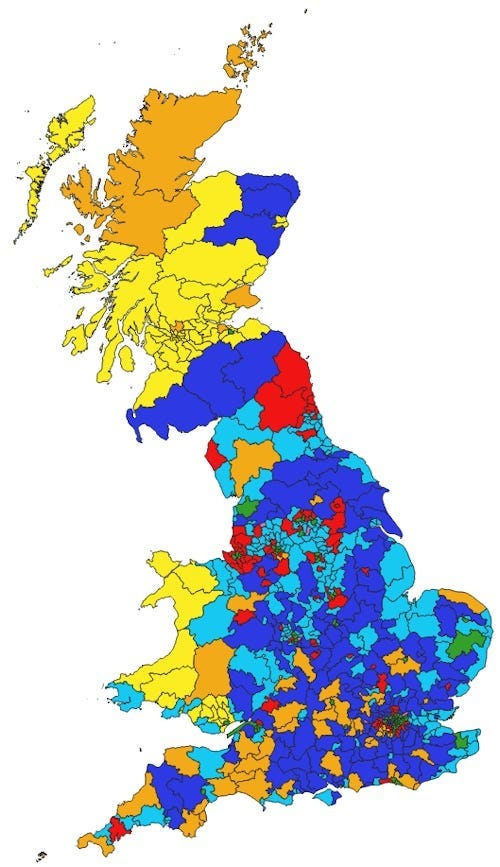
Let’s start with local council elections, which are happening across England, but not in all areas.
There are almost 5,000 seats up for grabs across 136 local authorities, with Labour defending just over 2,000, the Conservatives around 1,300, and the rest split between Liberal Democrats, Greens, Reform UK and independents.
The party in power – here, Labour – almost always tends to lose ground in local elections because turnout is lower and voters vent their frustrations. For Labour, this is truer than ever. Turnout in local elections typically hovers between 25 and 35 per cent, and when voters are more disillusioned, the results become harder to read as genuine mandates. Fewer votes in total means smaller, more motivated blocs — whether a local residents’ group, a single-issue campaign, or a party with a narrow but disciplined base — can punch well above their weight. Councils can end up controlled by parties or coalitions representing a fraction of the electorate, while the majority simply didn’t show up.
Some polling suggests the governing party could be in for a bloodbath, set to lose more than 1,000 councillors, as voters across the spectrum find an outlet their mid-term exasperation. But the more unsettling possibility is not just that Labour loses seats, but its winners have thin, fragile mandates that make governing very difficult in practice.
This time, something different is occurring too. Despite being in opposition, the Conservatives’ vote share is also expected to fall according to pollsters Colin Rallings and Michael Thrasher of Exeter University, as “neither opinion polls nor local by-elections suggest much has changed” in the past 12 months. In other words, voters are not yet done punishing the Tories, creating a fragmented field where multiple parties can win by default rather than dominance.
This changes what ‘losing’ looks like. Losses are more likely to be diffuse, spreading across councils rather than concentrated in clear defeats. Control of councils will hinge less on national swings and more on vote-splitting, tactical withdrawals, and hyper-local dynamics.
That fragmentation is reinforced by voter behaviour itself. YouGov’s polling on local priorities shows voters are not converging around a single dominant issue. Instead, concerns vary sharply between communities, with the economy, NHS, crime, housing and local services all competing for attention. The result is a political environment in which voters are all moving in different directions.
The rise of independents and hyper-local campaigns adds another layer. In some places, elections are no longer about national parties at all, but planning disputes, local services, or foreign policy positions that cut across traditional left-right divides.
Overall: expect more councils under no overall control [NOC], and more unstable administrations.
Reform UK rising
The most disruptive force in these elections is Reform UK. Polling suggests it is no longer just a protest vehicle but a viable electoral competitor, particularly in suburban and post-industrial England.
In the North and Midlands, councils and wards in places such as Doncaster, Barnsley, Rotherham, Stoke-on-Trent, Dudley, and parts of Nottinghamshire and Derbyshire represent the clearest expression of Reform’s ‘working-class protest’ appeal. These are areas where Labour still dominates, but where voter loyalty is increasingly soft and turnout-sensitive. In next week’s elections, Labour faces losing yet more councillors to the insurgent party in similar areas, such as in Barnsley, Wakefield and Sunderland. Crucially, Reform does not need to win outright control to be significant; it only needs to poll strongly enough to split the anti-Labour vote or embed itself as a permanent second-order choice.
In the South and East, the dynamic is different but equally important. Last year, Reform seized control of eight authorities from the Conservatives, including former strongholds in Kent. Areas such Thanet and Medway, and Thurrock and Basildon in Essex, as well as parts of Hampshire and Lincolnshire will continue to be fertile ground for Reform’s suburban insurgency, as concerns over immigration, taxation, and trust in national institutions map more directly onto Reform’s message.
The key point is that Reform’s impact is two-fold. In some areas, it replaces the Conservatives; in others, it replaces Labour. But in both cases, it destabilises the old two-party local order. In practice, that means more hung councils – administrations where no single party has a majority but one party might have enough seats to block or obstruct policy. For the public, this could look like budgets being delayed or deadlocks, planning decisions being stalled or local services caught in the crossfire of decision making.
Look to North Northamptonshire Council – Reform-run since last year – which pushed back its net-zero target by up to 20 years, splitting the authority and drawing condemnation from across the political spectrum. A small example of what Reform control actually looks like on the ground.
The Green surge
The Green Party’s challenge outside London is more geographically concentrated, but increasingly credible in specific types of place: university cities, affluent progressive towns, and parts of the South West.
The Greens are the biggest party in local government on a dozen councils already, and in some cities like Bristol and Brighton, they have already demonstrated the ability to lead the agenda and win council control.
In Cambridge and Oxford, the Green challenge is shaped by a highly educated, transient electorate and a strong environmental policy salience. Elsewhere, in parts of Manchester, Leeds, Sheffield and Liverpool, the gains are more incremental but still strategically important, clustering in inner-city wards with younger populations.
Unlike Reform, the Greens rarely reshape control of councils on their own. But they chip away at Labour’s urban coalition, particularly among younger and more progressive voters who might previously have defaulted to Labour in local elections. And it’s worth pointing out that the Greens are surpassing their own expectations: on the Green’s surprise victory in the Gorton and Denton by-election last month, Green leader Zack Polanski declared: “It’s not hyperbole to say that our win – in a seat that was 127th on our target list – has changed everything.”
 Tiktok failed to load.
Enable 3rd party cookies or use another browser
The fragmentation capital
If these elections tell a national story of fragmentation, nowhere embodies it more clearly than London. On paper, this is still Labour’s city, but in practice, it is becoming a multi-party battleground.
Labour and the Conservatives combined could fall below 50 per cent of the vote in parts of the capital, an extraordinary figure in a system historically structured around two-party competition.
In outer boroughs such as Bexley, Bromley and Havering, the key story is the fragmentation of the right. Reform is targeting the voters the Conservatives rely on: suburban, older, economically anxious. Even modest gains could deny Conservative control outright and turn previously safe councils into hung administrations.
In inner London, the pressure comes from the opposite direction. The Greens are polling strongly across a corridor including Camden, Islington, Hackney and Lambeth – areas with younger, more progressive electorates. Increasingly, disillusioned Labour voters are not moving to the Liberal Democrats, but to the Greens.
 Tiktok failed to load.
Enable 3rd party cookies or use another browser
Add in independent candidates, particularly in areas shaped by Gaza politics and foreign policy concerns, and Labour’s dominance begins to look less secure than headline seat numbers suggest.
Across London, three indicators to look out for are the number of NOC councils, Reform breakthroughs in outer boroughs and Green gains in urban areas. What might make this more destabilising in England is the electoral system itself. What makes this more destabilising in England rather than Scotland or Wales is the electoral system itself. First-past-the-post was designed for two-party competition, manufacturing majorities but punishing smaller parties. But as support fragments, it starts to produce the opposite: false minorities and distorted outcomes. Scotland and Wales both use PR which are better wired for multi-party politics.
Mayoralties and personality politics
There is not a full set of regional ‘metro mayor’ elections this year, but a smaller number of directly elected borough mayoralties in London, where personal recognition and local incumbency matter more than party brand. These include Hackney, Lewisham, Newham, Tower Hamlets and Croydon.
That said, they still behave differently from standard council contests. They are more visible, more personalised, and more volatile. Turnout tends to be higher than in ward-level council elections, and candidates often draw support based on name recognition, local profile, and protest sentiment rather than strict party loyalty.
The Greens will be eyeing the Hackney and Lewisham mayoralties, while Labour is expected to hold onto Croydon, Newham and Tower Hamlets, but not without a fight. Luftur Rahman – who won the Tower Hamlets mayoralty back in 2022 as head of his own Aspire party after being banned from office – has shown the power of a well-organised hyper-local movement that combines community identity with anti-establishment feeling. Whether or not he holds on this time round, his model is a template for insurgents can win power in the right context.
SNP dominance under strain
Alongside England’s local contests, voters in Scotland and Wales will also elect members to their devolved parliaments – national institutions that run most domestic policy, including health, education, transport, housing and parts of taxation.
In Scotland, voters choose 129 Members of the Scottish Parliament [MSPs] in Holyrood, where a majority requires 65 seats.
Labour has seen some recovery in Scotland in recent years, particularly in urban and central belt areas, often driven more by anti-SNP sentiment than by a settled constitutional shift in its favour.
But according to the latest YouGov MRP modelling, the SNP remains on course to be the largest party and is projected to be in contention for an outright majority. This is rather striking, given years of incumbency fatigue, internal strain and scrutiny over delivery in government.
The Conservatives, meanwhile, continue to act as the main unionist force in parts of Scotland, but remain structurally constrained in national terms. The result is less a clean swing between two dominant parties, and more a fragmented recalibration of Scotland’s political blocs – with SNP dominance still intact, but increasingly contested at the margins.
Take it to the Senedd
In Wales, voters elect Members of the Senedd [MSs] to the Welsh Parliament – the Senedd Cymru – a devolved national legislature responsible for health, education, transport and local government.
Just five years ago, Welsh Labour was celebrating one of its best Senedd election results. Now, according to the latest YouGov MRP modelling, the party is set to face a once-in-a-century defeat, as its vote share is projected to fall to 13 per cent, down 23 points on the 2021 election. In its place, a tight competition is emerging between Reform UK and Plaid Cymru for second place.
Plaid remains Labour’s most established challenger, especially in Welsh-speaking and rural areas, where it blends cultural identity with critiques of economic performance and public services. But the newer story is Reform UK’s rise in parts of Wales, particularly in more economically strained Valleys and coastal areas. While still less embedded locally than the main parties, it is drawing support from voters who have drifted between Labour and abstention – and are now looking elsewhere entirely.
More broadly, the political story in Wales is no longer just about Labour’s gradual erosion, but about a potential turning point in the country’s direction. Wales is increasingly being pulled between two very different visions of nationalism: Plaid Cymru’s pro-devolution, more powers-for-Wales agenda, and Reform UK’s more UK-centric, devolution-sceptic approach.
The bigger story behind the ballots
These elections probably won’t deliver a single dramatic shock result. But they may well confirm something we’ve long suspected: the slow, uneven unravelling of Britain’s two-party politics.
Across England, Scotland and Wales, the pattern is likely to be one of more fragmentation, more volatility, and fewer areas where one party can take control and assume loyalty will follow.
The evidence is there in different forms: Reform UK pulling apart traditional party coalitions on both left and right, the Greens steadily building in urban, younger areas and devolved politics in Scotland and Wales increasingly shaped by competing nationalist visions.
Even voter priorities are no longer clustering around a single dominant issue. Instead, they are scattered across a wide set of local and national concerns, from public services to identity to trust in government itself.
For Labour, the question is how to govern in a country where its support is more conditional than it looks on paper. For the Conservatives, it is how to remain relevant in a system where they are no longer the automatic alternative. And for everyone else, it is an opportunity to break through a system that once seemed impenetrable. For voters, the outcome will be a politics that feels less predictable, more localised, and increasingly hard to map onto the old labels.■
About the author: Zoë Grünewald is Westminster Editor at The Lead and a freelance political journalist and broadcaster.
Support our independent journalism by becoming a paid subscriber of The Lead today and claim 30% off for the first year.
🗳️Keep your eyes across our Lead Local network this week as we’ll be covering all the local elections fall-out with a focus on the Valleys of South Wales, Calderdale Council elections, the battle for Sefton and Lancashire district council elections. We’ve also been out on the streets speaking to voters – so keep an eye on our TikTok and Instagram to see what people had to say ahead of the 7 May polls.
From what I can see, neither Labour nor Tories have the resources to mount countrywide campaigns for these local elections. Reform, by contrast, is throwing lots of money at it, while the Greens are able to mobilise lots of enthusiastic supporters to target some wards. The hyper local parties are also getting in out support in their strongholds.
I think my biggest interest is to watch what happens in Scotland, the SNP seem like they are on course for this out right majority but it seems so unbelievable with how unpopular they are/ have been