


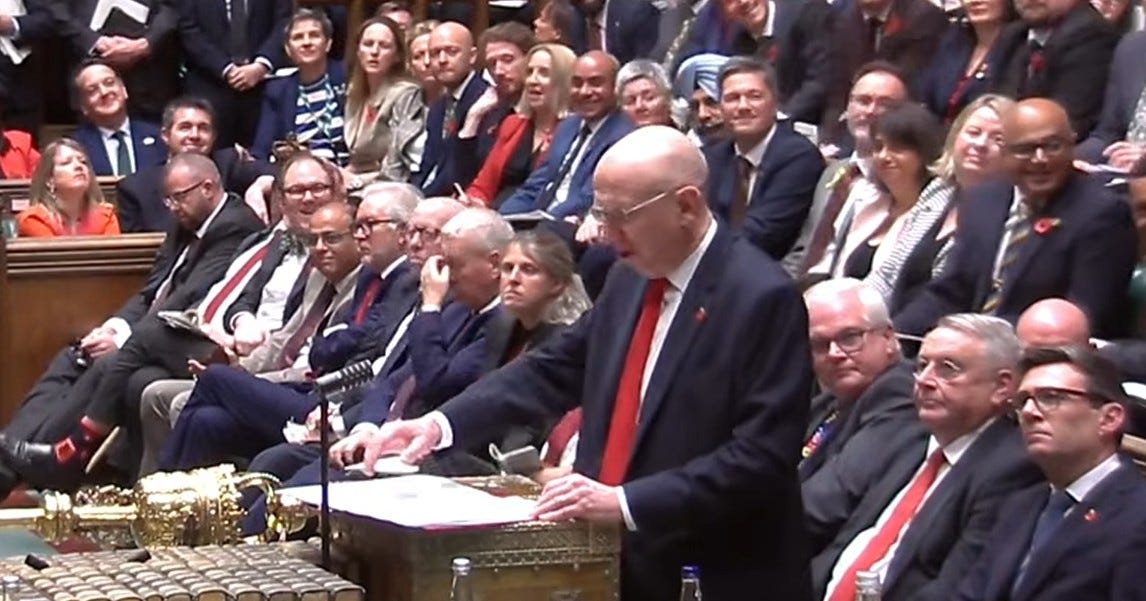
Desperate times call for desperate measures. Unless — perhaps — your name is John Healey.
Because today, at a moment of such clear need, we got a budget of half measures. Small packages of relief to blunt the worst of the pain. But that pain is still coming, and it’s going to hurt.
Energy bills are forecast to rise by around 27 per cent in January. The Trussell Trust reported last week that almost nine million people are now in severe hardship, and that without further action another 165,000 will join them by the last full year of this parliament. Two in five people referred to its food banks are already behind on their energy bills.
The wider economic picture is just as grim. The chancellor mentioned the conflict in the Middle East so many times during the Budget pre-amble that yours truly lost count. The Iran war has indeed sent energy prices soaring. Gilt yields are above 5 per cent and the cost of servicing our debt has jumped £14 billion this year. The OBR has cut next year’s growth forecast from 1.6 per cent to 1 per cent, and Healey’s headroom against the fiscal rules has fallen by almost £9 billion since March.
The political weather has shifted a long way since 2024, yet this government is binding itself to the manifesto it was elected on. Never break the fiscal rules, never raise income tax, National Insurance or VAT. When Andy Burnham entered No 10, he said Britain should not be “in hock to the bond markets”. His first budget held the bond markets’ hand from start to finish.
Let us give credit where it is due. Taking green levies off energy bills and paying for them through general taxation is the right call. Charging every household the same flat amount for the energy transition was always regressive, when young workers in draughty houseshares pay as much towards a wind farm as the millionaire pensioner down the road. Moving those costs onto the tax system, where the better-off contribute more, is fairer, and it means future price shocks will hurt just a little less.
Equally, the carer’s allowance taper finally ends the shameful cliff edge that pushed carers into debt. And handing mayors a share of income tax, the power to set overnight visitor levies and control of business rates is full frontal Burnhamism, if anything is.
But this budget may come to be remembered solely for its absences. The green levy switch came with no date. Gas standing charges go in 2027 “or as soon as possible after”, though the cost simply moves onto the unit price, predicted to save the average household about £45 a year. The families who use the most gas, including those in large households, poorly insulated homes and people who are ill and at home all day, could end up paying more. Against a 27 per cent rise in January, a £100 winter payment and an extended VAT cut won’t touch the sides.
Then there are the gaping holes. Welfare reform is parked until the Milburn and Timms reviews report, so millions face another year of uncertainty and demonisation as food and energy costs climb. The path to 3 per cent of GDP on defence has slipped to next year’s spending review. And Rosebank, the oilfield the energy secretary insists only she can decide on, is already accounted for in the numbers: the Treasury asked the OBR to count its tax receipts.
We are constantly told that Britain has no money. Our national debt sits at 95 per cent GDP, and servicing it costs more every year. Andy Burnham came in with big ideas and bigger warnings about a country that isn’t working, and there is of course a difference between borrowing to pay the bills and investing to change the country. Something, somewhere has to give. So why a status quo budget that kicks every hard decision down the road?
Privately, MPs worry that Burnham’s small fixes will only get them so far. Cheaper gherkins and plentiful Post Office drop boxes might show voters he gets the frustrations of everyday life. But ordinary families are about to get very cold and very hungry this winter, and they are acutely aware that their elderly parents and children face bleak prospects for their security and prosperity if things continue as is.
Part of the answer is caution. With an eight-point poll lead and nervous markets, a quiet budget is a rational choice, and Burnham’s “everyday fixes” are building trust. But placating the markets and getting the public to like him cannot be ends to themselves. They should be the building blocks for a larger, more urgent mission: to support a government that promised not just change, but ambition, radicalism and a rewiring of Britain.
The other answer may be timing. Some (many) in Westminster now suspect the big ideas are being saved for an early election, where a fresh mandate to rewrite the fiscal rules and raise taxes would buy room – and authority – to act. Burnham has already ruled one out, and with good reason. Labour would likely lose seats, further frustrate voters and waste weeks campaigning when too many problems need fixing now.
But if a new mandate is what he is waiting for, consider that he doesn’t need one. A government with a large majority and a healthy poll lead can simply point to all the reasons 2026 is not 2024, and push forward. Breaking manifesto pledges may once have been a cardinal political sin, but the rules of the game have changed. The populist right is on the march, big tech is out of control, our allies are increasingly unreliable, and our climate and economy are at best stalling and at worst failing. The stakes are too high to stay bound to Treasury orthodoxy and a manifesto written for a different world.
This was a budget that deferred rather than launched. There will never be a better moment than this one: a big majority, a poll lead and a public that knows the country isn’t working. No more rolling the pitch. Roll up your sleeves and get on with it. ■
About the author: Zoë Grünewald is Westminster Editor at The Lead and a freelance political journalist and broadcaster.
👫Agree with Zoë? Share this story with your friends, family and colleagues to help us reach more people with our independent journalism, always with a focus on people, policy and place.
We’ll be back in your inbox with a new edition of The Lead Untangles, going deep into what’s been promised to Mayors in The Budget. Subscribe now to get it first.
Excellently put Zoe. Absolutely spot on assessment.
I always expect better. They continue to displease.
No matter who gets in that job they are sh*t scared to do anything good. They are so inept they get sacked and booted out or forced to resign. No chancellor gets it, because they just can’t see it!they are so inept fir the job and yet we still keep putting up with second best.
Healey could have written the script we want! But oh no! Cheaper gherkins and no change!
It’s so disappointing. No wonder we are in this mess. If that’s the best we can expect!
Can’t they understand money and tax!?? Surely that’s the least we should expect!
Look, any monetary economy based on fair exchange of work effort for tokens to exchange with others for their work, means exactly that! Tokens have to be exchanged!
And considering all tax is triggered by SPENDING then you would deduce that money has to be used to exchanged and that exchange by SPENDING triggers taxes! That what we need more than anything is a constant flow of money do people have it to SPEND!
Yes you’d think that he must concentrate on money that is out there has to be SPENT to give us better and higher incomes that can be SPENT with others that trigger tax and onward flow of money to others to pay them for their work effort!
But oh no! He thinks Gherkins! I’m that upset I feel like crying! With laughter! At his unit stupidity.
The problem we always had and still do is a lack of cash or money flow! Because money is tight it means it’s not flowing! It means whoever’s got our money isn’t exchanging it! They are hanging onto it!
We’ve got to make it better to spend it than save it. I’m all for rainy day money but really! There are billions unspent each month. Money that we all rely on to receive as our incomes!
We rely on the SPENDING of others to receive our incomes. And if you think that government needs SPENDING to trigger tax revenue then. Isn’t it blindingly obvious they need to increase their SPENDING and make the system that they are in charge of endure unspent money now gets spent!
And pretty dam quick! Because the quicker we get on with it the quicker we’ll get out of this crap.
We need more SPENDING of more money that is lying unspent each month. Our system can’t afford to have all that money idle snd missing in action.
We need more spending because it not only pays the wages and incomes of others but triggers more taxes each time it does. So it’s time critical .
We need 4D answers to the 2D thinking if Chancellors. We have to do it faster. We need to all obey on with it, starting with those holding money or rather withholding it from our economy.
A very poor effort. Had he consulted Mr Burnham about the issues? Healey's deceitful jibe at the Scottish Government was childish and below the belt. We had already been told to expect help with our energy bills.