


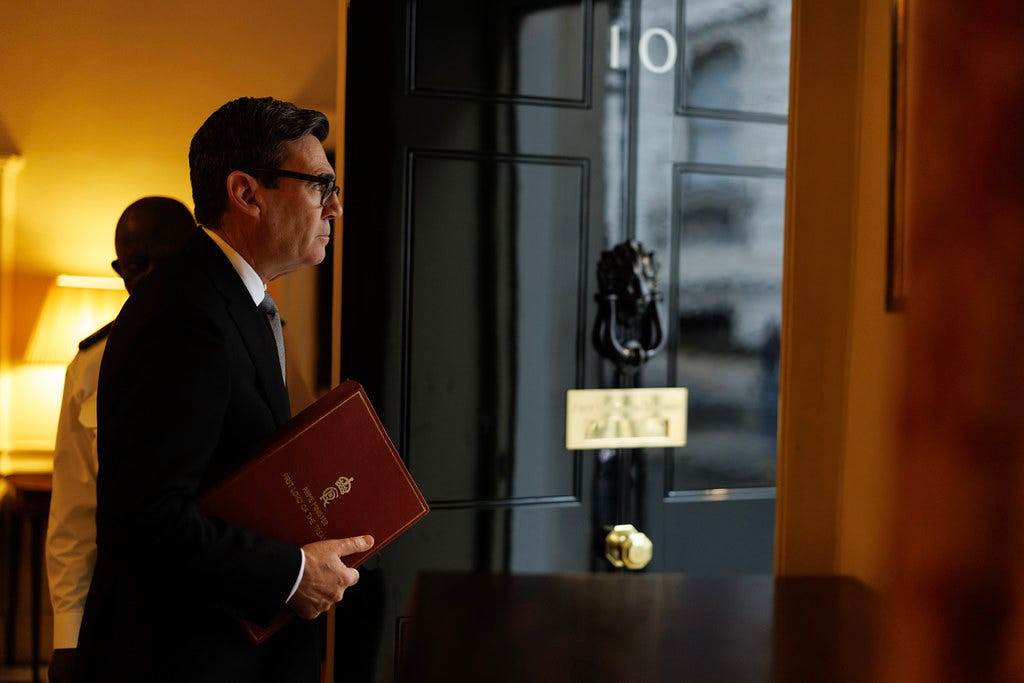
At the second annual EU-UK summit on 20 November leaders will assess any progress in the bilateral relationship and seek agreement on ways to make it closer.
Andy Burnham will meet the heads of the European Council and the European Commission in Brussels aiming for deals on measures including trade and immigration, as well as discussing the UK’s longer-term relationship with the EU.
The summit, postponed from July because of Keir Starmer’s resignation, is an opportunity for “every family and business to feel the benefits of a closer relationship with Europe”, according to his successor Andy Burnham.
How likely are concrete measures for the short term and how will EU heads respond to the question of a wholesale reset of the relationship, including the possibility of the UK rejoining?
Context
The first EU-UK summit was in London in May 2025, when the two parties established a post-Brexit Strategic Partnership, with the main agreement covering security and defence, and a “common understanding” to work together on fisheries, energy and climate, and youth mobility. Leaders committed to annual summits thereafter, but this year’s date was only confirmed last week.
In a statement to MPs – overshadowed by the debate over possible Russian interference in the Brexit referendum – Burnham said the summit could offer progress on boosting UK growth and controlling “illegal immigration”.
On the table are a trade deal on food and drink products, a deal on emissions trading and energy systems, a new youth experience scheme, and deeper co-operation on immigration.
“Together, these deals will add the equivalent of over £10 billion per year to the UK economy by 2040, with the potential to add significantly more,” Burnham claimed.
Burnham will meet Ursula von der Leyen, president of the European Commission, and Antonio Costa, president of the European Council, who said the EU and UK are “like-minded partners, united by common values and shared interests”.
Deal by deal
Food and drink: Leaders are aiming for a common sanitary and phytosanitary area that would remove the burden of the many certificates and controls concerning the movement both ways of animals, plants and their products.
Border document checks are estimated to cost the Scottish salmon business – the country’s largest food export – £100 million a year. UK farmers and food producers can pay £1,400 on a single shipment for the right paperwork. Export health certificates for small businesses can cost £200 each.
“This is having a real impact on businesses and the agreement on the table could reverse some of that damage,” said Burnham, adding that it will “ease the pressure on prices in the supermarket”.
Emissions trading and energy systems: The EU and UK are now “tying a ribbon” on an agreement to link their emissions trading systems, according to one EU diplomat, with the deal to be confirmed at the summit.
This will mean carbon-intensive businesses exporting to the EU will be exempt from its Carbon Border Adjustment Mechanism (CBAM) tax, which is designed to prevent “carbon leakage” from countries with weaker environmental laws. Similarly, EU companies in energy-intensive sectors such as cement and aluminium will be exempt from the UK’s CBAM tax, which comes into force next year.
Discussions are also taking place on linking UK and EU electricity and energy markets, and co-operating on clean energy technologies. Burnham claimed this could lower energy costs for households and businesses, including a 20 per cent cut for wholesale energy in Northern Ireland.
Youth experience scheme: There are no reported ribbons yet on a deal allowing 18 to 30 year olds from the UK to live, study and work in EU countries and vice versa. Since Brexit ended freedom of movement, visa restrictions have curtailed youth mobility but the UK has been cagey about a new scheme for fear of creating concerns about increased migration.
Since the first EU-UK summit, the UK government has signalled its intention for a deal modelled on its existing schemes with Australia and New Zealand that would cap the number of visas annually and limit the time period young people could stay here, perhaps to two years.
But individual EU member states have a role in implementing a youth mobility scheme, and some are reported to be sharply at odds with the European Commission over whether the deal should be linked to an agreement by London to reduce university fees paid by EU students in the UK, which can reach £38,000, compared with £10,000 for British students.
Immigration: As a result of Brexit, the UK lost access to Eurodac, which would allow it to check whether asylum seekers had previously applied elsewhere. It also lost access to the Schengen Information system, which shares information about individuals for national security, border control and law enforcement, and the European Arrest Warrant system, meaning requests for extradition have to go through lengthier legal proceedings.
Although the number of people arriving in the UK on small boats has dropped, Burnham places great importance on striking a deal and believes von der Leyen is open to restoring data sharing on immigration. “On immigration, we could link up our law enforcement efforts once again, sharing more data and criminal records of foreign nationals as well as faster electronic evidence from the phones of those behind the gangs,” he said.
On Monday [18 Oct] the home secretary Shabana Mahmood met the European Commission officials for further talks on “migration, border management, law enforcement cooperation and counter-terrorism”.
Made in Europe: The EU’s Industrial Accelerator Act aims to increase the share of manufacturing in EU GDP from 14.3 per cent in 2024 to 20 per cent by 2035. A key plank is the so-called Made in Europe policy, in which EU procurement contracts, subsidies and state aid depend on a minimum share of the goods being made in the EU. One aim is to protect the EU from Chinese competition but UK automotive, energy and chemicals companies fear they will also be frozen out of EU supply chains.
Burnham told MPs Made in Europe “presents risks to British manufacturing” but it is unclear whether the situation can be resolved at the summit. France and Germany have dropped their opposition to UK inclusion, but EU legislation for the Industrial Accelerator Act has not been completed and a deal may have to wait until it has.
“I am raising those concerns with European partners,” said Burnham. “It is important that we get to an arrangement that works for both the UK and the EU. After all, we are both trying to deal with the same issue: the damaging effect that Chinese exports are having on our industries.”
What people are saying
“A threadbare Brexit deal has damaged our economy. Britain can do so much better, so at this summit I want to take practical steps that pay off for the British public, cutting costs for our farmers, food producers and families.” - Andy Burnham, prime minister
“Here he is unpicking the deal this country signed with the EU a decade after the referendum. He is not going to get a better deal. The EU are tough negotiators, and it’s not just that the EU are tough negotiators, he has already revealed his entire negotiating hand.” - Kemi Badenoch, leader of the opposition
“We on these Liberal Democrat benches have consistently argued that their Brexit deal has made us all poorer, weaker and less safe, so I am glad that the prime minister has arrived at the same conclusion, but now it is time to do something about it.” - Ed Davey, Lib Dem leader
“If Andy Burnham, the King of the North, wants a fight in Doncaster and the ‘Red Wall’ with me on rejoining the EU, then bring it on, I say.” - Nigel Farage, Reform UK leader
What happens next
The breadth and depth of the deals to come from the summit will set the tone for what the European Council calls an “occasion to discuss the next steps in bilateral relations” and what Burnham says is “being open to a discussion about our relationship with the EU in the longer term”.
If that conversation takes place, it could mean joining the customs union or Single Market, or even rejoining the EU itself. Burnham insists any such talk is premature.
“Our immediate priority is securing a successful outcome at the summit, and I believe we should then set up a serious dialogue about the different options for our relationship in the long term,” he said. ■
About the author: Kevin Gopal is a Manchester-based journalist who has returned to freelancing after editing Big Issue North from 2007 until its closure in 2023. He writes regularly for The Lead to untangle the issues facing the UK and also reporting on social justice and other issues across the North of England as part of our award-winning The Lead Local titles.
About The Lead Untangles: In an era where misinformation is actively and deliberately used by elected politicians and where advocates and opposers of beliefs state their point of view as fact, sometimes the most useful tool reporters have is to help readers make sense of the world. If there is something you’d like us to untangle, email ed@thelead.uk and you can see every edition of The Lead Untangles so far.
👫Found this edition of The Lead Untangles useful? Share this story with your friends, family and colleagues to help us reach more people with our independent journalism, always with a focus on people, policy and place.
A new relationship with Europe is nothing new to readers of The Lead, recap our full series on The EU Referendum a Decade On. And see our political editor, Zoe Grunewald, took a deep look at Burnham’s comments about a new future with our European neighbours.
This weekend we’ll be back in your inbox with the latest in our Burnham’s Britain series, as Samir Jeraj considers the state of our prison system and what the UK can learn from elsewhere - particularly Europe. Make sure you’re signed up to receive it first