


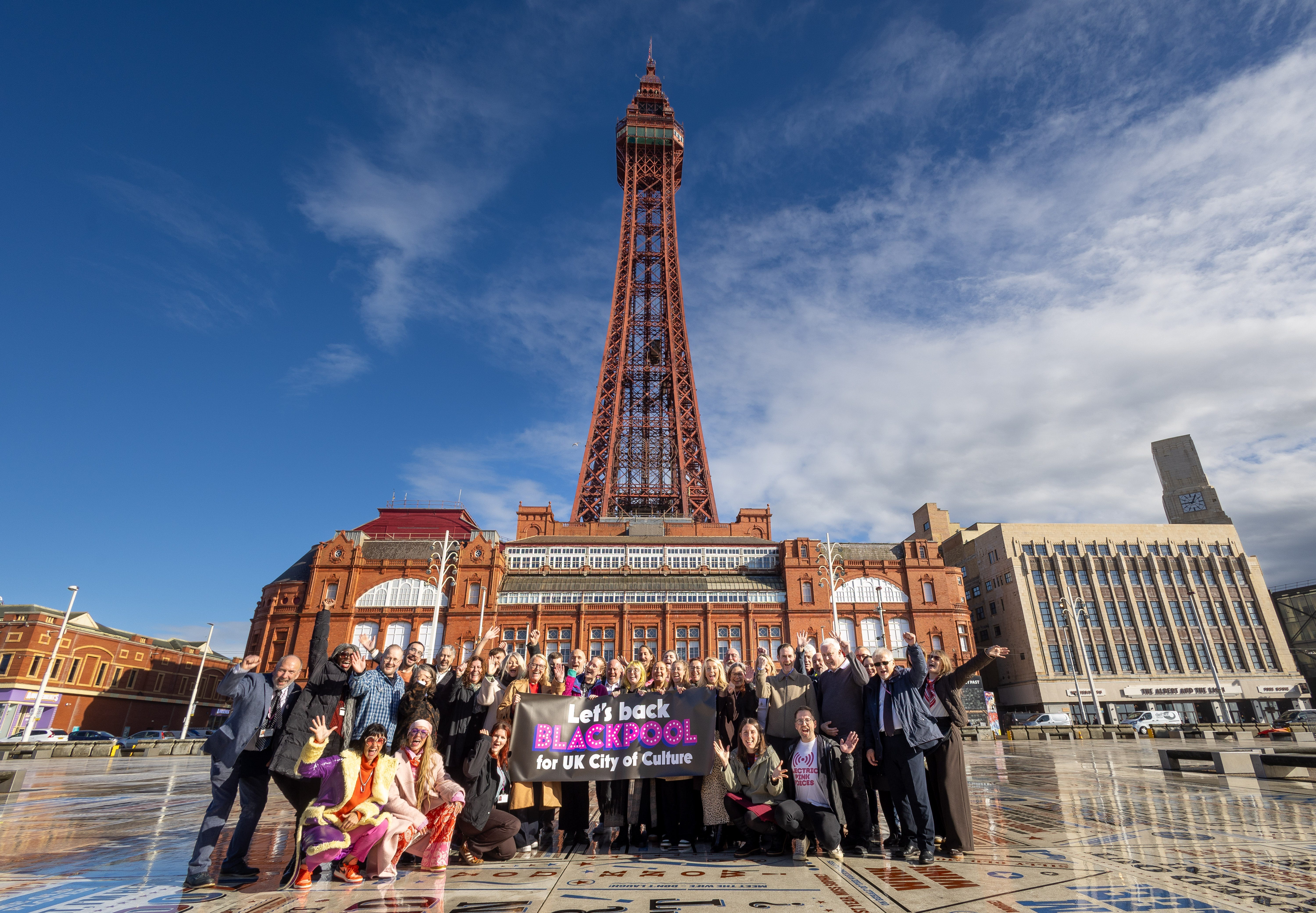
Blackpool, Milton Keynes, Sheffield and Wrexham are vying to be UK City of Culture 2029, with a £10 million prize, after nine applicants were whittled down to a shortlist last month.
The winner will get to put on a year-long programme of cultural events and activities that celebrate its strengths and stories, aiming to bring in investment, create jobs and increase tourism.
The other applicants, assessed by a Department for Digital, Culture, Media and Sport expert panel, were Inverness-Highland, Ipswich, Middlesbrough, Portsmouth and Swindon. The eagle-eyed will notice not all of them are cities.
This is the fifth UK City of Culture competition. Research shows that previous winners Derry-Londonderry, Hull, Coventry and Bradford enjoyed widespread participation in the programme and tourism and economic benefits during their year. But evidence of longer-term benefits is less clear.
Background
City of Culture owes its origins to one Andy Burnham, when he was culture secretary. Marking the end of Liverpool’s year as European Capital of Culture, which saw an extra £800 million spent in the city, he proposed a UK competition.
Burnham’s successor as culture secretary, Ben Bradshaw, announced the first competition, won by Derry-Londonderry for 2013. TV producer and screenwriter Phil Redmond, a leading figure in Liverpool’s European year, has chaired the UK City of Culture Panel since then.
Bidding costs cash-strapped local authorities money – although it can be a worthwhile process in itself for focusing cultural strategy making. This year DCMS gave a £60,000 grant for applications from the longlisted bidders, and the shortlisted four will get a further £125,000 each to develop their case.
But the big difference this year is that there is a prize fund of £10 million for the winner, “in acknowledgement of the programme’s impact”. Previously the winner had to put in piecemeal applications for government cultural and regeneration funding after being awarded the title, as well as private sector investment.
Ministers encouraged applications from larger towns such as Blackpool, as they had for Cornwall in 2025. Culture secretary Lisa Nandy has now also launched a UK Town of Culture award for 2028.
Redmond said there is a “hard choice ahead” to pick the UK City of Culture winner, with the result expected early next year.
“Each place represents a different view, or aspect, epitomising what culture is, the sum of all we do together, and while each approaches it differently, they all share the common aim of reminding the rest of the UK of who they are, where they are and why they are worth visiting,’ he said.
The bids
Blackpool
Blackpool’s bid has four elements. We’ll Show You builds on its showtown heritage and will include major performances and immersive spectacles, dance, music, broadcasting and “artist-led interventions”. The Welcome Inn is about Blackpool’s tradition of hospitality. Sea Change will connect culture with “care for people, communities and the environment”. It’s Like Blackpool Illuminations in Here! will use the 150th anniversary of the Illuminations to feature local and international artists.

Milton Keynes
Design is to feature highly in the bid from Milton Keynes, inspired by its grid-like new-town planning, modernist architecture and creative industries enjoying proximity to London. Plans include new creative apprenticeships for young people, support for emerging talent, and Culture Kids MK – offering every baby born in 2029 five years of free cultural access. If successful, Milton Keynes’ City of Culture year would coincide with the opening of a new £76 million, 4,000‑capacity venue.
Sheffield
Sheffield’s council says its creative scene goes from DIY grassroots to global. “Think synth pop, think indie, think Adolescence. However, we remain under-recognised and under-funded compared with other core cities.” Its programme to address this has three core ideas: make, belong and imagine. The first will celebrate what it makes in music, festivals and artistic commissions. The second will entail community-led programming across its 147 neighbourhoods and a Sanctuary Carnival, celebrating its status as the country’s first City of Sanctuary. The final idea is to use creativity to explore climate, nature and wellbeing.
Wrexham
Led by Wrexham Community & Culture Trust, the North Wales city says its ambition is “simple but bold: to make Wrexham the world’s most playful place”. It boasts that thousands of people have shaped its bid, after it was pipped to the post by Bradford in 2025, including residents, artists, schools, businesses, volunteers, community groups and more than 1,000 schoolchildren. One priority is to support Wrexham’s grassroots musicians, artists, designers and makers to “continue to live and work in the place they call home”.
Analysis
Last year Bradford put on more than 6,500 events, more than 80 per cent of them free. That resulted in capital investment for over 30 local cultural organisations. A fuller economic assessment for Bradford Council is due by the end of the year, but a report to the executive last month referred to the “extremely positive provisional evidence of reach, participation, quality, pride and connection” of its City of Culture tenure.
In Hull, tourist visits increased by 9.7 per cent when it held the title in 2017, compared with 2016. Jobs in the visitor economy grew by over 27 per cent between 2012 and 2017. In its creative industries sector, including the cultural industries, employment rose by 15.4 per cent from from 2015 to 2017. Between 2013 and 2019 an estimated £676 million worth of new public and private investment in Hull could “at least be partly attributed to the UK City of Culture”.
There is no reason 2029’s winner cannot achieve similarly impressive figures – but it’s not a given.
In 2013, Derry-Londonderry boosted visitor numbers, improved its image and saw better community relations, but its ambitious tourism targets were not met, because it was forced to scale back its cultural programme. The council had to increase its direct funding for the year because sponsorship, ticket sales and merchandising revenue fell short of expectations.
The trust set up to run Coventry’s year in 2021 has been liquidated after taking a loan from Coventry Council while possibly insolvent. Earlier this year the Charity Commission said the trustees’ failure to maintain effective oversight of the charity’s finances amounted to “misconduct and/or mismanagement”. The regulator acknowledged that the Covid-19 pandemic adversely affected Coventry’s year.
Cultural organisations prize legacy over almost anything, but it can be elusive. Researchers have found that City of Culture programmes can boost visitor economies over the short term but there is “no evidence to suggest these impacts are sustained in the mid to long-term” and that they should “not be seen as a quick fix for structural socio-economic problems within post-industrial cities”.
Hull University researchers said the city’s 2017 project “arguably did not give a sufficiently high priority to legacy and citywide cultural strategy considerations”.
What people are saying
“Great culture is everywhere, but the opportunity to showcase it, to put it on display and to show how it is woven into our national story is not… That is the beauty of the UK City of Culture competition.” - Culture secretary Lisa Nandy
“Despite the local MP being the Secretary of State’s parliamentary secretary, Ipswich still lost out to – Wrexham. Words desert me.” - Central Suffolk and North Ipswich Conservative MP Patrick Spencer expected better of his Ipswich counterpart Jack Abbott
“Some people are stating clearly they will not be part of a UK culture bid, so, as an elected representative, I need to be cognisant of that. Strabane, it’s not only a nationalist town, it’s a Republican town.” - Strabane independent councillor Paul Gallagher after the County Tyrone town was shortlisted for the UK’s first Town of Culture
What happens next
Flesh on the bones of a bid can only come when the winner is declared. But all four on the shortlist can expect a valuable boost to their profile anyway – even if some of it will inevitably be snobbish jokes questioning how [insert city name] can be equated with culture. ■
About the author: Kevin Gopal is a Manchester-based journalist who has returned to freelancing after editing Big Issue North from 2007 until its closure in 2023. He writes regularly for The Lead to untangle the issues facing the UK and also reporting on social justice and other issues across the North of England as part of our award-winning The Lead Local titles.
About The Lead Untangles: In an era where misinformation is actively and deliberately used by elected politicians and where advocates and opposers of beliefs state their point of view as fact, sometimes the most useful tool reporters have is to help readers make sense of the world. If there is something you’d like us to untangle, email ed@thelead.uk and you can see every edition of The Lead Untangles so far.
👫Found this edition of The Lead Untangles useful? Share this story with your friends, family and colleagues to help us reach more people with our independent journalism, always with a focus on people, policy and place.
We’ll be back in your inbox on Saturday with a dose of culture, mixed with scandal, the environment and politics. With a new film that features our award-winning reporting at The Teesside Lead too.