


A government review of PIP found the system “no longer fit for purpose” — what does that mean for the millions who rely on it every day?
After gathering evidence from disabled people across the country, the first report from a major review of the government’s Personal Independence Payment (PIP) scheme found the system was “no longer fit for purpose”.
Now the committee behind the Timms Review has set out its first ‘emerging recommendations’ for what could be a major overhaul of the benefit, which millions rely on to help shoulder the additional costs of life with a disability.
But while the proposals are provisional for now, a number of organisations are already concerned that changes could lead to some people being treated “less favourably” than others.
What is the Timms Review?
The Timms Review is the first comprehensive examination of the government's PIP assessment process since it was introduced in 2013.
The non-means-tested benefit is intended to help with the additional costs of disability and long-term health conditions, with eligibility assessed based on how a person’s condition affects them rather than only their diagnosis.
The review is co-chaired by Minister for Social Security and Disability Sir Stephen Timms, Sharon Brennan, and Dr Clenton Farquharson CBE, and is being guided by a steering group made up of disabled people, organisations, and people with expertise and experience of the system.
Why is PIP being reviewed?
Around 10 million people (24 per cent) of working-age people now report living with a disability, compared with under 17 per cent in 2013/14.
As of April 2026, around four million people were receiving PIP in England and Wales, with government spending increasing from £14.4 billion to £23.8 billion in real terms between 2020 and 2025.
The rise in the number of people claiming PIP was at the heart of a political row last year when Labour introduced the Universal Credit Act 2025, a set of reforms designed to reduce welfare spending, including proposed changes to the PIP eligibility process.
But backbench MPs blocked the plans, prompting the government to commission a review look more ‘fundamentally’ at PIP.
Other welfare reforms are going ahead, such as the reduction in the health benefit of Universal Credit, which The Lead revealed is likely to hit the over-50s hardest.

What’s wrong with the current system?
The assessment process itself has not changed in over a decade, despite significant shifts in how disability and health – particularly mental health and neurodivergence – are understood.
Following a call for evidence that collected over 38,000 responses from disabled people, carers, organisations, and others with experience of the system, the interim report found the process ‘fails to reflect real-life impacts’, particularly for those with multiple or fluctuating conditions.
PIP was widely valued, and ‘vital’ for many, but the assessment and decision-making process was described as ‘stressful’ and ‘dehumanising’, while others said it created barriers to ‘participating fully in work, social and community life’.
Alice Billin, head of policy and public affairs at the Cystic Fibrosis Trust, highlighted how current assessments reduce a complex condition that changes over time to “a snapshot of someone’s health”, describing the system as “stressful, inconsistent and deeply upsetting” and “damaging” for claimants’ physical and mental health.
What could actually change?
At the end of last week, the committee published its ‘emerging recommendations’ ahead of a series of ‘shaping workshops’ between 15 September and 7 October.
Initial proposals include reducing the number of reassessments for people with lifelong or degenerative conditions, introducing a fast-track process for new claimants with a terminal illness, and reviewing strict and ‘unnecessarily stressful’ rules that suspend PIP automatically when someone has spent more than 28 consecutive days in hospital.
People who struggle to articulate how their condition affects them could access advocacy, while the DWP would make better use of evidence from health and social care services, and a proposed ‘Tell Us Once’ system could avoid claimants having to repeatedly provide the same information.
Potential improvements to the way PIP assesses fluctuating conditions to better capture their impact over time have also been welcomed by charities.
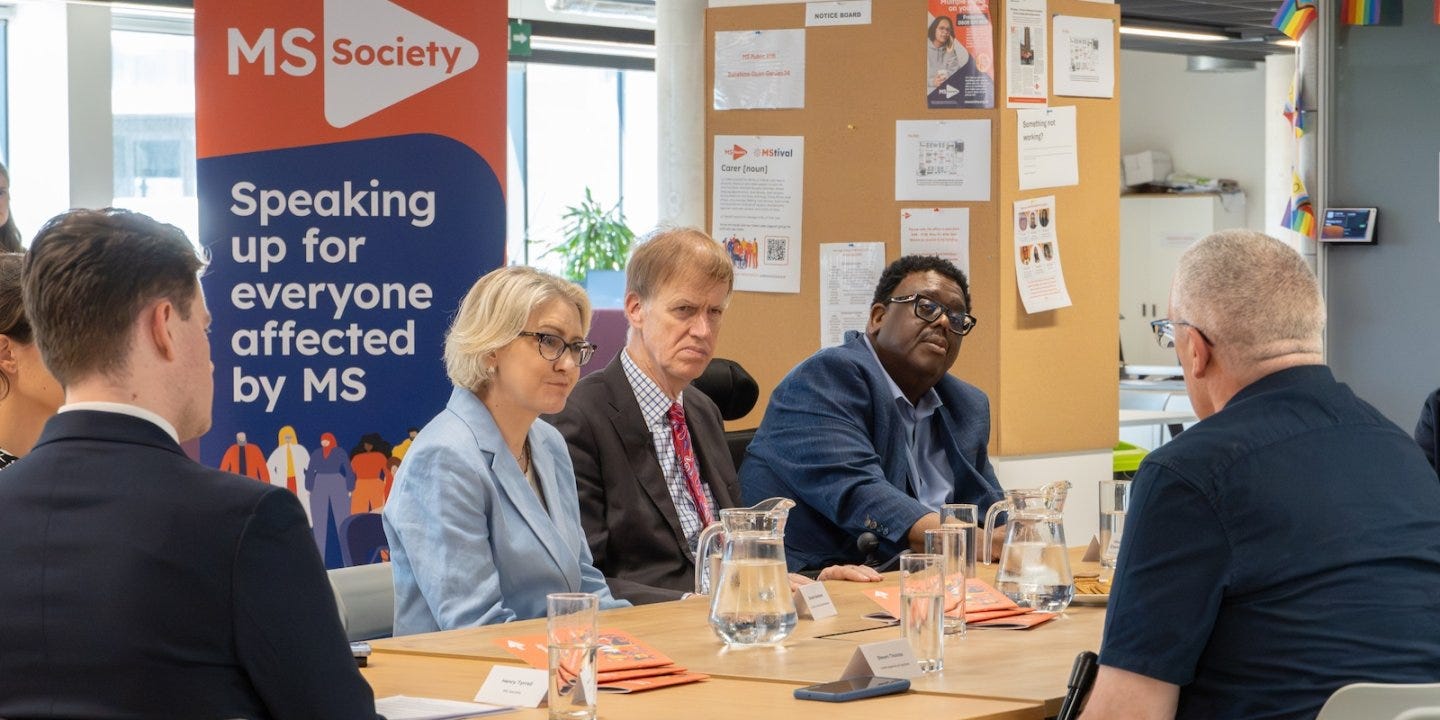
Ross Barrett, policy manager at the MS Society told The Lead that the recommendations acknowledge problems people with MS have been raising “for years”.
“We’re particularly glad to see emerging thinking on how fluctuating symptoms are assessed, reducing unnecessary reassessments, and making the process more supportive and person-centred,” he said.
Why are some disabled groups concerned?
While the review explicitly says PIP should remain non-means-tested and “cash will remain the foundation of the award”, the proposals suggest that some could receive “non-cash support,” such as services, equipment and aids, transport, clothing and bedding.
There is no detail at this stage about which claimants might receive non-cash support, or how this would work in practice, but Barrett warned that having the flexibility of cash was particularly important for those living with “unpredictable” and “fluctuating” conditions like MS.
“People with MS consistently tell us how important it is that PIP is a cash benefit, and is non means tested, to allow them the flexibility to use it in different ways to meet their extra costs,” he said.
The charity also raised concerns that the proposals could see people asked to estimate their own extra disability-related costs to help inform the level of PIP they receive.
“It can be hard for people, especially those with fluctuating conditions, to know what these will be from one week to the next,” Barrett added.
“It could mean more challenges for those already struggling to navigate a complex system.”
In a separate response, Disability Rights UK warned that the “vague and ambiguous language” used in the recommendations leaves room for speculation that some disabled people could be treated “less favourably than others”.
The organisation added that the proposed “light touch” initial assessment could create a “tick-box exercise” to divide impairment groups, who then follow different application pathways.
Does this mean PIP is being cut?
So far there is nothing to indicate that the level of PIP awarded will be reduced, and the recommendations confirm that it will remain non-means-tested. Neither is there anything to suggest it will be increased from the maximum of £187.45 per week, despite the “growing additional costs disabled people face”, noted Disability Rights UK.
The government is pursuing separate welfare reforms which aim to save £1.9 billion by the end of 2030/31, including changes to Universal Credit and health assessments, alongside operational changes to PIP. These measures are separate from the Timms Review, but any final recommendations must remain within the Office for Budget Responsibility’s projections for future PIP spending.
The Department for Work and Pensions forecasts that this will increase to over £41 billion by 2031 — a level of spending that many consider to be unsustainable.
But public opinion is not as divided as the political debate would suggest.
Findings from the National Centre for Social Research suggest that just under half of the British public thought the government should spend more on disability benefits even if it meant higher taxes, compared with just 7 per cent who wanted spending reduced. Those most likely to support cuts to disability benefits were Reform UK (7 per cent) and Conservative voters (11 per cent), but these were still in the minority.
What happens next?
The Timms Review is now sharing its recommendations, with disabled people and others with experience of the system, with almost 4,000 people registering to take part in workshops over the next few weeks.
The committee will consult with participants to understand whether the proposals are “fair, workable and capable of improving people’s experience of PIP”, as well as “supporting people to participate in everyday life”. The final recommendations are expected in November.
Barrett said any changes to the process should be built on “fairness, dignity and respect” and must “better reflect the reality of fluctuating symptoms, reduce unnecessary assessments, and improve how mobility is assessed”.
“The draft recommendations reflect a lot of the issues people with MS raise time and time again – and we’re pleased the Review has committed to work with disabled people to shape its final recommendations,” he added.
“It must continue to prioritise this co-production so that the final outcome of the review is a PIP system that is fit for purpose.” ■
About the author: Sarah Sinclair is a journalist specialising in health, drug policy and social affairs. She also writes regularly for The Teesside Lead where she’s reported on the local impact of PIP reforms.
About The Lead Untangles: In an era where misinformation is actively and deliberately used by elected politicians and where advocates and opposers of beliefs state their point of view as fact, sometimes the most useful tool reporters have is to help readers make sense of the world. If there is something you’d like us to untangle, email ed@thelead.uk and you can see every edition of The Lead Untangles so far.
👫Found this edition of The Lead Untangles useful? Share this story with your friends, family and colleagues to help us reach more people with our independent journalism, always with a focus on people, policy and place.
Our Burnham’s Britain series continues this weekend, as we look at the phrase reindustrialisation (featuring regularly in the government’s plans and what that means). Make sure you’re subscribed to receive the next instalment of Burnham’s Britain first to your inbox.

291909. I am too old to claim PIP but I do get AA as I have several health issues including being bi polar. My concern is for younger people with mental health diagnoses whose conditions change unpredictably and seriously. How is PIP going to be managed for people with fluctuating conditions?
On PIP and NEETs -
https://westenglandbylines.co.uk/news/education/welcome-to-the-youth-hunger-games-the-brutal-neet-race-for-shrinking-pickings/
" ... Who can blame them for seeking a PIP safety net that protects them from mercurial UC decisions, and provides certainty about their next meal, in a world where ‘if you work your socks off, you’ll gain security’ is a promise that simply never materialised?" Full article in link