


In his first address to the House of Commons as Prime Minister, Andy Burnham attempted to strike a hopeful tone, demonstrating the kind of positivity that has helped him surge past Reform in recent polling.
Many of his latest speeches have centred around broad calls for national renewal; he’s returned again and again to a diagnosis of ‘40 years of wrong turns’, and the fact that many communities around the country have never recovered from the process of deindustrialisation accelerated under Margaret Thatcher’s reign.
According to Burnham, the response should be “a more intentional approach to the reindustrialisation of Britain.” But what does this mean in practice?
From George Osborne’s ‘Northern Powerhouse’ to Keir Starmer’s pledge to invest £28bn in green industries (a commitment he later U-turned on), British prime ministers have repeatedly talked about returning to the UK to its industrial heyday. None of them have succeeded.
So is reindustrialisation actually possible for the UK, and if so, what is the most likely path?
How deindustrialised is Britain?
At the height of its Empire, Britain was labelled “the workshop of the world”, a nation which made huge profits from cheaply importing raw ingredients from global colonies and turning them into finished products for export.
The post-Second World War breakup of empire kickstarted the UK’s rapid industrial decline, which was accelerated when Margaret Thatcher came to power and pursued a ruthless shift towards a services-based economy: unions weakened, coal mines shut, the country’s manufacturing base massively reduced.
The UK’s manufacturing sector was responsible for nearly 30 per cent of national income in 1979, employing 6.8 million people; by 2010, this was down to 11 per cent and a workforce of 2.5 million. This represents one of the most seismic declines in manufacturing capacity any modern developed nation has experienced.
Today, over 80 per cent of GDP comes from service-based jobs like finance, legal services, IT, and arts and culture (an often overlooked sector — the UK is the world’s 2nd-biggest music exporter and creative industries contribute £145bn to the economy). Much of our industry may have gone; but we have replaced it with some extremely valuable alternatives.
What would reindustrialisation mean?
Burnham’s team — with its emphasis on devolution — appears to be aiming to move away from a top-down approach to reindustrialisation, instead leaving different regions to identify how to boost their productive capacity and work with Number 10 North to build their own industrial economies.
In practice, this means the Oxford-Cambridge corridor continuing to specialise in artificial intelligence, life sciences and biotech. It could mean ramping up the aerospace and advanced robotics industries in Sheffield and South Yorkshire.
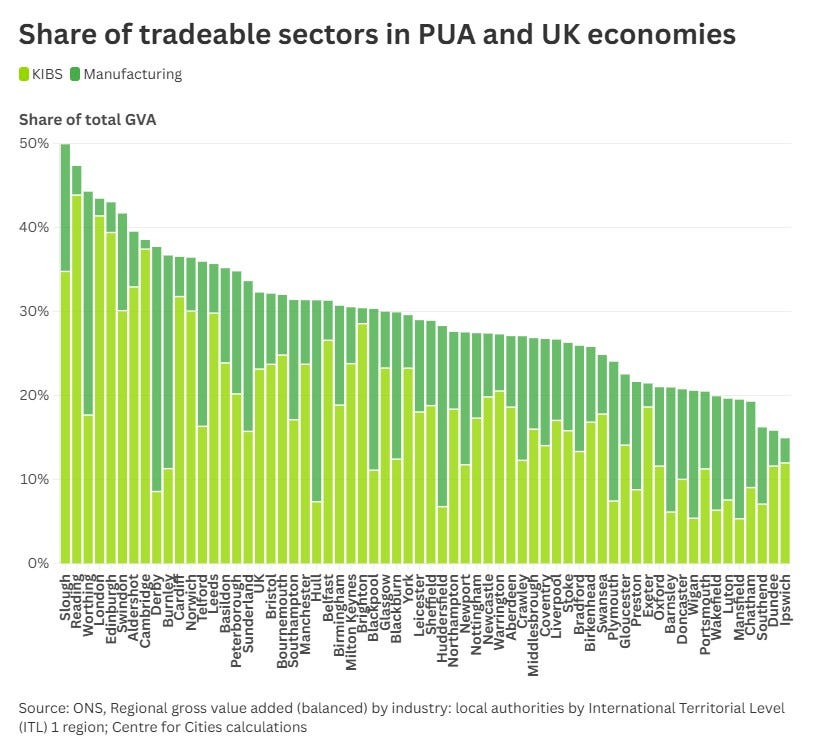
The Centre for Cities think-tank says it takes reindustrialisation to be a joint focus on both manufacturing and knowledge businesses. It says the focus in Greater Manchester was on ‘tradable sectors’ such as knowledge-intensive services and manufacturing. It has ranked major towns and cities in the UK based on how they perform for these two types of businesses with Slough coming out on top and it shows for most there is a long way to go.
For the West Midlands, it could mean an increase in electric vehicle production, and up and down the North Sea, continued investment in offshore wind.
As the last two points demonstrate, reindustrialisation in the UK would likely be centred around green technology. Certainly, many of the biggest advocates of a renewed industrial base use this argument readily. But one of the key issues with this is that green industries don’t necessarily create an abundance of jobs.
Things like retrofitting houses and heat pump installation provide lots of work for plumbers, electricians and builders, but once you’ve got an offshore wind farm running, it doesn’t take many workers to look after it. By the same token, solar farms require lots of workers for installation and construction, but offer very few permanent jobs.
A far more concerning area of the UK economy that some reindustrialisation advocates promote — which could create more lasting jobs — is military production. The government’s 2025 Defence Industrial Strategy marked defence as an “engine for growth” and argued that a “move to warfighting readiness” could reinvigorate the UK’s industrial base.
In reality, this means attempting to revive Britain’s economy by investing in drones, missiles, ammunition, AI, and robotics designed to wreak havoc and destruction on war-torn countries across the world.
The UK is already the world’s eighth-largest major arms exporter; in addition to supplying Israel with significant military components, we sell large amounts of arms to countries like Saudi Arabia, and in Gaza and Yemen respectively, the human cost of these sales has been horrific.
Besides the damage a military-led reindustrialisation would inflict abroad, it’s worth noting that channelling funds this way would also mean billions of pounds that isn’t spent on housing, high-speed rail, and green energy at home.
What people are saying
“Number 10 North will oversee the rewiring of the British state, the rebuilding of resilience in our communities and the re-industrialisation of our regions... a more intentional approach to the reindustrialisation of Britain is required” — Andy Burnham, Prime Minister
“Our economic and national security relies on us not being agnostic about where we make stuff. That doesn’t mean splendid isolation. It means taking the Prime Minister at his word and working with him to reindustrialise Britain.” — Paul Nowak, TUC general
“This is not about a return to the 1970s or feather-bedding failing enterprises. Rather, it is a recognition that there can be no genuine and sustained prosperity without a strong manufacturing base.” — Larry Elliott, author and journalist
“Our politicians may not like it, but the truth is the country they seek to govern is a broad-based services economy. The fact is almost never celebrated, but the UK is the second largest exporter of services in the world. Reindustrialisation is not the route out of stagnation.” — Torsten Bell, economist and Labour MP
“New manufacturing ventures in countries like the UK tend to be capital intensive without creating many jobs. The nostalgia for manufacturing jobs is understandable but unimaginative. We can’t reverse history, but we can learn from it.” — Sarah O’Connor, Financial Times journalist
“British industry has the talent, discipline and ambition to compete. What it does not have is a Government on its side… [the] net zero agenda is making energy more expensive, pushing jobs abroad and accelerating Britain’s deindustrialisation.” — Kemi Badenoch, Leader of the Opposition
What happens next?
According to policy platform The Burnham Programme, the government’s reindustrialisation programme is about “productive capacity: advanced materials, low carbon energy, life sciences, digital systems, creative production, construction, transport engineering and the supply chains around them.”
This suggests an understanding that the UK’s manufacturing heyday is over, coupled with a desire to double down on the areas of industry that the UK already has levels of expertise in. But often, the impact this reindustrialisation could have in terms of job creation is overstated.
Regardless of what Burnham’s government does in office, industry will remain a relatively small part of the UK economy compared to services. Once an economy specialises in something, it’s very hard to change that basic structure — instead, the UK should arguably focus on further boosting its services sector, with more investment in the creative industries, for example.
This is hopefully an indication that the UK wouldn’t seek to boost its industrial capacity by focusing on the military; however, it’s still unclear exactly what reindustrialisation means for this government. ■
About the author: Fred Garratt-Stanley is a freelance journalist who writes about culture, politics, football, and pubs.
About The Lead Untangles: In an era where misinformation is actively and deliberately used by elected politicians and where advocates and opposers of beliefs state their point of view as fact, sometimes the most useful tool reporters have is to help readers make sense of the world. If there is something you’d like us to untangle, email ed@thelead.uk and you can see every edition of The Lead Untangles so far.
👫Found this edition of The Lead Untangles useful? Share this story with your friends, family and colleagues to help us reach more people with our independent journalism, always with a focus on people, policy and place.
If you’re enjoying our Burnham’s Britain series, as we unpick the difficult decisions he will need to make as Prime Minister and more become a subscriber to support us to tell more stories from beyond the Westminster bubble.