

When politics feels broken, think smaller: the case for community action
There couldn't be a worse time to drop out of politics — here are the people choosing to zoom in instead


All over Britain, people are losing faith in big picture politics. It’s understandable: from the economy to climate, news and politics are dominated by stories and problems that feel out of our control, while trust in the government has fallen to a record low, with almost three-quarters of Britons believing that the government does not have things under control. It’s no wonder, then, that “people feel like they are lacking agency,” as Ed Hodgson, deputy director of research at More in Common, tells The Lead. But there are ways to feel empowered.
Instead, what if we tried zooming in, and focusing on smaller, local or community-based issues where real change is not just possible but already taking place? “Realistically, it’s very hard for an individual to influence the situation in Gaza, for example, or to get more funding to the NHS,” but Hodgson, who has conducted extensive research on the tide of disillusionment in the UK. “But attaching yourself to a rooted, local cause, which can be winnable, will be a lot healthier.”
It’s a bottom-up approach to structural problems, starting with the people, places and things that are already being impacted by issues such as the housing crisis, climate change or a lack of government funding. It could look like anything from joining a community gardening project to volunteering with a local charity.
The Lead spoke to three people who have found hope in local initiatives, showing just how many vehicles there are to create real change – from starting a union to empowering their communities.
Building resilience through community
When Benjamin Mitchell, 24, lost faith in national politics and climate activism, he shifted his focus towards hyper-local and community-based action in Brighton, where he lives. “I’m getting significantly more satisfaction and feeling of change-making, as well being able to genuinely benefit myself and those around me from local organising,” he tells The Lead.
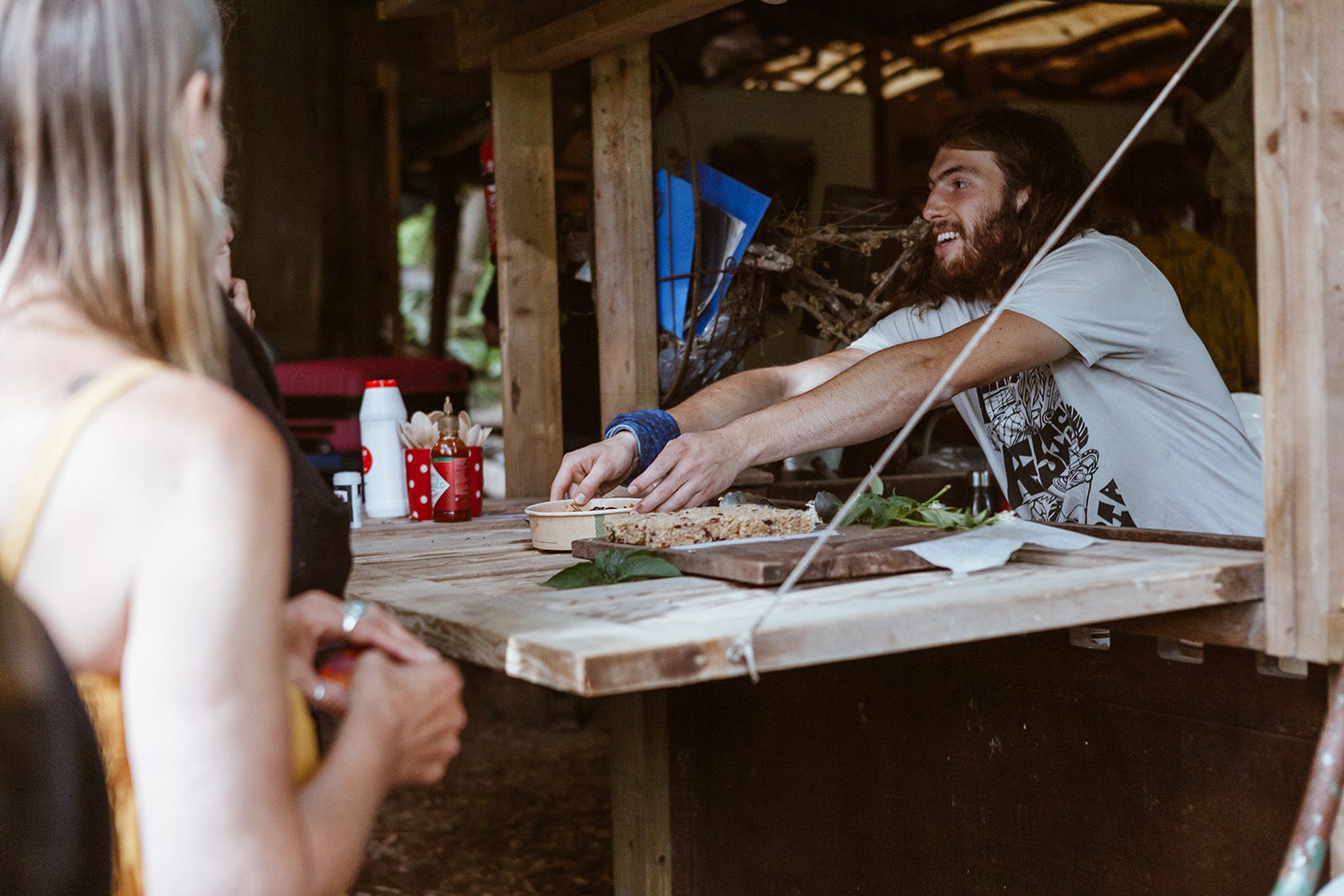
“I started to run local projects with the idea that we are building resilience, empowerment and community locally,” he says. His main focus is as an events organiser for Future Roots, a community space in the woods in Stanmer Park, which holds eight annual festivals for people to “give gratitude and reverence to nature”. Made up of a core group of four directors – Raffa, the main visionary of the project, Moses, a gardener and caretaker and Steve and Elaine who help to run workshops among other things – as well as a community of around 30 volunteers. Future Roots also offers an “introduction to community land ceremony” – a ritual to honour, bless, or acknowledge the land and its original inhabitants –as well as regular workshops on different aspects of political organising and resistance and woodwork skills such as fire building.
He also runs his own organisation, Culture of Care, which stands for community action, resilience and empowerment, where he puts on events for people in the local area to attend. “The main format it has taken in the last couple of years has been events and gatherings, because that’s my skill set and how I can get the most people together at once to talk about these different aspects,” he says. “We also support community groups and charities to put on events to fundraise or to raise awareness, or to bring the community together.”
On top of that, Ben dips his toe into anything that comes up, from helping to regenerate a patch of chalk grassland to helping with woodland management projects around Sussex. “I wear lots of different hats,” he says. He sees community work and activism are the key to building structures that can “catch people before that moment of crisis,” where they may drift toward fascism and extremism.
Volunteering to make a real impact
Kat Viva, 26, works in local government, but in her spare time she volunteers with multiple charities that are “addressing problems caused by politics or where government aid isn’t reaching.” Mainly, she volunteers as a senior fundraising manager at Make More, a charity that works with disadvantaged communities in the Black Country, and a communications manager at Housing for Women, a Brixton-based housing association and charity. She also volunteers at a British Heart Foundation Books and Music charity shop.

One of the most fruitful aspects of volunteering for Kat is meeting a diverse range of people, which she says offsets a lot of hopelessness: “You meet very kind people, very interesting people, and you have a lot of normal conversations.” She also once met a lawyer who offered to work for free for someone who was appealing to get their citizenship. “She works every day pro bono after work, which is insane that she has to do that, but it restored my faith that there are good people.”
This aspect of local activism is sometimes taken for granted, but can be instrumental in addressing division and disillusionment. As Hodgson notes, meeting people who care and share your concern (even if they might differ in other views) can help to create a sense of togetherness that bridges echo chambers. This could reenergise people for politics in general: “The more connected you are to people around you,” says Hodgson, “the more likely you are to get into politics to improve their lives as well as yours.”
For Kat, the best thing about working with charities is seeing the people-first approach to dealing with wider problems. “Having worked for the central government and local government, I can see that what they do isn’t enough,” says Kat. “There are guidelines and regulations, and the approach tends to be ‘we probably can’t help in this situation’.” Meanwhile, she adds, charities tend to take the approach of helping actual individuals.
“I think in my nature as a young leftie, disillusionment is maybe part of that package,” she says. “But what I found more useful than studying or working in politics is working with charities where you can actually see the impact – even if it’s just that one person you help or that one person you connect to someone else, you’ve actually changed their life.”
Unionising at work
Hannah Taylor, 28, from Middlesborough has been a member of the Labour Party for a decade, but she recently started to feel like national politics was “too big-picture” to make a difference as an individual. “I obviously believe that who runs the government is really important, and I would still push for good people to become candidates,” she tells The Lead, “but as one individual, unless you are already established in quite a big way to be one of, realistically, very few people in a government or in a political party who can make big changes, it’s really tough.”
Although Hannah never cancelled her party membership, she says, reading the news, scrolling social media and “stressing about things when you can’t affect it very much,” felt heavy. So she shifted away from party politics and towards something more “tangible”: the union movement.
While working at a charity in Edinburgh after university, she rallied her colleagues to strive for union recognition. “There had never been a recognised union at the charity, so we obviously couldn’t bargain for pay and conditions,” she says. “We didn’t have a say in what we got paid, or what happened to the lowest paid workers, or how good our maternity policy was, and it was easy to talk to people, despite not knowing their wider views on things, and get them motivated.”
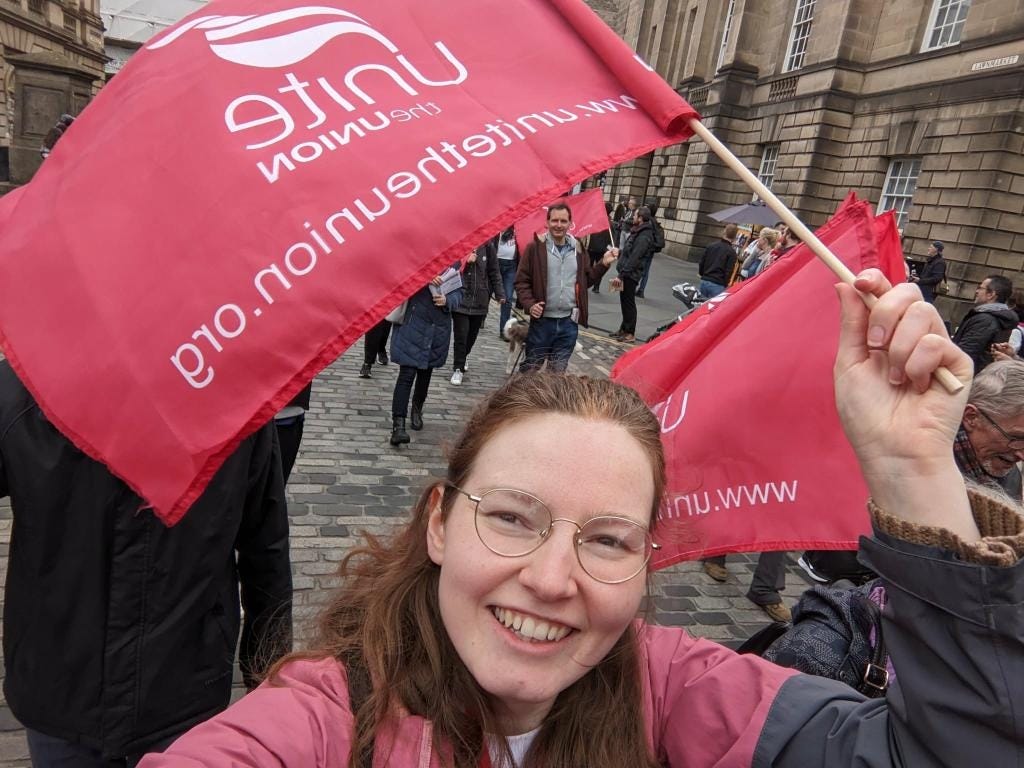
Hannah and a small group of her colleagues worked behind the scenes for months. “It was entirely voluntary, off our own backs, people were working lots and lots of hours on it, and just because we thought it was the right thing to do, the right goal to have,” she says. With support from the union Unite, they surveyed their colleagues to find out what they wanted and how they could serve them. “At times it was really exhausting, going through the process,” recalls Hannah. “You get a lot of pushback and resistance from management and even other colleagues.” Eventually, though, they finally voted for union recognition,
“I remember being on a call with a lot of senior people on the team and seeing the result get read out for the first time, and it was just a massive win,” says Hannah. “It felt like a step change – things had been a certain way, the balance of power was a certain way, and then we’d permanently changed it. It was really exciting.”
Eventually, they negotiated to remove the bottom couple of pay bands, meaning people would never be paid that low again. “That was a permanent change and it really made a difference,” says Hannah. Compared with party politics, she says, this “feels so much more real, and you can see how it helps people on an individual level.”
Her experience taught her that it is extremely important to think about what is in your control and what you can do to contribute. “Whatever that is, whether it’s volunteering, if it’s doing something in the union movement, if it’s giving money,” she says. “You can still do your bit and make concrete changes.”
If nothing else, getting involved with a cause closer to home allows us to connect with those around us while striving to make things better for everyone. As Hodgson notes. Connection alone can have a profound effect on the cycle of disillusionment. “These things are two sides of the same coin,” he says. “If you're less connected to people around you, you're less likely to want to get into politics to improve lives for them, and if you're less interested in politics, you're less likely to want to bother with the people around you.” ■
About the author: Ella is a freelance journalist specialising in worker's rights, housing, health, harm reduction and lifestyle. You can find her work in Prospect Magazine, Dazed, Observer Magazine, Women’s Health and - most importantly - here at The Lead.
The Hope Reset is our January series that aims to help you start the year on an optimistic note. Ditch the doom-scrolling and tap into something hopeful instead. Cutting through the apathy of our times starts with you. Thank you for reading.
👫Enjoyed this article? Share it with your friends, family and colleagues to help us reach more people with our independent journalism, always with a focus on people, policy and place.
And, subscribe to The Lead in January and get a huge 26% off annual membership, which means it’s just £36.26 instead of £49 for the whole year.
Hello, I'm 80 years old, and have always found volunteering to be very empowering. You're correct in saying the political landscape is too big for individuals. Think small and local!!