


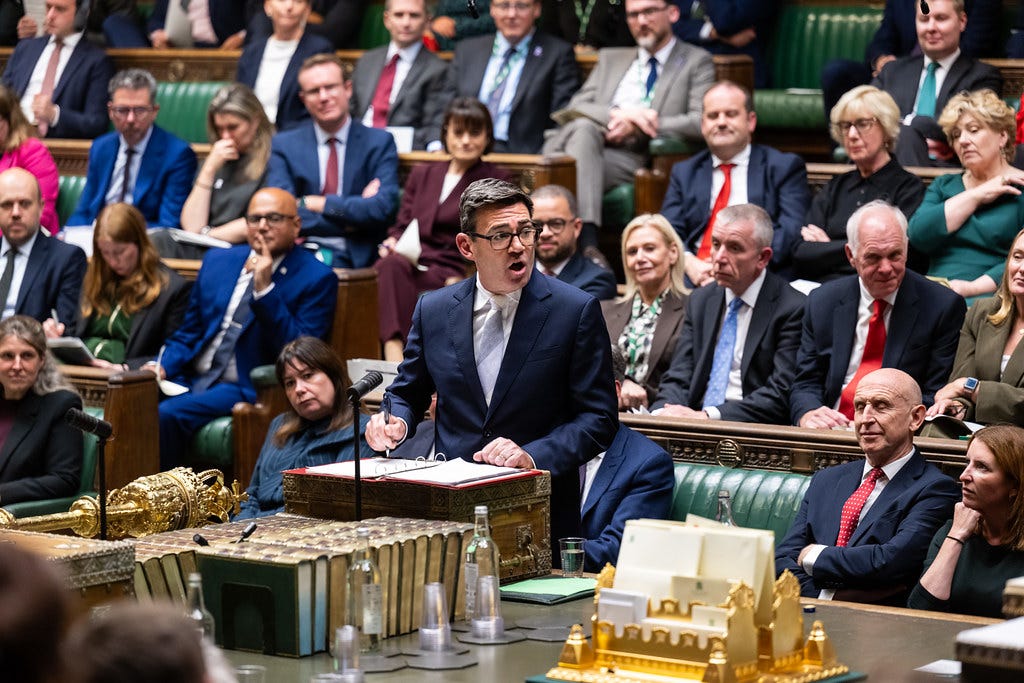
Westminster returned from conference season yesterday to find the prime minister rummaging around in the attic. Andy Burnham had dug out a box that has gathered dust in the corner of British politics for the best part of a decade, and he did what no prime minister since 2016 has dared to do. He opened it. The label on the side read “Brexit”.
Burnham told his MPs that the status quo was “not good enough for Britain” and that turning away from a closer relationship with Europe would be “a major dereliction of duty.” Next month’s Brussels summit would be the start of a “serious dialogue” about the long term. This is the latest in a series of pro-EU noises made by our Prime Minister. It’s now clear: “Breturn” is no longer unthinkable.
Many of us let out a breath we’d been holding for a decade. Successive governments have spent years tiptoe-ing around red lines on Europe, ignoring the red ink on the nation’s balance sheet. But the road once travelled may not be as gentle as it once was, and it’s worth being honest about how hard this will be.
The first problem is that it means having the whole argument again. Brexit didn’t just change our trading arrangements, but tore through many families, towns and friendships. As I’ve written before, it rewired our politics: destroying and creating political parties, seeding a new electoral battleground in the Red Wall that has dominated every campaign since, and handing the populist an endless well of grievance. Now we are supercharged by algorithms, a thriving right-wing media eco-system and mass disillusionment. Is there really public appetite to go through all of that again — but this time on steroids?
The second is that nobody yet knows what closer alignment actually means (possibly including the prime minister himself). Are we talking about re-joining in its entirety, the single market, or a customs union? Or more a string of dull treaties on food standards, emissions trading and youth mobility? These are very different propositions. And while recent polling from British Future showed that while a majority (57 per cent) of Brits admit Brexit as a failure, less than half (46 per cent) would vote to re-join, and even less (34 per cent) want a referendum as soon as possible. Mention free movement as the price of membership, and support dwindles further. Sentiment is nuanced and caveated.
Third, Brussels has little reason to be generous. Britain had a pretty good deal before it left: a budget rebate, opt-outs from the euro and Schengen. A returning member is very unlikely to get those terms. Having spent years being stonewalled by successive prime ministers, the chances of the EU rolling out the red carpet are slim.
Fourth, if re-joining is the destination, there will almost certainly have to be another referendum. And that creates a trap. If you cast doubt on the legitimacy of the first vote, how do you then argue that a second one, held on the same terms, is any more legitimate? This is why Burnham’s weekend comments about Russian interference caused uproar. Moscow clearly tried to meddle in our democracy, but opening up the Brexit debate can’t rest on the claim that 17.4 million people were duped. That way lies disaster.
None of that is a reason not to do it. The damage Brexit has done to trade, investment, growth and our standing in the world is now too great to keep pretending otherwise.
So the question isn’t whether Burnham should make this case, but how. We may have already guessed that the Kremlin was rather pleased with the outcome of the referendum, and we may still be righteously furious about the £350m weekly promise to the NHS, or the fake proclamations of “taking back control”. But the argument that the 2016 vote was illegitimate will not wash with voters who already feel that Westminster looks down on them.
Instead, the case for re-join must be made on how the world has changed. In 2016, the United States was a dependable ally. Now, Trump’s approach to Russia and Ukraine shows that Europe can no longer assume moral alignment, let alone protection. Russian aggression has escalated dramatically, and we are being hit by shock after shock: pandemic, energy crisis, trade wars.
We also now have a much clearer understanding of how much damage fourteen years of Tory austerity and underinvestment did to the economy, from energy to infrastructure, and the small businesses being squeezed even harder by red tape at the border.
So this has to be an argument about security, the economy and our values — not a rematch of the referendum. Immigration will be the hardest sell, and it can’t be ducked. The honest picture is more complicated than “small boats went up because of Brexit.” But the facts remain that Britain’s exit from the EU left us outside the very arrangements Europe uses to share intelligence on smuggling gangs and return people across borders, and those arrangements have moved on since we left. Equally, mass migration – driven by conflict and soon by climate breakdown – is a continental problem. Global problems need shared solutions.
Winning the argument will depend not on proving 2016 was a mistake, but convincing the country that 2026 demands something different. That means a patient, honest case about what Britain needs to be safe and prosperous in a far more dangerous world, and a narrative that persuades the country to look to a brighter future, not the gloomier past. ■
About the author: Zoë Grünewald is Westminster Editor at The Lead and a freelance political journalist and broadcaster.
👫Agree with Zoë? Share this story with your friends, family and colleagues to help us reach more people with our independent journalism, always with a focus on people, policy and place.
Maybe there’s more reading of The Lead in the corridors of Northern and Southern power than we thought - given our big focus in the summer on a decade on since Brexit and outlining the impact it’s had. See our full series on The EU Referendum a Decade On. And become a supporter of The Lead to help us go deeper on the stories affecting the UK right now.
We were lied to by Farage, Johnson et al, about everything negative associated with being an EU member state. They by rights of their lies, have not been held accountable for the damage they did. But it has exposed the corruption behind the motivation to spread those lies.
They wanted division, to sow the seeds of white nationalism that Farage has espoused continually, stoking racist xenophobia and hatred of different, the Trump method of lying.
Farage and his lies must be undone, becoming an EU member state once again has to happen for the UK to prosper, share strategic data with allied partners, re-enter key EU programmes and undo what was done that has limited growth capacity.
All politicians must be held accountable for their lies, any politician who lies must not be allowed to get away with it like Farage and Johnson have. If they lie, and it's uncovered, they are barred from positions of power.
Why is Brexit right for the money men in the UK - supported by establishment figures like Boris / Farage / Tory ERG group !
All this nonsense about UK laws / migrants !
Reality it was about money / financial business in the secret inner mile in London with their own Major & Police Force & how to keep our 13 tax havens havens ! Europe was coming after the big tax avoiders !