


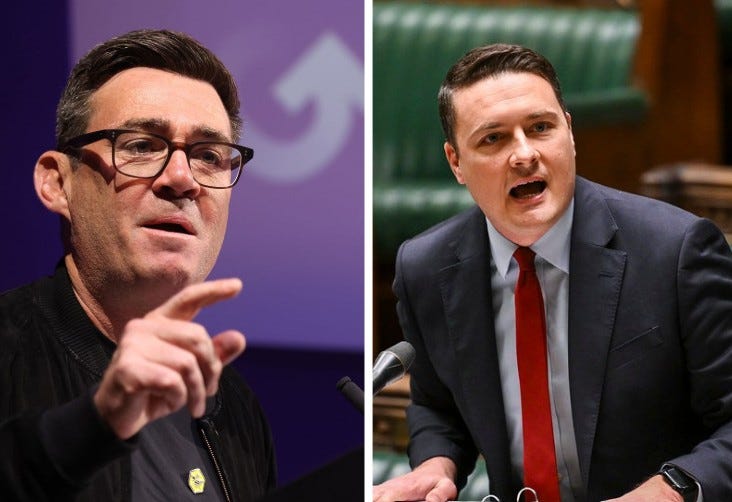
Wes Streeting soft launched his Labour leadership bid this week with a statement on Brexit that shows to voters what many inside Westminster already knew: he doesn’t really care what you think about him, as long as he believes he is right.
His comment was a statement of fact, though he knew it would be attacked as a dangerous matter of opinion. What he said was this: a Labour government must move Britain back towards EU membership.
Critics within the party emerged immediately. Red wall MP Lisa Nandy said Streeting’s position on Europe was “a bit odd” and represented a “fundamental misreading” of public attitudes after their party received a drubbing at this month’s local elections. “If going back into the EU was the answer to the problems that people have in their lives, then we would be telling people in towns like mine that everything was fine in 2015,” she said.
Compared to today, things were relatively better in her constituency town of Wigan in 2015. Back then the town’s employment rate was almost 80 per cent according to the Office for National Statistics; by the end of 2023 it was at 70 per cent. Economic inactivity in the town is rising, even though benefit claims aren’t. Its economy is stagnating.
Meanwhile, Andy Burnham - the so-called ‘king of the north’ - also says he “doesn’t want to re-run” the arguments over Brexit. For years he was an outright remainer, yet now he says he “respects Brexit”.
What is there to respect? We all know it has been an unmitigated economic and diplomatic disaster. Conservative estimates place the economy at around 8 per cent smaller than it would have been if we’d remained in the union. Even the people who voted for Brexit with hope and enthusiasm no longer believe that it has represented progress.
According to a 2023 MRP poll by Focal Data/UnHerd, in the constituency that Burnham is chasing on his path to party leadership, Greater Manchester’s Makerfield, 51 per cent of voters now agree that “Britain was wrong to leave the EU”, compared to 31 per cent who disagree.
Wes Streeting is right. It is impossible to have a serious conversation both about the future of the Labour Party and, more importantly for voters, the future of the British economy without confronting the tragedy of Brexit. He is setting out a dividing line with his opponents in his willingness to be honest about the gravity of the country’s problems.
What is frustrating the electorate more than anything is a dual sense that nothing is changing for the better (the cost of living, for example, means their daily lives are tangibly more miserable by the day) and that they are still being told things slowly on the up. Starmer tried to level with voters about the complexity of the omni-crisis in the first weeks of his premiership and was accused of doom mongering. In some ways that communications misstep was the first red flag foreshadowing the predicament he’s in now, yet though his delivery was all wrong his intention was well placed.
Given that Streeting is a London MP, it’s very easy for him to speak truth about Brexit. It’s much less comfortable for the likes of Burnham and Nandy who are working for the Labour electorate that helped push the Leave campaign to slim victory a decade ago. Yet the biggest political risk any candidate can take now is dishonesty. This week the BBC dragged up an interesting clip of Burnham, recorded during his 2015 party leadership campaign, in which he warned that people were “losing faith in politics”. This is why. Voters still feel like they’re getting half the truth - and no more so than in this forthcoming Labour leadership battle.
The race for the leadership is at risk of being painted as a Socialist North vs Blairite South fight for the soul of the party. That’s a massive oversimplification, and it is misleading to both Manchester’s voters and the whole Labour party membership. There seems to have been a strange collective amnesia about Burnham’s own political journey.
In the 2000s he was a Blairite, and he has brought many of those sensibilities to his handling of the Mancunian economy with huge success. The changes to Manchester wrought under his leadership were not the product of a huge local government investment strategy alone. What he has done so skilfully is attract private corporate investment into the city through targeted development planning and support for growth sectors while also injecting public money and control into improvements in crucial infrastructure such as public transport.
It’s not a full-on private finance initiative, but ‘Manchesterism’ is a very close sibling to New Labour economics in strategy and execution. Critics of the approach warn that though the city region appears to be booming now, there is a high risk of the wealth generated being whisked out by overseas investors in, for example, the masses of ‘build to rent’ properties that have arrived. Blood red socialists are not being honest with themselves if they think Burnham is their saviour.
As a candidate for prime minister, Streeting has many drawbacks: he is nakedly ambitious in a way that provokes nausea in many, he is a slick messenger but perhaps more suited to the media landscape of two decades ago than the TikTok led ferris wheel of modern politics, and he is too closely linked to damaging figures of the past such as Peter Mandelson.
Yet apart from their personal presentation, there is very little that separates Streeting and Burnham apart from Streeting’s willingness to speak with a surprising honesty about very hard things - including the truth about Brexit.
It probably won’t win him the Labour leadership contest, but it is likely to secure him a respect that outlasts this shambolic era. ■
About the author: Hannah Fearn is a freelance journalist specialising in social affairs. She was comment editor of The Independent for seven years, and has previously worked for The Guardian, Times Higher Education and Inside Housing. She has a special interest in inequality, poverty, housing, education and life chances. Zoë Grünewald is away.
👫Agree with Hannah? Share this story with your friends, family and colleagues to help us reach more people with our independent journalism, always with a focus on people, policy and place.
Redevelopment of empty tax free buildings FOR affordable housing is a MUCH BETTER OPTION ripping up green belt to line the pockets of developers will NOT generate the solution to affordable housing. I live in a small town in Devon - empty buildings are an obvious solution.TAX on empty urban buildings and redevelopment for affordable housing is a much more sensible option on resources.
Pathetic. Just trying to attract Reform voters away from Reform. Brexit was a disaster. These candidates don’t care about the future of this country - just their access to personal power.