


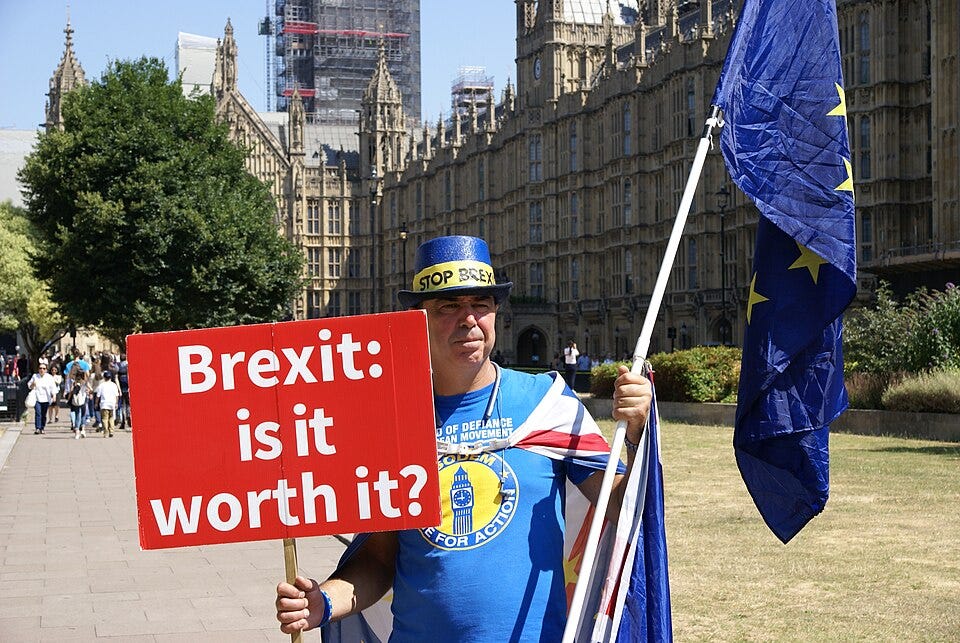
We all know the cursed ratio off by heart - 52:48, a tiny victory for the Leave campaign, and certainly no roaring mandate for the very hard version of Brexit we ended up with. Almost immediately after that vote back in 2016, Best for Britain was set up and began publishing its ‘Brexit Shift’ reports, using a then little known polling technique called MRP to track the shift in sentiment from anti to pro-EU membership on a constituency basis. We were surprised how quickly lots of seats that had voted leave, were flipping to Bregret.
A decade on, and the clamour is even louder. Support for rejoining is highest, unsurprisingly, among Labour, Liberal Democrat, and Green voters, above 80 per cent in each case. But almost two-fifths of Conservative voters and nearly a fifth of Reform voters also back it.
This is the majority position, held across the political spectrum, and it is growing. The government’s current reset strategy commands broad, but not deep, support: 61 per cent back it, but only 19 per cent feel strongly about it. A membership commitment would generate a movement and propel us in the right direction, and secure the much needed votes for progressives.
The Brexit debate is moving from a culture war to a conversation about realities and charting a path to the kind of country we are ambitious to see realised.
The referendum result was a howl of frustration from communities that had watched their high streets hollow out, wages which fell behind the cost of living and a sense of being ignored by those in Westminster. Being tough on the causes of the vote matters enormously, because it is key to understanding why the conversation has changed and why it can change further still.
The evidence has accumulated to a point where it is simply very hard to overlook. The Bank of England estimates that Brexit has reduced UK GDP by 6 per cent. NBER calculates that business investment has reduced by 12-18 per cent due to leaving the EU. Haulage firms in the UK have been going bust at twice the rate than the five years prior to Brexit. I could go on. I won’t, but what we have is nearly a decade of data and economic loss that has compounded the background of every budget, every NHS waitlist, every unaffordable home, and commensurate polling to show voters would now opt to go back in.
What changed? Views on Brexit are shifting because they are now being formed by lived experience rather than identity or anger. People cannot see their GP any more easily than they could ten years ago. Their weekly shop costs more. Jobs have been lost. And tensions stoked as problems then wrongly blamed on Brussels are now being falsely pinpointed on immigration.
Our latest research has found that reinstating our membership of the EU, our largest trading partner, could generate £92bn in GDP; creating the economic boost we desperately need to fund social services, infrastructure and growth. As we look towards the next ten years, and ask where we want this country to be, the numbers are pointing us in one direction only.
The current government’s instinct has been to dip a toe in the proverbial EU membership pool: a youth mobility scheme here, sector-by-sector agreements there. Partial arrangements deliver partial benefits. They require lengthy negotiations, unavoidable trade-offs, and they do not resolve the underlying challenges that people are facing every day.
The significant economic shift needed to positively impact people’s lives will not come from concluding another incremental agreement, but from signalling a credible intent to pursue membership. That signal alone would begin to change investment decisions, business confidence, and Britain’s standing in a world where our most important friends and neighbours happen to be in the European Union. This would make a real difference in our lives.
Anniversaries often inspire reflection on the past. The question for this anniversary is whether Britain is finally ready to have the honest conversation about where that course has led and where we plan to go. The public, it turns out, is ready. They have been for some time. ■
About the author: Naomi Smith is the chief executive of Best For Britain, a group of researchers, data scientists, strategists, and activists, fixing the problems Britain faces after Brexit
👫Agree with Naomi? Share this story with your friends, family and colleagues to help us reach more people with our independent journalism, always with a focus on people, policy and place.
🇪🇺 This story is the next part in our series examining the impact voting to Leave the European Union had on the UK since June 2016. We’ve dug into the numbers around the economy, immigration and more since the EU Referendum and also heard how Brexit has left our universities in a bleak position. Next we’ll be exploring what life’s been like for EU migrants living here and how Brexit paved the way for Reform. Sign up now to make sure you receive it first.
Plus take advantage of our special offer and get 30 per cent off an annual subscription (usually £49, use this link to get it for £34.30 instead) to help us write more in-depth original series like this, going deep into the issues affecting people, policy and place in the UK right now.
Brexit has been an absolute.bonus for the very few UK,and a mitigated disaster for us the very many,and what a mess it is.We now need to get back in there ASAP,please please please,let,s hurry this along Mr Burnham.
Naomi talks of “reinstating our membership of the EU”. She really fails to understand how long and complex this process will be.
It has to start with the election of a UK government committed to apply for accession. Then it’s up to EU member states to decide if and when to trigger Article 49 negotiations, which usually take about ten years.
There are at least six countries in the queue ahead of us, and there’ll be no special favours for UK as a former member - rather the opposite, as member states will want to be sure Britain won’t “do it all again” under a new government, quite possibly including Reform Ltd.
That’s why a referendum maybe be needed as part of the process, and with much less favourable terms likely to be available (no more rebate, and a commitment to join the €, for starters), the outcome of that referendum cannot be taken for granted, despite current polling.
Just because rejoining the EU is difficult is not a reason not to try. Indeed, given the support levels among younger voters, it may be inevitable that UK will apply to rejoin one day, and likely that EU member states will agree. But it is important to focus on the immediate and realistically available options.
That is why rejoining the single market must be the focus for now. That enables largely frictionless trade to be restored with our principal market, and is worth up to 3% on UK medium term GDP, boosting business confidence, renewing FDI to UK, and enabling economic growth to resume.
Unlike rejoining EU itself (and the customs union), UK can rejoin the single market now, via EEA (which nobody voted to leave). Being back in EEA simplifies trade and travel, restoring reciprocal free movement of citizens as well as of goods and Services. It also makes UK eligible to rejoin other crucial agreements, like the Dublin agreement and the CSDP common defence policy. That is crucial to UK security in a more hostile world as Trump prepares to take US out of NATO.
Rejoining EEA (almost certainly via EFTA) is also the first step to rejoining EU itself one day, since it largely eliminates the regulatory divergence. As Iceland will now show, that makes the process of accession to the EU much simpler and quicker. It is important that EEA is seen just as the first step, since it does little to increase UK influence - we will be consulted on regulatory changes on which we now have no say, even though post UKCE we have little alternative but to comply with them anyway.
One day, UK voters may want this country to regain its lost influence in Europe and the world beyond. That cannot be done without securing renewed membership of the EU, so that UK ministers are back at the table when important decisions which affect us are taken in the European Council, and UK MEPs are back in the European Parliament again.
But that is one for future parliaments, possibly for future generations. For now, the priority must be to rejoin the single market which was one of UK’s prudent achievements during our years of EC/EU membership.