


Two decades ago, European universities were entering an exciting chapter. For generations they had worked in isolation, drawing undergraduate students primarily from their own home population. But by the mid-2000s, with European cooperation well established and open borders across the European Union, they were preparing to become one large higher education system.
Through changes known as the Bologna Process, universities began to harmonise their work so their degrees became equivalent and students could move seamlessly between countries and institutions. As part of this shift, most European universities began to offer a range of degrees taught in English, opening them up to foreign students from all over the world.
It was a savvy move: at that time, Asian universities were starting to challenge the Western domination of the global education market and Europe wanted to place its stake back in the ground. Britain could have been worried by the unfolding of this new era, with so many nearby competitors now offering similar courses which anyone could access as long as they spoke English, but it wasn’t. We were part of the gang. We were a leader in Europe, helping to drive this common progress.
Then Brexit happened. Ten years on, though our universities are still world-ranking, our global academic reputation has tanked.
Every year the Times Higher Education World University Rankings include a category asking academics worldwide what they think are the best universities today. The proportion voting for British institutions among that number has been in steady decline since 2020. In part that is because the Asian market has boomed, but the idea that Britain has closed itself off to the world of academia is proving hard to shake.
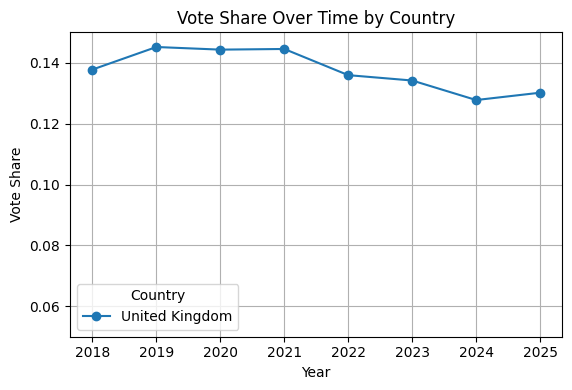
“There’s no question that UK soft power has taken a major hit,” says Phil Baty, director general of the Education World Forum. “In the early days there was an incredulity, but now it’s just eye-raising mockery about what a self-destructive decision it was. And now we do have hard evidence of a reputational decline within our world rankings. The general sense is of us being less open and less welcome.”
Just like many other sectors, policymakers didn’t spend a huge amount of time planning what Brexit might mean for universities, and the hard Brexit we eventually got was particularly damaging. Leaving the European Union had an immediate impact on the number of European students who chose to enrol in British universities, largely for cost reasons. Number crunchers working for the UK’s vice-chancellors scrambled to replace those missing students with those from elsewhere across the world, bringing higher fees with them. But the knock-on impact of this has been felt well beyond our campus walls.
“EU students would probably spend more in the local economy than those who would come in from elsewhere and also, given British voters don’t like immigration, it replaced them with students who were more likely to bring dependents with them,” says Glen O’Hara, professor of modern history at Oxford Brookes University and a campaigner to protect British higher education.

“It was a mad decision from the perspective of what the British voters will tell you they want.”
According to the think tank Best for Britain, the loss of young European academic talent has an impact for trade and industry as well as universities. We are no longer attracting or retaining that local expertise through our university due to the lack of mobility. Negotiating a reduced EU tuition fee rate could help to redress the barriers, as well as deleting the costly immigration surcharges that now apply. “These are huge financial barriers that a lot of students aren’t able to afford,” says senior policy officer Ayesha Chaudhry.
For some institutions the pull away from Europe was disastrous. The University of Kent, for example, had adjusted its mix of courses to capitalise on its location close to the edge of Europe. It had opened up partnerships with French institutions, offering cross campus joint degrees. “For them, Brexit was a complete catastrophe,” one expert in higher education policy, based at a UK university, explains. “It was the big loser”. The institution is now merging with the University of Greenwich to create a new ‘super university’.
For academics at every university there have been huge ramifications. One consequence of our hard Brexit deal was removal from Horizon Europe, the EU’s flagship research funding programme. This cost British researchers millions of pounds in funding for their work and disrupted research relationships across the block. British academics became isolated.
Dame Alison Wolf, professor of public sector management at King’s College London, says that at the time Brexit was being negotiated, Rishi Sunak was unconvinced about the benefits of being part of an expensive, sometimes slow-moving research bloc. He believed direct funding at home would be more efficient. “I’m perfectly willing to believe that it is, but the reality is that modern science is incredibly super-national and the scientists were beside themselves. These were the key networks for something we did, and do, very well - and it was all being blown up,” she says.
Since our departure Baty has observed major university alliances forming between clusters of European institutions, which he calls “powerhouse groupings”. Our institutions are nominally involved in a number of partnerships but the close, critical relationship has been lost. “Britain is now completely out of the loop of some of the most exciting higher education initiatives,” says Baty. “We were isolated long enough that some good solid research links went cold. It cooled our relationship just as everyone was working on harmonisation and alliances.”
Britain formally rejoined Horizon Europe in January 2024, and the current government is exploring ways to bring our universities back into the heart of European higher education. Since rejoining our reputation among academics has started to rise again, but the damage can’t simply be undone by membership. “In terms of hard metrics, in terms of the UK’s research standing, I think it will continue to be felt. There’s way more to come that’s sitting in the time lag. That harm will still filter through for years,” Baty says.
This affects how individual academics feel about British higher education too. Researchers and lecturers are agents of soft power around the world. They move overseas to follow a career path, and they share information globally across their discipline. Right now, they feel completely divorced from the British state. This would be bad enough, but our universities are facing a financial crisis too with student enrollments starting to drop, international competition from all over the globe and a depressing debate opening up about whether university is valuable at all.
“I don’t think in my career there has been a time when the rank and file academics are so far from the government,” says O’Hara.”The government has piled on costs when we already have no money. They just feel completely abandoned by the government, which seems paralysed by the lights in front of them like the oncoming train.”
How can any of these be unpicked? There is a lot of hope attached to rejoining the Erasmus scheme, which encourages student movement throughout Europe, and a proposed youth experience scheme to give young people the opportunity to rebuild the intellectual and social connections that build British soft power through education. “We’d be keen to see the successful negotiation of a UK experience scheme,” says Chaudhry. “The UK’s withdrawal from the EU has deprived a generation of a lot of opportunities. Being able to see progress is welcome. While it might not fully eradicate some of the damage that’s been done, it can help us.”
O’Hara thinks it will take more to save British universities from slipping down the global rankings in the aftermath of Brexit. He calls for a clear and rational planning system for our future university funding streams based on where research collaborations are working well and where students want to go, helping to rebuild our European and global links. But, after many conversations with the current government’s policymakers, he’s not hopeful.
“They don’t even seem interested in that. It’s a bizarre phenomenon when you’ve got loads of Labour supporters in higher education.” ■
About the author: Hannah Fearn is a freelance journalist specialising in social affairs. She was comment editor of The Independent for seven years, and has previously worked for The Guardian, Times Higher Education and Inside Housing. She has a special interest in inequality, poverty, housing, education and life chances.
👫Agree with Hannah? Share this story with your friends, family and colleagues to help us reach more people with our independent journalism, always with a focus on people, policy and place.
🇪🇺 This is the next part in our series examining the impact voting to Leave the European Union had on the UK since June 2016. Last week we dug into the numbers around the economy, immigration and more since the EU Referendum. Next we’ll be exploring what life’s been like for EU migrants living here and how Brexit paved the way for Reform. Sign up now to make sure you receive it first.
Plus take advantage of our special offer and get 30 per cent off an annual subscription (usually £49, use this link to get it for £34.30 instead) to help us write more in-depth original series like this, going deep into the issues affecting people, policy and place in the UK right now.