


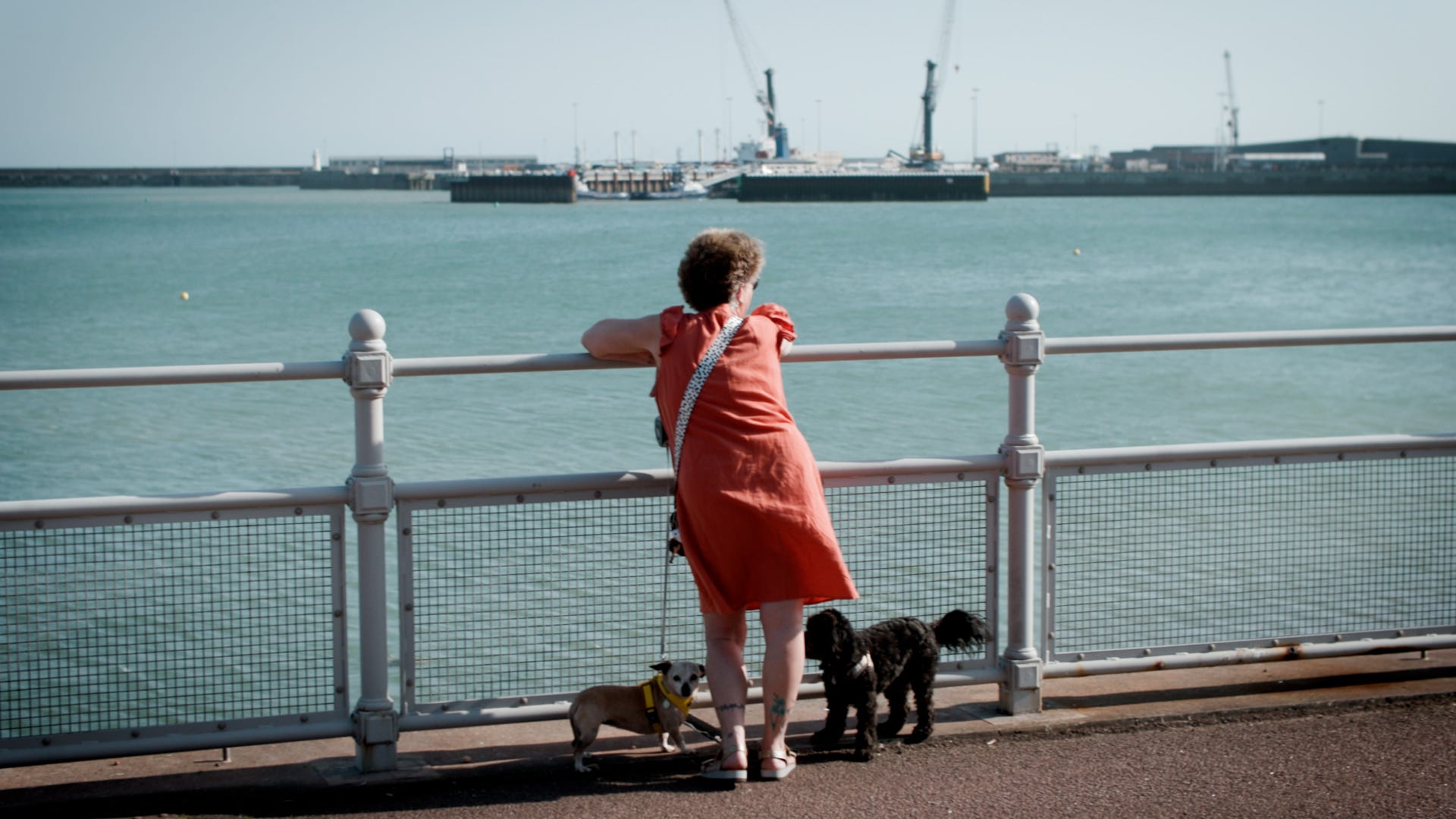
A town and a port that’s always been a crucial place in our national story, finds itself once again at the frontline of British politics. A place to pass through, and yet a home to many, we see what life has been like in Dover since the EU Referendum and the impact of Brexit.
It’s a sunny spring day, and the town’s high street is relatively busy; warmed by unseasonable rays, plenty of people are happy to stop and chat. But ask about how the town’s identity has been shaped by the local port — which is Europe’s biggest ferry port, handling over 11 million passengers each year — and most locals offer a gloomy outlook.
“It doesn’t invest anything into the town, it does nothing to keep the passengers in the town,” says Janet. “The Harbour Board just rules it, and nobody else gets a say.”
Dover, Kent, is Britain’s closest point of connection with the European mainland. Looking out over the English Channel, the northern coast of France is just 18 nautical miles away. There are countless signs scattered about in French and German, medieval churches and a majestic castle built by the Normans, and constant waves of tourists from the EU traversing the paths up the White Cliffs.
And yet, in recent years, this proximity to the continent has primarily been used as a reason for greater hostility and mistrust of outsiders. Dover has extraordinary symbolic value: in UKIP billboards and promotional videos for Reform, Nigel Farage has repeatedly used the famous image of the white cliffs and the seas beyond to evoke a kind of vague Second World War spirit, rooted in misguided nostalgia and the sewing of hatred. That symbolic value has been exploited to make this border the most hotly contested battleground in UK politics. How did it happen?
Beside the seaside
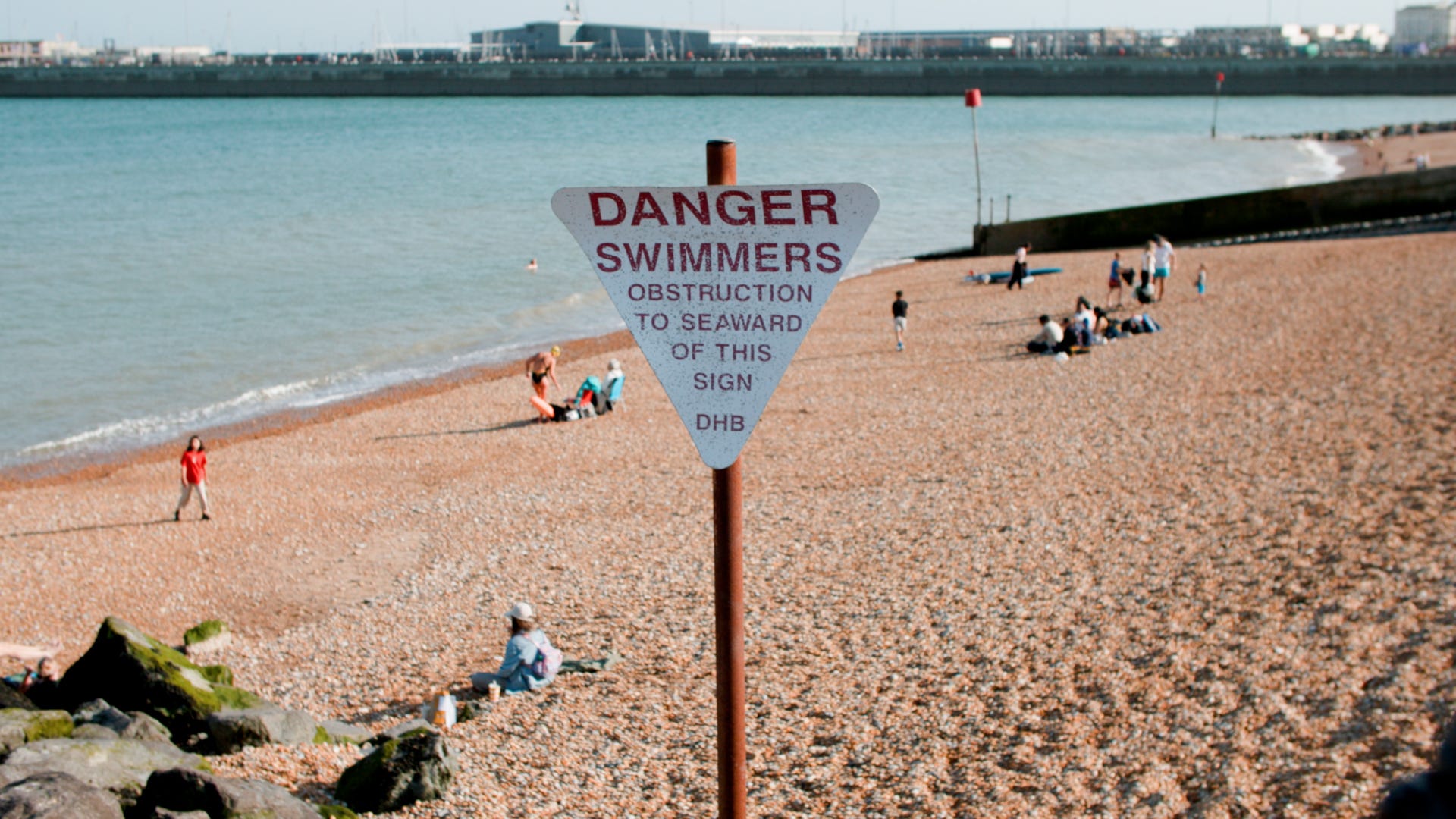
In 2016, this town voted decisively to reject closer ties with our European neighbours, with Leave collecting 62.2 per cent of the vote in Dover. This was part of a much broader national phenomenon that saw the vast majority of former English seaside resorts back the Leave campaign.
In the fallout from Brexit, pundits identified a widening North/South divide, with towns in the so-called ‘Red Wall’ Labour heartlands shifting right on immigration and seeking to punish the establishment for decades of deindustrialisation and decline inflicted on their communities. Around this period, there was also plenty of analysis of the difference between urban constituencies and more provincial or rural areas, with the latter being far more likely to vote for Brexit.
But perhaps the biggest indicator of whether a town would vote leave – and something that’s often been brushed over in Brexit-related commentary over the last decade – was its proximity to the sea.
“English seaside resorts reverberate noisily with the ghosts of their history,” writes Madeleine Bunting in The Seaside, a text which identifies how “incomers in search of cheap housing drive a coastal pattern of deprivation in England and Wales”. Research suggests deprived coastal towns have some of the country’s highest rates of antidepressant prescription , and given the way these places have been gutted by decades of austerity, job depletion, and tourism decline, that’s hardly surprising.
Their response in 2016 was to kick back. Many of the areas of England that recorded the highest leave vote in 2016 were deprived English coastal towns, many of which had previously been popular resorts: Boston and Skegness (75.65 per cent), Clacton (73 per cent), Kingston Upon Hull East (72.8 per cent), Great Yarmouth (71.5 per cent), and Great Grimsby (71 per cent) are all classic examples.
Farage and co. successfully took the justified rage of these towns and turned it against migrants arriving from the EU (as highlighted by this striking electoral map). But the issues that led to the vote haven’t been resolved. In many of these communities, poverty, housing, job insecurity, and lack of opportunities for young people have only worsened.
Child poverty in Dover wards like Town & Castle and Tower Hamlets has increased to 32 per cent and 31 per cent respectively, and the town has one of the south east’s highest youth unemployment rates. Back in 2016, voters were famously promised £350m more per week for the NHS; instead, health services in Dover and other parts of Kent have faced huge deficits and had to take cost-cutting measures.
They were also promised tougher borders, with ‘immigration’ one of the two main reasons people voted to leave, alongside ‘sovereignty’. Whatever your view on this issue, there’s no denying that the subsequent increase in net migration between 2021 and 2025 led to a breakdown in trust amongst a large section of the electorate.
The issue of migration has also become far more visible, as the UK’s scrapping of safe routes for asylum seekers via the EU’s Common European Asylum System (CEAS) ended up creating the small boats crisis that now dominates headlines. In turn, the increase in legal non-EU migration in the aftermath of Brexit under Tory PM Boris Johnson — seen as a negative shift by those on the populist right — has led to the popularisation of the term ‘Boris-wave’.
Dover’s geographical location means the town has moved to the centre of an increasingly volatile national debate, as Reform UK and other voices on the populist right, such as Restore Britain, have exploited this rise in human trafficking across the Channel.
Nigel Farage’s consistent portrayal of the rise in small boat crossings as a “national security emergency” and his use of the language of “invasion” have become worryingly normalised. His position as an outsider has allowed him to first blame the Conservatives’ record and now the Labour government’s.
This is, of course, highly ironic given Farage’s status as one of the chief architects of Brexit, and the fact that Brexit-induced labour shortages and the withdrawal from the Dublin Agreement were what led to increases in non-EU migration and small boat crossings.
“I think Nigel Farage and Reform are the best option,” says Ruzie Knight, a young man who grew up in Dover. “A lot of governments say, ‘we’re doing this, we’re doing that’, and then they don’t [change anything]. But if they get a lot of votes, things might change.”
“There needs to be stricter rules on illegal immigrants,” he says, before adding, “I do feel sorry for the kids, to have to be involved in that. They obviously want a life, which is understandable, but this country can only put up with so much.”
“I’ve seen no improvement since Brexit,” says Janet. “The main problem has obviously been the immigration and the small boats. And as far as I can see, nothing has been done to stop them. If anything, we encourage them.”


This view is held by a large number of people living in England’s deprived coastal towns, and in 2026, they responded by voting for Reform: the party won control of numerous coastal councils, including Sunderland, Gateshead, and Hartlepool, plus counties like Essex and Suffolk with plenty of Brexit-voting seaside constituencies.
Three of the four seats with the highest proportion of Brexit voters (Boston and Skegness, Clacton, and South Basildon and East Thurrock) went Reform in 2024. Of the top 10 Brexit-voting seats, only Ed Miliband’s Doncaster North is not currently projected to swing to Reform.
That being said, on the streets of Dover, the public express much more nuanced positions on small boats than the mainstream press may lead you to believe. Like Ruzie, even those who are concerned about immigration figures often display sympathy for those coming over, and you get the impression that if the material factors driving discontent were addressed, they’d very quickly lose interest in the arguments pushed by Reform.
Antisocial media
The far-right’s portrayal of Dover as a community under siege, a critical frontline being “invaded” by hostile foreign forces unsurprisingly doesn’t match up to the reality on the ground.
Social media may be awash with footage of people arriving in the area in small boats and being processed at the local port, but the impact on the town itself is minimal. ONS data shows that the proportion of Dover residents born in England actually increased between 2011 and 2021, while the town’s population remains overwhelmingly white (around 95 per cent at the last census).
“There’s a lot of misleading information on social media,” says Mohamed J., a chef at town centre café Brunch who moved to the UK from Morocco over 20 years ago. “Some [people] think minorities are basically getting everything. They need to understand the situation properly: they don’t know what most immigrants are going through. I see them sleeping in the street in Dover. They are really struggling, it’s sad.”
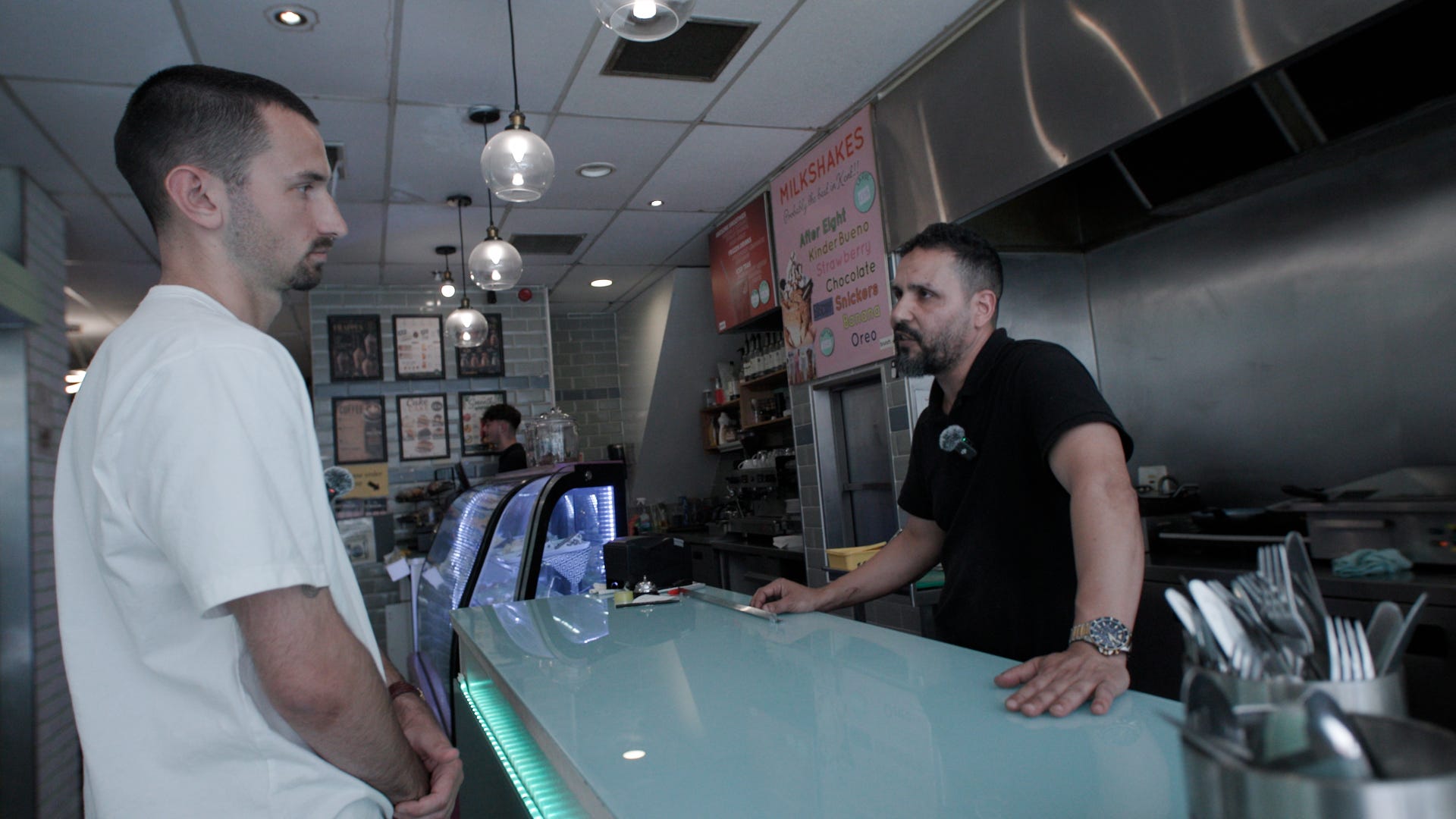
“A lot of people have lost humanity,” he continues. “Most people come here to work, or they’ve got no choice. I didn’t have a choice to come. I also loved living back home, where my family are. For example, today’s a big celebration [Eid], and I’m working. Would you want to be working at Christmas?”
But the misinformation has clearly taken root. Despite a persistent scepticism about Reform and their ability to govern, an increasing number of people in Dover are willing to take a punt on them if it means reducing the flow of asylum seekers and migrants into the UK.
Paid subscribers to The Lead can listen to an exclusive podcast with Fred about his visit to Dover and what he heard and felt

Current polling suggests that if a general election result were held tomorrow, Reform would take the Dover & Deal constituency from Labour, whose local MP Mike Tapp assumed office in 2024 after 14 years of Tory rule (we contacted Tapp for comment, but had no response).
The 2025 Kent County Council elections showed just how much progress Farage’s party has been making in this corner of England. Reform took control of the KCC (the country’s largest county council) after winning 57 seats, including all seven seats in Dover. Each of these seven wards were seized from the Conservatives, reflecting the widespread hostility felt toward the former ruling party.
In terms of the national picture, 2026 saw Farage’s party gain 1,451 council seats across the country, profiting from anger and resentment built up after years of austerity, inequality, and the lack of resolution provided by Brexit.
The trend of coastal towns lurching to the right also accelerated with Restore Britain’s local offshoot Great Yarmouth First winning all nine seats it contested in the East Norfolk town. Rupert Lowe’s party is making inroads across the country, threatening Reform from the right (their 7 per cent share of the vote in the recent Makerfield by-election being a key example of this).
Although it’s unclear whether this pattern will extend to east Kent; while several KCC councillors expelled by Reform last year have since joined Restore Britain (most of them based in Maidstone), right-wing politics in Dover appears to remain dominated by Reform, for now.
“At the last election, I voted for Labour. Now, I’d choose Reform,” says Ruzie. “I think a lot of people are on the same page.”
The footfall problem
Talking to people across the town, we encounter lots of frustration that the enormous amount of traffic experienced at the port hasn’t materially benefited the local economy. Brexit has restricted the easy flow of tourists and school trips from across the Channel, but regardless, if even a fraction of the people passing through the port today were encouraged to explore local landmarks and historical sites, and spend money in high street shops and cafes, the impact could be profound.


“We get cruise ships in and they take people to Canterbury or other towns, and I’m like, ‘stop here!’” says Carmina Ballantine, who we meet in the beer garden of historic local pub The White Lion. “Dover is overlooked for all its history: the castle, the Saxons… you’ve got all the green around, you’ve got the sea, the cliffs. This town has so much going for it.”
Jason Gilbert runs the charity shop Help Our Town CIC, which focuses on raising funds for anyone struggling in the town. According to Gilbert “things are getting harder and harder. Wages aren’t going up the way the cost of living is. The energy caps are just going up again. Daily things that we all have to pay for, all going up: bills, food, shopping, it just doesn’t equate to what we’re earning these days. Rental prices for everyone are extortionate, and obviously for people who have been lucky enough to have a mortgage, they’ve gone up as well.”
Almost everyone else we speak to identifies rental prices as a huge issue. Dover is a working-class town, and it hasn’t experienced the levels of gentrification seen in other coastal Kent communities like Folkestone, Margate, or Whitstable; however, its location in the more affluent south-east means rents and the broader cost of living are still higher here than in many other deprived coastal towns. In the last year, average rents in Dover increased by 5.8 per cent.
Rent doesn’t just affect people struggling to get affordable homes; lots of buildings remain empty, with Matthew Angliss, who runs a gaming shop with his wife, only able to make it work because the building owner offers him a favourable rate for the lease. “We’re purely high street-focused, and people say that shops like ours are the reason they come into town,” he says. “But it goes to show how limited it is: online shopping kills the reason for people popping into town.”
The future of Dover
So what do towns like Dover need more of?
“More effort put into the high street, special community events,” says Matthew. “I don’t really see the reason [for] putting walls up around ourselves… it comes across as selfish of us, not being willing to help others outside. Here in Dover, they do have [anti-immigration] protests at times, and all I see is people having a big drink up. We’ve had the protest police come through and we’ve literally decided to close shop early to prevent any aggro. The flags and stuff, people see that and don’t want to travel to that town. It’s very unwelcoming.”
Anti-immigration protests, many of them with links to far-right organisers, have become more common in Dover in recent times. In July alone, two protests have been organised, with groups like Pink Ladies UK and Kezza’s Pink Patriots brandishing flyers with slogans like ‘Unite the Right’ and ‘Take Back Our Country’. Given that figures from Restore Britain and other far-right bodies have previously organised in Dover, expect more of the same over the summer.
While the seeds of this hostility and division were sown in the decades before, its continued presence in mainstream British politics ultimately stems back to the Brexit campaign. Coastal towns like Dover played a decisive and often unappreciated role in swinging that vote, and in the 10 years since, their problems remain unsolved, and their frustrations have only worsened.
It’s clear that people in Dover, as in many other parts of the UK, are sceptical of Reform, whose leader clocks in with a public net favourability of -31 according to YouGov. Nigel Farage remains a deeply divisive figure, and the thought of him in Downing Street concerns people. But they’re feeling reckless. They want to make their voices heard.
Right now, Reform’s populist right-wing message feels like the only way of cutting through. But if the material concerns of voters are addressed, and if measures are taken to make the cost of living less overwhelming, there’s an appetite for an alternative path. If not, Dover may well be one of many coastal towns that Reform could seize at the next general election. ■
About the author: Fred Garratt-Stanley is a freelance journalist who writes about culture, politics, football, and pubs. He's based in London and has written for a wide range of publications including The Lead, The Guardian, NME, Huck, and Pellicle.
👫Enjoyed Fred’s writing? Share this story with your friends, family and colleagues to help us reach more people with our independent journalism, always with a focus on people, policy and place.
🇪🇺 This story is the latest part in our series examining the impact voting to Leave the European Union had on the UK since June 2016. We’ve dug into the numbers around the economy, immigration and more since the EU Referendum and also heard how Brexit has left our universities in a bleak position. And we welcomed Naomi Smith from Best For Britain as she argues why the time is now re-joining based on the public mood and our Westminster Editor Zoë Grünewald penned an exclusive essay on how the EU Referendum paved the way for Reform.
Next we’ll be exploring what life’s been like for EU migrants living here. Sign up now to make sure you receive it first.
Plus take advantage of our special offer and get 30 per cent off an annual subscription (usually £49, use this link to get it for £34.30 instead) to help us write more in-depth original series like this, going deep into the issues affecting people, policy and place in the UK right now.
The people of the EU feel the same about governments forgetting their people. Immigration is not a problem. It’s the liars and grifters that are the issue. Yes there are immigrants that should not be allowed into the country or Europe, but that doesn’t mean the genuine asylum seekers should be stopped and those with skills rarely come by an inflatable boat. We need to look why they are coming here, not just a knee jerk reaction stating it for benefits / commit crime. It is a hard question to answer and only will be solved with all of Europe coming together. The European Union has its issues, however we can only change it when in it. Closed minds never solve problems, open minds do.
There are limits to what any government, including a Reform government, can do to regenerate Dover.
The town cannot recover the labour-intensive passenger ferry economy of the 1960s and 1970s. Technology and the Channel Tunnel have permanently altered that market.
Its geography is fixed. The port occupies much of the waterfront, and the surrounding valleys and cliffs limit opportunities for large-scale redevelopment.
It is relatively distant from the UK's largest centres of high-value employment.
It's main hope would be to become a high value logistics and trade hub, but this isn't going to sustain the present population.