


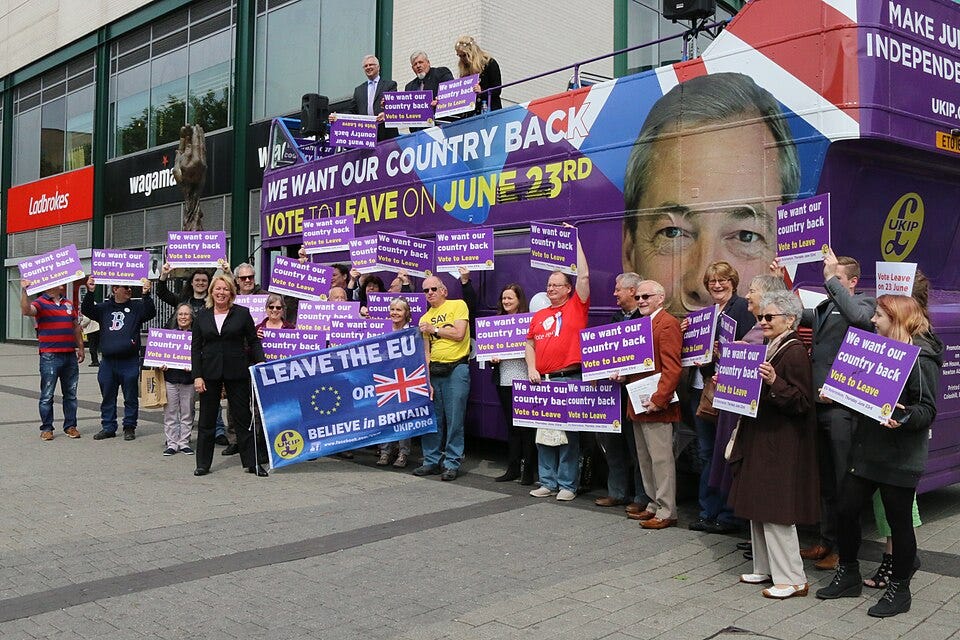
Brexit was supposed to be the answer. For decades, the nature of Britain’s relationship with Europe had been the question that would just not go away. It destroyed political parties, consumed governments and ruined family dinners. It divided towns, generations and worldviews. But the referendum of June 2016 was meant to settle that nasty chapter once and for all.
Ten years later, Britain has left the European Union, but the anxieties that powered the Leave vote remain as potent as before. Concerns about immigration, national identity, economic insecurity and political distrust have become organising principles in British politics. We stand, in many ways, on the very same footing.
Rather than ending an era of populist nationalism, Brexit legitimised and institutionalised it. And today, we find ourselves trapped in a strange political loop: arguing over the same issues, with all the same protagonists, but a darker and more confident populist force at the wheel.
Brexit’s broken promises
Despite the Brexiteer fantasy of a shiny new Singapore-on-Thames, our decision to leave the world’s largest single market has — unsurprisingly — left the UK economy around 6-8 per cent smaller than expected.
The reasons are hardly mysterious. Leaving the EU’s economic bodies created barriers where there weren’t any before: customs declarations, regulatory checks and new frictions. As William Bain of the British Chambers of Commerce observed, Brexit has become “an ongoing, gnawing issue that is holding back trade.” For businesses, this means higher costs, more paperwork and greater uncertainty.
While Brexit was far from the only economic shock Britain faced in the last decade, those additional costs filtered through the economy. Consumers were already grappling with soaring energy prices, rising interest rates and post-pandemic inflation. Brexit added another drag on growth at precisely the moment the country could least afford it.
The result was a sustained squeeze on living standards. Inflation hit a 41-year high of 11.1 per cent in October 2022. Prices rose faster than wages and disposable incomes in 2024 were lower than in 2019 — the first fall across a full parliamentary term since records began.
Behind those figures were real and accumulating pressures for voters. The weekly shop cost more, energy bills climbed. Millions suddenly faced higher mortgage repayments. Life simply became more expensive.
Taken together, these pressures have created a mood of sustained, simmering frustration. Ministers speak endlessly about growth while avoiding the Brexit-shaped elephant in the room. By April 2026, even Keir Starmer was only just publicly acknowledging what economists had argued for years: Brexit had inflicted “deep damage” on the British economy.
The more interesting question is why so little of that frustration was directed toward Brexit.
By the 2024 general election, the cost of living topped the list of voter priorities, yet just three per cent of Leave voters cited Brexit as a major factor in deciding how to vote. Only eight per cent of Britons overall considered it one of the country’s most important issues. The pain was being felt keenly, but Brexit was not being blamed. Instead, public frustration found other targets, and that target was migrants.
The immigration paradox
The Brexiteers promised to take back control of Britain’s borders. What they delivered was precisely the opposite: more immigration, more visible immigration, and no trust in anyone’s ability to manage it.
EU net migration did briefly turn negative after 2016, with more EU citizens leaving than arriving, but that was never the full picture. Industries like healthcare, construction and hospitality still needed workers, and with the EU route closed off, non-EU immigration rose to fill the gap. Net migration hit a record peak of over 900,000 in the year to March 2023 – nearly three times the 321,000 recorded in the year before the referendum.
Then came a second, compounding issue: small boat crossings, a phenomenon barely visible before 2016. In 2018, just 299 people arrived by this route. By the year ending March 2026, around 39,000 were crossing annually, making up approximately 90 per cent of all arrivals by irregular means. Before Brexit, the UK relied on the EU’s Dublin Regulation to return asylum seekers to their country of first arrival. The withdrawal agreement replaced that with nothing, so returns became far harder, and crossings grew exponentially. In raw numbers, boats remain a tiny fraction of total immigration, but as images, they were everything. Dinghies on the water gave perpetually unsatisfied nationalists a visual shorthand for broken promises that no statistic could match.
The Conservatives under Boris Johnson made this worse on a third front: lies, damn lies. Desperate to be seen delivering the will of his people, Johnson declared Brexit a success by sheer force of repetition. He won his 2019 landslide on “get Brexit done,” and he did, in the narrowest sense, break the parliamentary deadlock that had paralysed his predecessor Theresa May.
But the immigration system he now controlled outright saw numbers surge to record levels on his watch, as the economy stalled. For voters already primed to distrust the establishment, this was confirmation. The Brexit coalition had been built on the idea that elites lied and tried to put a lid on the will of the masses. Johnson — the Leave campaign’s figurehead in Tory camps — was the supposed outsider. He made promises he wouldn’t keep. He turned out to be exactly what they’d suspected all along.
With no Brussels to blame, on the right, this got its own name — the “Boris wave” — a symbol of a ruling class that promised one thing and did entirely another.
So when official figures now show the numbers falling — net migration down to 204,000 in the year to June 2025 — nobody believes it. Only 16 per cent of people think migration has fallen in the past year, while 49 per cent think it’s risen.
With public trust burned, fact and perception have almost completely diverged.
“Brexit supercharged ‘control’ as a political concept but it also exposed how hollow it can be,” Naomi Smith, chief executive of Best for Britain explains. “We ‘took back control’ — if you accept that framing — of our borders, and net migration subsequently hit record highs.”
“What that tells you, is that the anxieties driving the immigration debate were never really about the EU at all. They’re fuelled by far right narratives that exploit economic insecurity, pressure on overstretched public services, and a political class that hasn’t been straight with voters about the trade offs and economic realities we face today. Those conditions haven’t gone away - in fact quite the opposite - so neither has the dissatisfaction.”
Same faces, new grievances
Voters who had been promised prosperity, control and national renewal instead found themselves facing higher costs, record immigration and a political class insisting everything was working.
The grievances remained and trust collapsed. Brexit had created an electorate primed to feel betrayed and looking for someone to blame. All it needed was a skilled operator to channel that anger into a new political project.
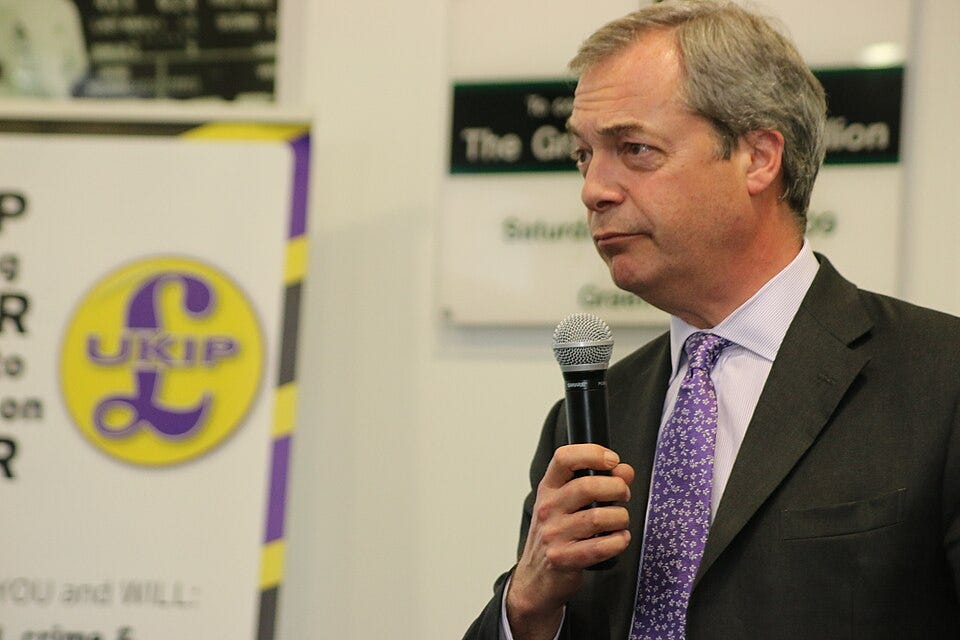
Enter Nigel Farage.
Farage had spent over two decades as the most persistent advocate for British withdrawal from the EU. He forced David Cameron’s hand on a referendum the Conservative party never wanted, and when Leave won in 2016, he resigned as UKIP leader within days. “I have never been, and I have never wanted to be, a career politician,” he told reporters. “My aim in being in politics was to get Britain out of the European Union [...] I don’t see what more I can achieve.” Many took him at his word: his job had seemingly become obsolete.
That didn’t last long.
Within three years Farage was back, founding the Brexit Party in 2019 to pressure a Conservative government he decided to be too slow and too amenable to Brussels. He stood candidates down across swathes of the country in December 2019 to clear Johnson's path, then receded again once Brexit was “done”. The Brexit Party was rebranded as Reform UK in January 2021 in opposition to COVID lockdown measures and a broader anti-establishment platform. Farage stepped back from leadership of the party at that point, leaving his now deputy Richard Tice in charge.
So when in May 2023, Farage appeared on BBC Newsnight and told Victoria Derbyshire that “Brexit has failed”, it wasn’t a man discovering a new cause. Rather, it was the third time he’d reactivated the same one.
“We’ve not delivered on borders, we’ve not delivered on Brexit. The Tories have let us down very, very badly”, he lamented. Farage had found a whole new way to launder his reputation. He did not need to take accountability for the failures of Brexit, because he had decided they weren’t his to take. The betrayal of higher costs, less control, and a diminished place in the world was an execution error. And so he had to return: his job was unfinished.
This propelled Farage back to the frontline of British politics. By June 2024, he had resumed the Reform UK leadership and won the Clacton seat — his eighth attempt to enter Westminster. He would no longer campaign on Britain’s relationship with the EU, instead focusing on immigration, social cohesion, and — increasingly — what he calls “Judeo-Christian values”.
As of May 2026, Reform sits on 25 per cent in voting intention polls, ahead of Labour on 18 per cent and the Conservatives on 17 per cent. This year, the party swept local elections, winning overall control of 10 councils and 1,257 seats.
Farage may have created Brexit, but in many ways, Brexit created him too.
The referendum was supposed to settle the defining question of his career. Instead, it provided the foundation for a new one. Farage successfully repositioned himself as Brexit’s betrayed champion.
“Nigel Farage and Reform UK aren’t creating something new but harvesting something old,” Smith explains. “Just as the Leave campaign of 2016 did, they’re making false promises and whipping up xenophobia, blaming the country’s problems on others rather than being honest about the economic damage of Brexit, the dangerous man in the White House and their billionaire mates cream-skimming wealth from the public.”
The numbers bear this out. Farage’s party is now the most popular party among over-50s — drawing 34 per cent of voters aged 50-64 and 33 per cent of those 65 and over. These are precisely the demographics most likely to have voted Leave in 2016. Almost seven in ten of the British public now feel that society is in disrepair — a sentiment shared across all parties, but felt most acutely among his supporters. The unresolved tensions on immigration, identity and economic disappointment that his Brexit surfaced gave him and his party an endless pool of anger to draw from.
Brexit…forever?
The question now is how long we will let Brexit destroy our politics — burning through leader after leader and dividing us further.
Reform has a long journey to Downing Street, but it already leads polls, controls councils, and is dominating political discourse. Keir Starmer is the latest casualty in the Brexit fallout, his early departure reflecting not only the abysmal economic outlook, but also the pressure Reform has exerted on the centre ground. In an effort to counter Farage’s rebirth, Labour shifted decisively right on immigration and social policy, attempting to park their tanks on his lawn. But in doing so, they alienated huge swathes of their own, while propelling Reform’s hostile brand of politics into the limelight.
But this is not just a story of electoral positioning. The money and networks surrounding Reform point to something more sinister still. Christopher Harborne, a Thailand-based crypto investor, has donated £9 million to the party and made a £5 million personal gift to Nigel Farage, which was not properly declared and is now under investigation. Questions about what such extraordinary generosity is buying have not gone away, despite Farage insisting that the money was “a wholly private matter” unconnected to his political activity.
The party’s questionable links don’t stop there. Just look to Nathan Gill, former UKIP MEP and the Leader of Reform UK in Wales, now serving a decade in prison after he was admitted to accepting bribes in exchange for spewing Russian propaganda.
And then there’s the hard-right US legal networks that have been cosying up the Farage, such as the Alliance Defending Freedom, a Christian campaign group central to the overturning of Roe v. Wade. They have been working Farage into Trump-aligned circles and facilitating MAGA political ties. Reform is now increasingly filling its ranks with fundamentalist advisors and anti-abortion hard-liners, and Farage himself has now started openly questioning abortion term limits.
Taken together, Reform’s emerging programme speaks to the darker aftershocks of Brexit: fierce hostility to immigration, suspicion of liberal institutions and values, and a crueller, more divisive politics. The party has pledged to leave the European Convention on Human Rights, repeal the Human Rights Act, and scrap the Equality Act , as well as introducing the mass detention and deportation of foreign nationals. What has been created in the last decade is not some settled post-Brexit order, but a looser, more volatile politics shaped by new money, shadowy alliances and a hostility to progressivism.
“Brexit was sold as a full stop but turned out to be a comma,” says Smith. “The promise was that leaving the European Union would draw a line under a decade of political turmoil. Instead it created a new set of questions that Britain is still wrestling with today: what kind of relationship do we want with our nearest neighbours, what kind of country are we, and who does our politics actually work for?”
Those questions may remain unanswered, but Farage remains the man most willing to exploit the silence. He has trained the electorate to see betrayal everywhere they look, helped create the conditions for his voters’ hardship and ensured they would never blame him for it. And the parties and politicians around him have remained complicit, too afraid to name Brexit’s failures and too blinkered to contend with its damage.
What comes in the next decade depends entirely on whether Britain’s mainstream politicians can finally do what it has spent the previous decade refusing to: tell the truth about what Brexit did, who bears the cost, and why the man promising to fix it helped cause it all in the first place. ■
About the author: Zoë Grünewald is Westminster Editor at The Lead and a freelance political journalist and broadcaster.
👫Agree with Zoë? Share this story with your friends, family and colleagues to help us reach more people with our independent journalism, always with a focus on people, policy and place.
🇪🇺 This story is the latest part in our series examining the impact voting to Leave the European Union had on the UK since June 2016. We’ve dug into the numbers around the economy, immigration and more since the EU Referendum and also heard how Brexit has left our universities in a bleak position. And this morning we welcomed Naomi Smith from Best For Britain as she argues why the time is now re-joining based on the public mood.
Next we’ll be exploring what life’s been like for EU migrants living here and life in the coastal town which has seen Brexit first-hand. Sign up now to make sure you receive it first.
Plus take advantage of our special offer and get 30 per cent off an annual subscription (usually £49, use this link to get it for £34.30 instead) to help us write more in-depth original series like this, going deep into the issues affecting people, policy and place in the UK right now.