More energy, more passion: The five big tests for Labour in 2026
The government must think bigger and braver than they did in 2025.
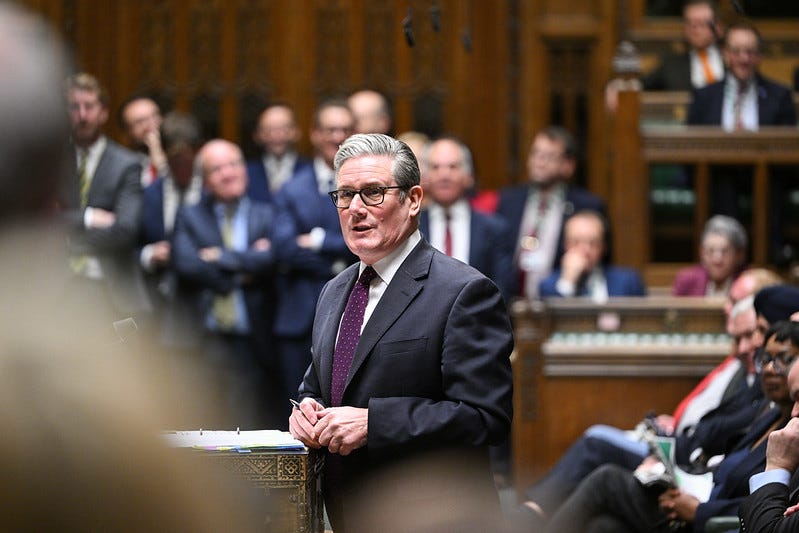
Keir Starmer will be glad to see the back of 2025.
It was meant to be a gentle year: a chance for a new Labour government to settle in, and for the country to take a breath after more than a decade of chaos. But voters weren’t quite so forgiving. Cost-of-living pressures remained stubbornly high, patience for long-term fixes was thin, and the promise of competence only went so far when people were struggling with costs day to day.
Across the democratic world, governments are learning the same lesson. Being sensible and careful isn’t enough anymore. Managed growth, incremental reform, staying in the middle of the road: all of that feels like too little, too late when far-right forces are moving fast and political frustration is high.
And that pressure will only grow in 2026. The economy continues to wane and global instability is everywhere – from war and trade to climate shocks, and our politics are being deliberately tested by those trying to push Britain away from tolerance and pluralism.
The real question for Starmer this year isn’t just whether he can govern, or whether the government can deliver on policy. It’s whether they can show enough courage and clarity to confront these challenges head-on, rather than just manage around them. This is a test of vision, drive and purpose: the government must think bigger and braver than they did in 2025.
Below we’ve charted the five big tests for this Labour government as we enter the new year. It is by no means definitive or final (as we know, a lot can happen in just one day in politics), but these are the areas that present the biggest threat and opportunities for the government to test their vision, and the ones we at The Lead will be watching closely.
1. The economy – and whether anyone actually feels it
On paper, things could look cautiously optimistic. Small shoots of growth, improving headlines, and the chancellor heading off to Davos in January to woo global investors. But 2026 will be judged by whether that translates into something ordinary people can feel in their pockets.
Middle-income earners are likely to feel the pinch from the latest budget, while unemployment is creeping up and economic insecurity is spreading. Young people are getting hit hardest: entry-level jobs are disappearing, businesses are nervous about taking on inexperienced staff, and changes to student loan repayment thresholds make the future look even more daunting. Meanwhile, energy bills, transport costs and housing continue to bite voters across the generational divide.
The government is betting everything it has on infrastructure-led growth – and planning reforms, housebuilding and green investment may help down the line – but voters need relief now.
The central political question remains unanswered: will any of this make people feel better off in their daily lives? And if not, what more is the government prepared to do?
By the end of 2026, voters will have run out of patience if current trends continue. The next budget – in Autumn next year – may need to provide something radical to convince voters that change is coming. It is quite possible that Rachel Reeves has more up her sleeve. We can only wait and see.
2. Public spending and services
If the economy is Labour’s first test, public spending may prove its most combustible. Rows over junior doctors’ pay have dragged on over Christmas, public sector wage negotiations loom again in the spring, and Labour’s relationship with the trade union movement is visibly fraying.
Unions that were once instinctively loyal are growing restive. UNISON’s recent decision to elect left-wing outsider Andrea Egan as leader signals a harder line, and alongside Unite – another major Labour backer – discussions about formal disaffiliation are no longer unthinkable.
Beyond pay, pensions and welfare spending are becoming increasingly politicised, with further rows likely as ministers attempt to rein in costs. Meanwhile, councils are creaking under the weight of responsibility without adequate funding, and small, targeted initiatives such as the “Pride of Place” scheme risk feeling tokenistic against the vast scale of local decline.
Education could be the next political hot potato. A school’s white paper is due early in the year, and SEND reforms are shaping up to be a political battleground. Ministers insist the focus will be on early intervention rather than cuts, but soaring SEND costs risk turning into yet another wider debate about fairness and state support.
3. Immigration and confronting Reform
Migration numbers are falling rapidly and the government is introducing measures to close migrant hotels and speed up processing. You would be forgiven for thinking the opposite, as none of this has stopped the constant media fascination with it. Nor has it done anything to stop the rise of Reform UK. If anything, it emboldens them while frustrating voters.
The debate has fallen into the far right’s hands. Labour often looks reactive rather than principled, and playing politics with asylum seekers may seem like a short-term tactic, but it ignores a basic truth: the country needs steady migration to keep industries, public services, and regional economies afloat.
The asylum system absolutely needs reform – faster, fairer, more humane – but reducing people to numbers or leaning into dehumanising rhetoric just feeds the politics of grievance Reform thrives on. Standing up to the far right requires courage, values, and a clear sense of what Britain should be. Starmer started to vocalise this in his Labour Party Conference speech back in the Autumn, but since then, his rhetoric has been missing in action as the conversation around nationality, race and belonging continues to spiral downward.
4. Britain’s place in a shifting world
Though no shortage of domestic troubles, foreign policy is going to be an unavoidable focus of 2026. A fracturing global order, war on Europe’s doorstep, escalating tensions with China, and the unpredictability of Trump’s Washington all demand clarity from a government that ran on careful, measured diplomacy and an ambigious platform of “progressive realism”.
Voters want to feel that Britain can lead – competently and confidently – not just follow or flinch. Yet the UK is being tested on every front: the European Convention on Human Rights is under attack again, and the Munich Security Conference in February will host far-right figures from Germany’s AfD, highlighting Europe’s political shifts.
The challenges we face all have roots in the international: our environment, our economy, our borders. We can not pretend we are not at the mercy of what our neighbours across oceans choose to do. Thus far, the government has engaged in some successful diplomacy, but has too often failed to stand up to tyrants, whether in the White House or Middle East.
There are green shoots of opportunity here, if the government chooses to water them. Ministers are signalling a desire for closer economic, trading, and security ties with the EU – a tacit acknowledgement that Brexit has damaged the UK economy and its place in the global order. But for a leader who looks squeamish about having principled battles, anything that looks remotely like unification is unlikely to be off the table.
In an ever-divided world, the UK will need to decide where it stands. Fence-sitting is no longer an option.
5. Starmer… and Labour’s direction
Finally, there’s the man himself. Starmer’s authority relies on discipline, competence, and unity – but all three are under strain. MPs are increasingly divided over Labour’s direction, from workers’ rights to green investment to economic intervention. Countless U-turns, errors of judgement in appointments, communications or decisions and a failure to engage with the fresh faces on his backbenches, have all left MPs despondent about their government’s election.
Union leaders have already warned that sticking to a cautious, orthodox economic agenda risks fracturing core support. And with local elections looming, 2026 will deliver an early verdict on Starmer’s leadership.
If things go wrong, questions about Starmer’s leadership will inevitably resurface. And if he does step aside, Labour will need to rally behind someone with a coherent, hopeful vision for the country – quickly. Drift won’t be forgiven.
2026 will be the greatest test of this government yet. On top of all the challenges outlined above, Starmer must keep his party united while showing Labour can lead with both courage and conviction – not just competence. It’s a tall order, but it’s precisely the kind of year that will determine whether this government is transformative or merely transitional.
Here at The Lead we will continue to keep a close eye. Thank you for all your support thus far, and do keep following our coverage as we examine these issues and hold the government to account.
Happy New Year… we hope.■
About the author: Zoë Grünewald is Westminster Editor at The Lead and a freelance political journalist and broadcaster. Zoë then worked as a policy and politics reporter at the New Statesman, before joining the Independent as a political correspondent. When not writing about politics and policy, she is a regular commentator on TV and radio and a panellist on the Oh God What Now podcast.
👫Enjoyed this article? Share it with your friends, family and colleagues to help us reach more people with our independent journalism, always with a focus on people, policy and place.
And our January sale is now live too, you can get 26 per cent off an annual subscription to The Lead for full access and a way to support our independent progressive journalism too. It means it’s exactly £36.26 for the year, which is equivalent of £3.02 per month, instead of £49. Bargain!


Very well laid out - good article