


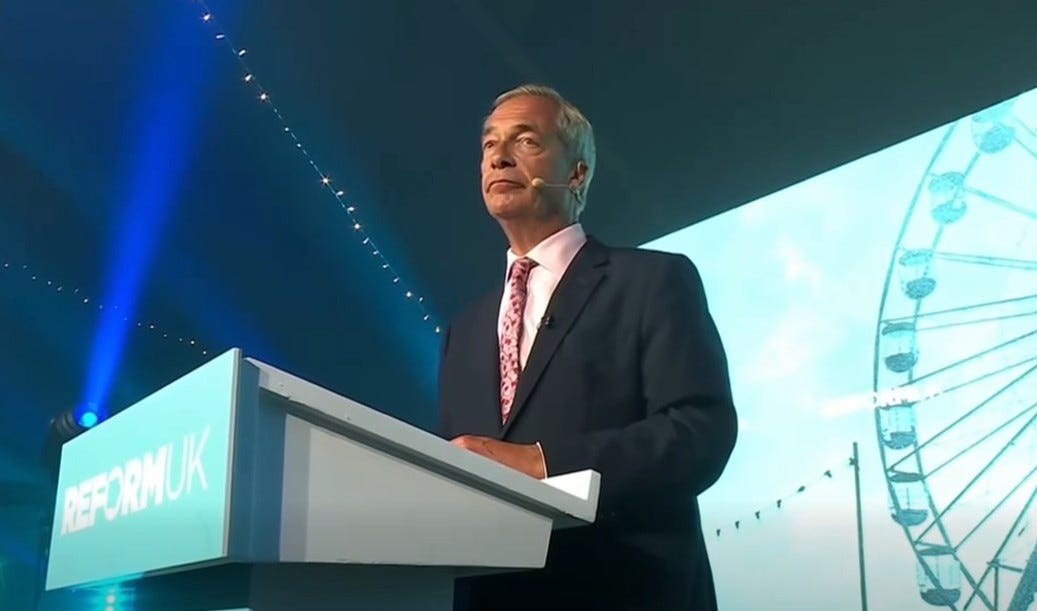
Nigel Farage ostensibly got what he wanted in Clacton.
He resigned his seat, forced an unnecessary byelection, spent weeks insisting that the people should judge him rather than Westminster’s “establishment”, and then won comfortably with over 22,000 votes and a 63 per cent vote share.
All in all; a political triumph. But not really. Because despite Farage’s resounding victory, the weeks leading up to the contest will be remembered as the moment Reform UK’s veneer cracked, and all the little pieces began to fall.
The result of the contest was never in doubt. Farage holds one of the safest seats in the country and none of mainstream political parties were prepared to indulge his political stunt. What Farage had maybe really intended to do was simply move the conversation on from finances and shady backers, to the idea of a witch hunt against him backed by an elite intent on destroying Reform.
But the questions surrounding Farage’s finances have hardly disappeared. Almost immediately – and as predicted – the Parliamentary Commissioner for Standards resumed the probe into Farage’s finances, while other inquiries and criminal investigations continue unresolved.
And the summer months, which Farage had once used to command headlines, have felt markedly different this year. Rather than launching major policy announcements, Reform has found itself responding to stories it would rather not be discussing, while Farage has himself went very quiet indeed.
In case you missed it, our special report from Clacton ahead of the by-election heard directly from voters on what they made of Farage with our mini-documentary being watched nearly 10,000 times.
Meanwhile, internal party tensions are becoming increasingly difficult to ignore. Farage and his former home affairs spokesman, Zia Yusuf, have publicly clashed in recent weeks after Yusuf described the former Conservative defence secretary Ben Wallace as a “traitor” on social media, prompting a public rebuke from his leader.
Rumours about a breakdown in their relationship have followed, but this is about more than a personal falling-out. Yusuf was a central figure in Reform’s earlier dispute with Rupert Lowe, now leader of Restore UK, exposing ideological and strategic divisions that were never properly resolved.
Some believe Lowe’s return could help Farage reunite the party and shore up support on his right flank. That seems a tad optimistic. Lowe’s supporters occupy an even more extreme political space, embracing figures such as Tommy Robinson and Elon Musk while advocating policies including mass deportations and the return of the death penalty.
If there is one consistent theme running through Farage’s political career, it is his striking ability to make enemies out of friends. He seems to be running out of allies. That helps to explain why rumours about his own future, including speculation that health concerns could eventually force him to step back, carry so much weight.
Reform is beginning to discover that beyond the man who is starting to falter, the party has remarkably little to say.
This week should have been an opportunity to shape the political conversation, buoyed by the momentum of their Clacton victory. But rather than focusing on welfare and the future of Britain’s benefits system, deputy leader Richard Tice used the accompanying press conference to launch into another broadside against net zero.
“When it’s a bit warm, let’s enjoy it,” he said. If climate change improved English sparkling wine and allowed Britain to “take on the French”, then all the better. It was a remarkable intervention from a party that claims to speak for working people. At a moment when communities are grappling with extreme temperatures, streets have been wiped out by wildfires, and there is growing anxiety about the climate crisis, one of Reform’s most senior figures chose to extol the virtues of champagne.
Aside from being remarkably tone-deaf, Tice’s comments expose the fundamental weakness within Reform UK. A movement built on moaning about immigration, net zero, anti-elite rhetoric and cultural wars does not a proper political party make.
Those issues have undoubtedly proved effective at grabbing attention, but grievance politics has limits. Eventually, voters start asking more difficult questions. What does Reform actually want to build? How would it improve public services? How would it raise living standards? What would a Reform government actually look like?
Reform’s outrage is beginning to falter as an effective governing philosophy. That challenge becomes even more acute when a party is consumed by investigations, internal disputes and questions about its own leadership. The energy that should be spent developing policy is instead spent on firefighting and cooling tempers.
Clacton was supposed to be a demonstration of strength, but Farage failed to silence his critics, consolidate his longevity and renew the party’s offering.
Of course, we all knew that winning a by-election against Count Binface was never going to solve the key challenges facing Farage. Instead, it raised an altogether different question: is Reform itself beginning to crack? ■
About the author: Zoë Grünewald is Westminster Editor at The Lead and a freelance political journalist and broadcaster.
👫Agree with Zoë? Share this story with your friends, family and colleagues to help us reach more people with our independent journalism, always with a focus on people, policy and place.
This weekend we launch our series examining Andy Burnham’s policies and the challenges that await him once the summer ends, lead by our Westminster Editor Zoë Grünewald we will bring you deep insight, reporting and thought into the key issues shaping the UK and a Burnham premiership. Subscribe now to support us to report on this and get it first to your inbox too.
There is a detectable shift. Picked up by the RW media - if not the BBC. But they are still not challenged fully, and still hold 20+ % of the vote