


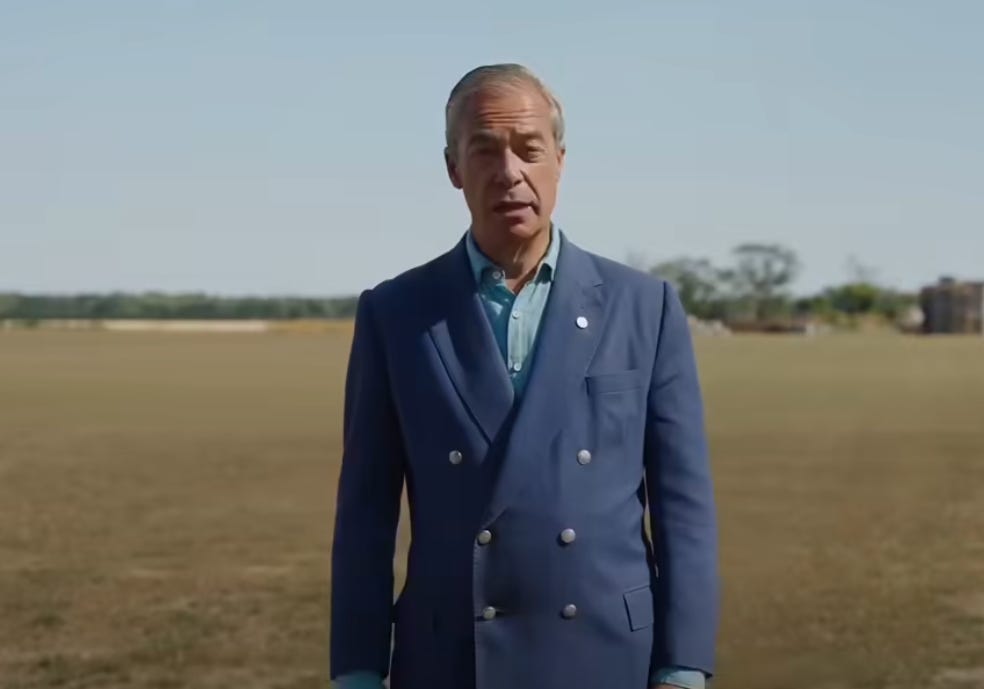
You may have noticed we’ve not been hearing as much from Nigel Farage lately.
After the self-indulgent diatribe about a media conspiracy against him — which ended with him resigning his Clacton seat and triggering an entirely unnecessary by-election — for the most part, Farage has been mercifully quiet.
Even before that, he’d been retreating.
Over the past few months, scrutiny of Reform’s finances had intensified after the reveal of an undisclosed £5 million gift from crypto-billionaire Christopher Harborne, plus questions over George Cottrell’s financial links to senior party figures. What was once a loud, outsider movement constantly dominating British politics had suddenly become a mainstream party quietly managing the same transparency questions it once levelled at others.
Only a few months ago, it felt like British politics had entered a new era. Reform seemed unstoppable, with Farage holding weekly press conferences to announce another predictable slice of new-right policy. The Tories were outflanked and Labour looked exhausted. Westminster’s only real preoccupation was how high the party could go.
Now, it would be foolish to declare the era of insurgency is over. British politics is too volatile for sweeping predictions, and the conditions that fuelled Reform’s rise (disillusionment, poorly regulated tech, falling living standards, distrust) haven’t gone away. But insurgency runs on momentum and a sense of inevitability that’s as much perceived as real.
For months now, Reform has publicly faced rough seas. A series of poor by-election results, mounting scandals, fractures across the populist right, and a shifting international climate, has produced genuine headwinds. When Farage retreats rather than braces for the storm, that tells you something important.
Andy Burnham has undoubtedly enjoyed a honeymoon. The “Burnham bounce” has seen the prime minister take a four-point lead ahead of Reform for the first time in fifteen months. Goodwill is politically valuable, and the new PM has projected optimism and competence, pairing quick wins like the bus fare cap and energy bill discounts with longer-term ambitions on social care reform and devolution.
In contrast, Reform UK remains almost entirely a party of grievance. Rather than a offering a vision of a more prosperous, productive or communitarian Britain, it doubles down on punitive proposals, like deploying the Royal Navy to intercept and forcibly return small boats, already dismissed by military figures and immigration experts as impractical, diplomatically inflammatory and potentially unlawful.
It’s politics built for headlines, not for reality. The disappointing by-election run points to the same problem, as does Farage’s decision to resign his seat and seek a fresh mandate. What is intended as a show of confidence has exposed raw vulnerability.
Then there’s the fading anti-establishment sheen. Reform has billed itself as the clean alternative to a corrupt establishment (never an easy claim for a party fronted by a former City trader and career politician, privately educated, who’s made £2 million in additional earnings on top of his MP salary). The question was always how quickly that would unravel, and the undeclared donations from Harborne and Cottrell, alongside a string of police and financial investigations, have answered it. Now, perception is shifting — recent YouGov polling found almost three quarters of Britons now regard Farage as sleazy, including 40 per cent of Reform’s own 2024 voters.
“Almost three quarters of Britons now regard Farage as sleazy, including 40 per cent of Reform’s own 2024 voters”
There’s trouble on the right flank too. The splintering of Restore Britain under Rupert Lowe, Farage’s former colleague, has rather complicated things. Lowe has become a figure of influence for those who think Reform is too focused on Farage himself, and who favour a much more extreme far-right politics of mass repatriation and division. He is backed by Elon Musk, whose platform, X, amplifies Lowe to his enormous following.
And even attempted peace talks have collapsed into more public fighting: within hours of Farage signalling openness to talks, Lowe accused him of “outright lying” about their private conversations. None of this projects a movement confident in its own supply.
As I’ve written before, the international backdrop that propelled the hard-right across the globe is possibly collapsing too. Donald Trump, once proof of concept for populists everywhere, looks more like a mad man than a strong man. British voters have little patience for a president who holds the UK economy hostage, enriches himself in office, and tramples norms for his own thin ego. Politicians like Farage — who have long tied themselves to the Trump brand — are slowly coming to regret it.
Now, I wouldn’t want to be the one to write Reform’s obituary too early. The party still commands a large vote share and benefits from deep malaise in mainstream politics. But Reform are starting to feel more and more uncertain, and their leader unmoored.
Momentum rarely dies in one dramatic moment, especially for populists who push norms and write explosive headlines every day. But it can erode through an accumulation of setbacks; like bad elections, awkward headlines, internal rivalries, shifting moods, and formidable opponents. For the first time since Reform’s emergence, all those trends are moving the same way.
If I were Farage, I’d be quiet too.
About the author: Zoë Grünewald is Westminster Editor at The Lead and a freelance political journalist and broadcaster.
👫Agree with Zoë? Share this story with your friends, family and colleagues to help us reach more people with our independent journalism, always with a focus on people, policy and place.
Plus take advantage of our special offer and get 30 per cent off an annual subscription (usually £49, use this link to get it for £34.30 instead) to help us keep holding power to account.
My view is that within a year or so the 2r's will be sharing about 20-22 % ish between them. Not one of them will have enough to be a force and they will be fighting bitterly between themseves.
You forgot to mention racism. That's what motivates most of his followers.That's why he talks about immigrants all the time. He knows he's onto a winner.