


There’s a specific kind of panic that no amount of media training can disguise.
It is vicious and snarling, like a wounded animal. It usually precludes something fatal; the moment when a politician’s carefully controlled public persona gives way to the more primal instincts of fight or flight.
Just ask Nigel Farage. It started with an altercation at Heathrow airport, where Sky News asked a relatively straightforward question about George Cottrell, the convicted fraudster who the Sunday Times revealed has been privately funded him for years.
Instead of answering, Farage turned on the cameraman, accusing the broadcaster of harassing his family and warned there would be “serious consequences”. Sky says nobody has contacted his family.
The crisis has deepened. Just now, Farage held a surprise press conference. During a long, rambling speech where he declared men in London cannot wear watches, compared donor rule changes to living in a communist country, and accused the Times editor of "directly threatening" his daughter's security, Farage somewhat buried the lede and announced he is resigning as an MP, forcing a by-election and will contest the seat. “This will be a people versus the establishment by-election,” he declared, with not a hint of fascism. “It’s a chance to stick two fingers up to the entire establishment, to frankly tell them where to go.”
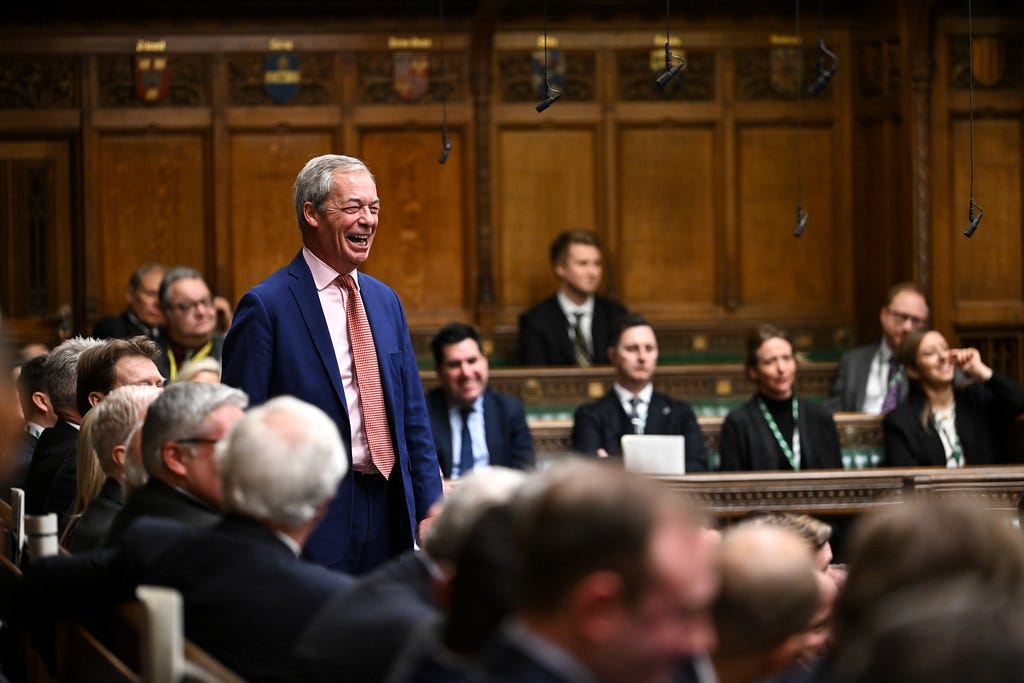
Underneath the familiar rhetoric, something has changed in Farage. This isn’t the man voters know. The image he has carefully cultivated for decades; an impish public school boy, impossible to rattle, happy to spar with journalists, always ready with a joke and a pint, is no longer there. That mask has slipped, and beneath it lay an angry, conspiratorial man.
For all the talk of political courage, the decision to call a by-election looked less like a bold gamble than an act of desperation. Farage may have bought himself some time by forcing the Parliamentary Standards Commissioner to suspend its investigation into his donations, but the manner of his response marks the beginning of a series of far larger questions that he must now answer.
The first is what it says about the company Farage keeps. Farage accepted staff, security and the use of a townhouse near Buckingham Palace from ‘Posh George’, a crypto financier convicted of wire fraud in the United States, who served time in prison and is now reportedly seeking a pardon from Donald Trump.
Reform UK’s defence is that none of this needed declaring because it predated Farage becoming an MP and was personal rather than political. That itself is a questionable defence — Farage served as Reform’s honorary president between March 2021 and June 2024, during which he received the support from Cottrell. On 3 June 2024, he confirmed he was returning as party leader and for Reform in Clacton-on-Sea. Under parliamentary rules, new MPs must declare financial interests and “registrable benefits” received in the 12 months before their election.
But of course, legality isn’t the only question. Cottrell appears to accompany Farage almost everywhere, from fundraisers to overseas trips. Why a man who wants to be Prime Minister has to be so closely trailed by a convicted fraudster is an entirely reasonable question — and one that, so far, has not received a convincing answer.
Nor is this the first time that Farage’s friendships have raised eyebrows. It is the second opaque funding story to engulf Farage this year, following the £5 million donation from Thailand-based crypto billionaire Christopher Harborne. Farage insists Harborne wanted “absolutely nothing” in return. Yet taken together, the pattern is uncomfortable. Two immensely wealthy benefactors and two relationships that Farage saw little need to disclose fully at the time. Curiously, in today's rant he found full-throated gratitude for Harborne, yet Cottrell's name never came up. If Farage were totally confident in both his relationships, why not give Posh George a shout-out, too?

The second problem is Farage’s selective transparency. The rules governing MPs’ interests are not especially complicated. Gifts or benefits that could reasonably be connected to political activity should be declared, and MPs manage this without much difficulty.
Yet every time Farage finds himself under scrutiny, the explanation is another technicality. He wasn’t yet an MP; it was a personal arrangement; it predated the register. This is coming from the very same man who branded Keir Starmer “Free Gear Keir” after accepting — and declaring — glasses and the use of a flat from a Labour donor and peer. Farage seems hot on the rules when it comes to his political adversaries but pretty lax on his own obligations.
The third problem is the money itself — and exactly what it might buy. Neither Cottrell nor Harborne are simply wealthy businessmen who happen to admire Farage. Both are deeply embedded in the world of cryptocurrency, one of the least transparent corners of modern finance. That world is lightly regulated and highly secretive, an attractive proposition to those who prefer money to move quietly.
That does not mean every crypto entrepreneur is suspect, of course. But when two of the politician’s biggest benefactors emerge from precisely that world, voters are entitled to ask why. The insistence that these men simply expect nothing in return —that extraordinary generosity is just part of their nature — asks the public to suspend an awful lot of disbelief.
Perhaps it is merely coincidence that Farage privately urged the Governor of the Bank of England, Andrew Bailey, to abandon plans for a state-backed digital currency that could have competed with Harborne’s Tether. Perhaps it is coincidence, too, that Reform UK has quietly dropped its promise to make Britain a “crypto powerhouse” from its website. But if so, he owes the public a better explanation than “nothing to see here”. After all, people do not generally hand politicians £5 million out of simple admiration when there are countless other causes that might benefit from such.
So, what can we conclude from this extraordinary saga?
Make no mistake, this is a serious gamble. Forcing a by-election hands the establishment he claims to despise the one thing they couldn’t otherwise get: a direct verdict on him, personally, mid-scandal.
The bet, presumably, is that Clacton backs him regardless, and he can then wave the result around as proof of concept — the will of the people, move along. But elections are blunt instruments, and this one risks revealing something Farage may have intended to keep quiet: Fifteen minutes of a man convinced the world is out to get him, snapping at anyone who suggests otherwise. That’s not the rogueish, unbotherable Farage of the last decade. It’s thinner-skinned, grumpier, and considerably less fun, and swing voters who tolerated the schtick because it came with a shrug may find they have far less patience for the snarl.
Underneath the funding rows and the flashes of temper, Farage has inadvertently raised some key questions. What happened to the Farage who was authentic, independent, impossible to buy? Watching him today — rattled and lashing out — it's hard not to conclude that Farage no longer exists. Perhaps it never did.
That image is the whole business model. Without it, the Farage mirage starts to disappear. ■
About the author: Zoë Grünewald is Westminster Editor at The Lead and a freelance political journalist and broadcaster.
👫Agree with Zoë? Share this story with your friends, family and colleagues to help us reach more people with our independent journalism, always with a focus on people, policy and place.
The Lead has been keeping a close eye on Reform UK and its leader: from his ‘lottery-equivalent’ donation from Harborne to the self-proclaimed anti-establishment leader’s silence on Epstein. More recently, we dug into his inflammatory (and false) claims about two-tier policing and, for our recent 10 years of Brexit series, Zoë charted the trajectory that got us here.
If he were to win in Clacton again, surely the investigation will simply reopen as the rules will still apply. So what then? Will he just keep resigning and calling by elections in perpetuity until Reform's £9m and his 'personal' £5m run out?
Farage is nothing but a con man. He was a terrible mp who held no constituency surgeries and only showed up in Clacton when there was a photo opportunity, he spent more time in the US, has 10 other jobs, and broke Westminster standards. Clacton deserves better