


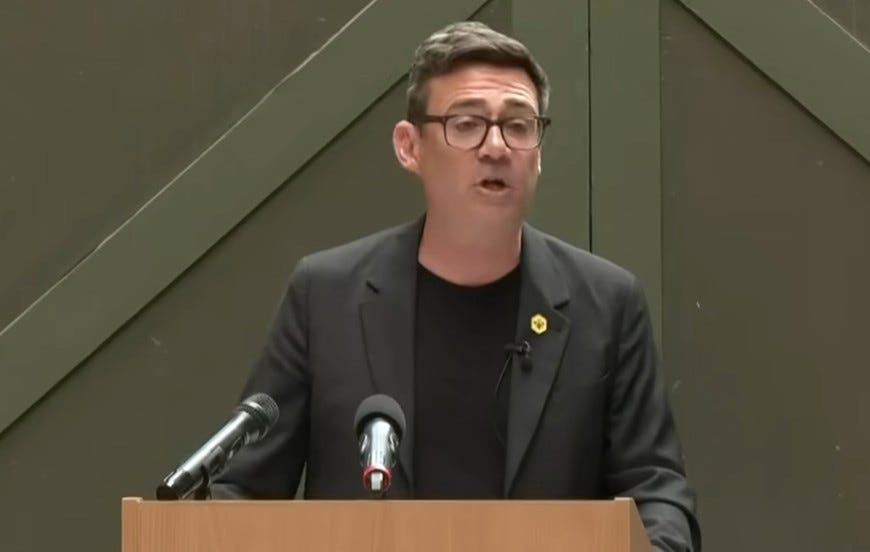
There was a line buried in Andy Burnham’s speech yesterday that mattered more than almost anything else.
Britain, he argued, doesn’t simply need a change of government. It needs “the biggest rebalancing of power our country has ever seen.”
For years, politicians have promised to mend the NHS, build houses and grow the economy. But Burnham’s intervention was important, because it started with the fundamentals: the way Britain is governed is itself part of the problem.
Britain is unusually centralised, more so than many of the democracies in the developed world. Decisions affecting millions of people are still funnelled through Whitehall departments and ministers who often know little about the places they’re making decisions for. Local leaders lament spending as much time bidding for funding as they do actually governing. Its an absurd way to run a country anyway, especially one that contains economies, demographics and needs as different as Manchester, Cornwall, Teesside and London.
Burnham’s proposed No.10 North and a new wave of devolution is therefore an encouraging place to begin. His speech yesterday was refreshingly optimistic, good-humoured and a direct challenge to Treasury orthodoxy and the political stagnation that has left the country listless. He certainly looked and sounded like the next prime minister.
But the diagnosis is easy — it’s the cure that’s tricky. Devolution is one of those ideas that has been tried, tested and flirted with by almost every political party. You are highly unlikely to hear a policy wonk or commentator worth their salt calling for more centralisation, and less power to local communities.
 Tiktok failed to load.
Enable 3rd party cookies or use another browser
The problem is the realities of governance. Whitehall has a long history of announcing decentralisation while quietly retaining control over the money, the rules and the ability to intervene whenever ministers feel uncomfortable. Genuine devolution requires a government with an appetite for relinquishing control, something that five year terms, FPTP and partyocracies don’t really leave space for.
Nor is devolution a magic wand. Scotland and Wales demonstrate its possibilities and its limits. Both have developed distinctive policy agendas and strong national political identities, but so too do they have sluggish productivity, stretched public services and difficult financial trade-offs.
England presents an even greater challenge. Metro mayors may have transformed local leadership in places such as Greater Manchester and the West Midlands, but their powers remain patchy and heavily dependent on what the treasury is willing to give. Different areas operate under different deals, leaving local government feeling more of a confusing patchwork than a coherent concept.
There’s another challenge, too. Burnham is right that Britain’s political system has lost public confidence. Trust in politicians is historically low, and Reform UK is building momentum on convincing voters that Westminster simply doesn’t work.
The temptation for any insurgent is to lean heavily into that argument, but Burnham must be careful with his outsider shtick. He cannot afford to become just another politician telling people everything is broken. If voters conclude the entire democratic system is irredeemable, it won’t be Labour that benefits, but Nigel Farage, and as soon as Burnham looks to become part of that establishment picture, voters will become suspicious.
That means Burnham needs to walk a careful line. He must be honest enough to acknowledge institutional failure, but optimistic enough to persuade people those institutions can still be repaired. That means reforms beyond devolution.
As I’ve previously written, the next prime minister should take a serious look at cleaning up Westminster. Things like tighter standards for MPs, banning second jobs, strengthening independent ethics enforcement, and finally confronting constitutional questions that have sat untouched for years — including electoral reform — would all signal that a promise that extends beyond speeches, is happy to remove the temptations of power, and demands high standards from elected representatives.
And then there’s the economy. Devolution can make Britain govern itself better, but that will not magically plug our economic blackhole. If the country genuinely wants sustained, progressive growth, higher productivity and rising living standards, it will eventually have to confront bigger questions about Britain’s relationship with Europe. Burnham has previously only said he wants to see the UK rejoin the EU in “his lifetime”. This conveniently long-term vision alongside some constitutional rewiring cannot fully compensate for the trade barriers created by Brexit.
And in the meantime, Burnham also needs short term wins. Voters struggling with mortgages, food prices and energy bills won’t wait years for constitutional reform to bear fruit. His plans on housing, high streets and the cost of living matter a huge amount to, and his government must work out how to quickly show that government can still improve people’s lives.
But that's ultimately what this speech recognised. Britain's crisis isn't simply one of public finances or public services, but of government, institutions and politics itself.
Most importantly, Burnham is signalling that carefully managed decline is no longer an option. He is willing to grapple with the deeper causes of Britain’s stagnation, not just its symptoms, and understands that the country has little patience left for technocratic tinkering. Whether that ambition survives contact with governing reality is another matter entirely. Good luck, Andy. ■
About the author: Zoë Grünewald is Westminster Editor at The Lead and a freelance political journalist and broadcaster.
👫Agree with Zoë? Share this story with your friends, family and colleagues to help us reach more people with our independent journalism, always with a focus on people, policy and place.
Enjoying our series on a decade on since the EU Referendum? Zoe’s essay on the rise of Reform since Brexit paved the way is available to catch up on, along with the case for closer ties with Europe, the impact Brexit has had on our universities and drilling into the data around what Brexit did to the economy.
Subscribe now to ensure you get our next parts as we visit Dover to hear from people on the frontline of Brexit and also those from the EU who have been living in the UK since the Leave vote.
Don't just need to decentralised government need to adopt a new economic model. 40byears of neoliberalism and market economics has resulted in austerity, the decimation of public services and the concentration of wealth in private, corporate or even foreign hands to the detriment of the working and middle professional classes. Is it time MMT should at least be trialled?
As in so many commentaries on Burnham, there is nothing here about his line on the UK's continued support of Israeli attacks and illegal takeover of land in the West Bank. Declaring Palestine a nation is one small step, but nothing more. Without more trenchant policies from the UK (whatever Trump does), the suffering will only continue. Huge numbers of wavering Labour supporters are waiting to hear from Burnham on this and on the insane imprisonment of people with legitimate opinions written on posters. If he doesn't mean to change, he won't last very long. Before the bi-election he waffled on it and his hiring decisions seem to be keeping him firmly under Israel's thumb. Decisive action on this would make more people willing to listen and perhaps even support him. Not optimistic sadly!