

Parents aren’t failing their children: the state is failing parents
Welsh baby bundles are welcome – but they won’t rebuild the village parents desperately need.


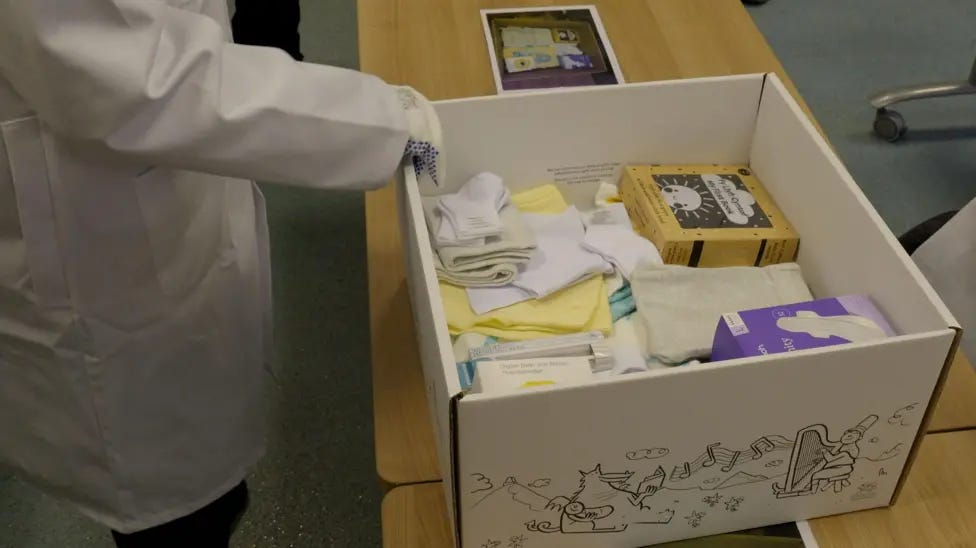
This week, the Welsh government’s launch of Baby Bundles – free essential supplies delivered to expectant parents – is an overdue and welcome recognition that parenting is not, in fact, a solo sport. It takes a village to raise a child, and by following in the footsteps of Scotland’s universal Baby Box scheme, Wales is making a deliberate intervention that acknowledges this forgotten truth.
In England, new parents are largely left to fend for themselves. As families live further from relatives, many in transient housing situations, community networks have thinned. At the same time, state support has been hollowed out. Sure Start centres have closed in their hundreds, health visitors are stretched beyond capacity, community spaces where parents once gathered have disappeared. Childcare costs are among the highest in Europe, while parental leave remains inadequate and unevenly distributed. In that context, a baby bundle feels almost radical – policy that is humane, forward-thinking and materially useful.
On Saturday, the latest feature in our ongoing series The Hope Reset will shine a light on the individuals and grassroots organisations working to fill the gaps left by eroding state support. From the dads collectives championing caregiving equality (and teaching fathers how to plait hair), to the community for motherless mothers – the village may look different now, but it hasn’t disappeared. Subscribe to The Lead to make sure our weekend read lands in your inbox.
Early years support has always been crucial. But recent headlines suggest it matters now, more than ever. Parents and teachers talk of a national crisis with 40 per cent of children showing up on the first day of school without basic life skills – many aren’t potty trained, some don’t know how to use a book, or feed themselves. This is undoubtedly a crisis. Not only for early years educators who are shouldering this additional burden – changing nappies certainly isn’t in their job description – but even more crucially, for the future of the next generation, seemingly stilted at a critical point in their development.
But the framing of this problem is worrying. The message is that something has gone wrong at home. Children are being allowed too much screentime, or parents aren’t reading or talking with their children enough. And exhausted mums and dads, already stretched to breaking point, are now being told that they have failed. But parents aren’t failing their children, the state is failing parents.
Most parents do not need to be convinced to read with their children, or that play, routine and conversation are vital. They want to do these things. What many lack is not motivation, but time, money, and support. When parental leave ends too soon, childcare costs swallow wages, and families are juggling insecure work and spiralling living costs, parenting inevitably becomes about survival, rather than enrichment.
Wales’ Baby Bundle contains a bilingual book and a playmat with a focus on giving children the “best start in life”. For families in poverty – (4.45 million children were living in poverty in the year to April 2024) – free resources are a lifeline. But this kind of intervention, while welcome, will only ever be a sticking plaster on a gaping wound.
If governments are serious about early years development, the solutions are not mysterious; longer and better-paid parental leave, affordable childcare, properly funded children’s centres, and financial security that allows families to spend time together.
Recent, smaller interventions have given hope that Labour (in England) are heading in the right direction on parental support. This week it was announced that families of children with cancer will have costs covered for travelling to appointments. The launch of hundreds of new primary school breakfast clubs, is another sign that the realities of parenthood are finally being acknowledged. But there is further to go.
Yes, Labour should launch Baby Bundles in England, but the village cannot be rebuilt with cardboard boxes and good intentions alone. If children are arriving at school already behind, the question is not what parents are doing wrong, but what the state has chosen to stop doing altogether.■
About the author: Natalie Morris is our Senior Editor here at The Lead. Elsewhere, she is a freelance writer, author and journalist and host covering social justice, inequality, health and community.
👫If this article resonates with you, comment, share and spread the word. We always love to hear your feedback, or if you have own experience to share – of lacking parental support, or another story we should be shining a light on – email natalie@thelead.uk.
Today parents are stuck in a widening chasm of isolation. Expectations of what a ‘good parent’ looks are higher than ever. Yet, our support systems are falling away underneath our feet. It is absolutely a systemic issue and they shape the social factors. I was reflecting on my mums motherhood journey. At the age of 21 she was married with two children, a house and worked full time. It seems impossible today but the game was different. She also had a secret weapon - a village. My grandmother lived 30mins away by bus. We’d spend whole weekends as her house at least twice a month. Then there was my aunt. We’d spend nights with her too. Then there were our neighbours who happily took us home with their children after school and looked out for us. Then the outdoors played a role too, something we don’t often consider - the streets felt safe enough for groups of children to play within view of the kitchen window.
The game has quietly but surely changed for today’s parent. The impact is clear - 20% of women experiencing postnatal depression. Suicide is the biggest killer of women during pregnancy and postpartum. Research has shown that women might only get one hour a day to themselves after having a baby. Social isolation is rife at this critical life stage with women spending 9+ hours alone in the day when their partners only get two weeks paid paternity pay. Women are under financial pressure to return back to work after birth before they’re even ready. These are complex issues with multiple causes but the system, in its current form, is making it increasingly harder to raise a family and stay sane. There’s so much to say and so much to fix. Parents aren’t failing their children, the system is failing parents. Couldn’t agree more.