


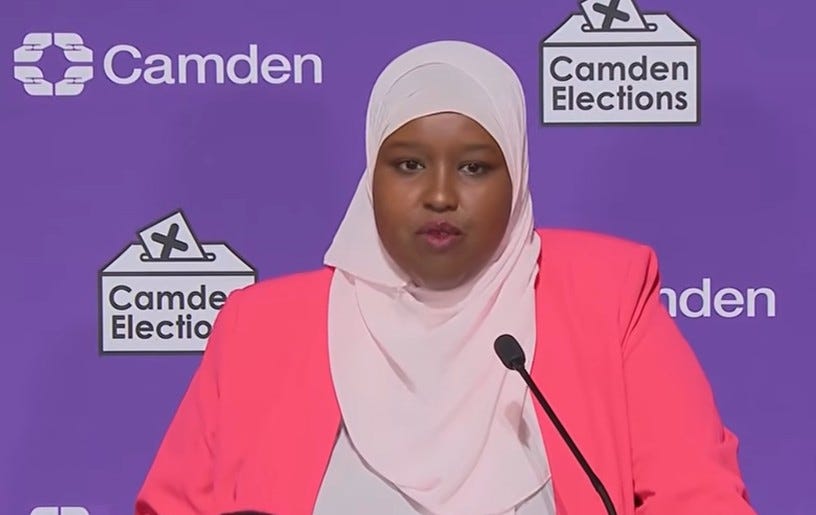
If you stayed up for the Holborn and St Pancras count hoping for a political earthquake, bad luck.
Labour’s Sagal Abdi-Wali held Keir Starmer’s old seat with 12,292 votes (45.1 per cent of the vote), beating Green leader Zack Polanski by 3,364. Turnout was around 39 per cent – totally unremarkable for a by-election.
It was a comfortable hold. The honest — and slightly dull — reading is that there isn’t much to take from it, except the one thing that matters most to Number 10 this morning: voters still seem willing to give Labour a chance.
Start with the Greens, because they built their autumn around this result.
On paper, Holborn and St Pancras is exactly the kind of seat where the Greens should be making seismic gains. It’s young, with an average age of 32. It’s highly educated: around half of residents have a degree. It’s home to UCL, the King’s Cross tech cluster and some pretty eye-watering property prices, yet fewer than one in four households own their home. Young, squeezed private renters and diverse inner-city estates make up the Polanski project; so it made sense to stand the Green leader. Sadly for them, he lost by 12 points.
It may or may not have helped that the final week of campaigning wasn’t about the Green’s flagship rent controls policy, but about the party conference voting to define Zionism as racism. Polanski skipped the vote to campaign in Camden. The Chief Rabbi condemned the motion, four of the party’s five MPs publicly rejected it, and Israel barred Polanski from entering the country. Former leader Caroline Lucas publicly criticised Polanski’s lack of leadership on the issue. How much that impacted the final vote is impossible to know, but it was certainly an unwelcome distraction for Polanski and the rest of his party.
To be fair to the Greens (who are making this point loudly this morning) their vote share more than tripled; a 22-point jump in one of Labour’s safest seats.
That reading may prove deceptive. As pollster Peter Kellner points out: In 2024, the anti-Labour left vote was split, and the Gaza independent Andrew Feinstein took 18.9 per cent, more than the Greens did. Feinstein backed Polanski this time, and if you put his share together with the Greens, the non-Labour left had 29.3 per cent in 2024. Last night it got 32.8 per cent. So only up three and a half points; not necessarily something that can be described as “a surge”.
In another context that would be perfectly respectable. The Burnham bounce is real, and holding your ground through a new prime minister’s honeymoon is no disgrace. But ultimately the Greens played their trump card, the leader whose personal brand has driven their poll surge.
Of course, you cannot extrapolate a general election from a by-election. This one had a historically unpopular former PM’s seat and a single-issue row in the final week, which made it a particularly strange contest (although by-elections have been mounting in their individual peculiarities in recent times). The Greens won Gorton and Denton in February, and that didn’t make them a party of government either.
For Labour, a hold like this does matter. This was Starmer’s seat. Voters here had every opportunity to punish Labour for the last two years, a protest vote would have been easy and cost them nothing, and there was no real threat of Reform winning in this area, which might have seen a coalition of left-wing voters holding their nose and voting for the governing party. Despite all this, Labour’s share fell by less than four points on 2024.
Even Polanski acknowledged it, telling Today programme’s Nick Robinson that voters liked what the Greens had to say, but they still wanted to give Labour another chance.
Further down, the Conservatives came third on 7.1 per cent and Reform fourth on 5.9 per cent. Don’t read too much into the Tories’ third place, their share is almost identical to 2024. Reform’s number is the more interesting one, sitting slightly below what they got here in 2024. This is about as Reform-unfriendly a seat as exists (and Restore Britain certainly nibbled at the edges), but it’s still fits that whispered pattern of the Reform vote stalling since Burnham arrived.
That brings us to the question everyone in Westminster is asking this morning: how about an early election?
Holborn suggests people still have some faith in Labour, but the gamble is how much patience. Burnham has to prove that something is tangibly changing in people’s lives. Meanwhile the Greens can keep pushing radical ideas from the sidelines, with nothing to deliver.
Burnham has radical answers of his own: fixing social care, a closer relationship with the EU, and proportional representation. These are big structural changes that could materially change things. The question is whether he can afford to leave them in the long grass, or whether he needs to bring them forward and show people what a Burnham government is actually prepared to do. ■
About the author: Zoë Grünewald is Westminster Editor at The Lead and a freelance political journalist and broadcaster.
👫Agree with Zoë? Share this story with your friends, family and colleagues to help us reach more people with our independent journalism, always with a focus on people, policy and place.
now we know where Wali is.
I think your article and the comment are somewhat previous and wrong. The results show that the Greens Party are still a force to be reckoned with. Polanski secured 32.8% of the vote, as opposed to 10.8% in the general election, and Andrew Feinstein, an indecent, secured 18.9%. This is when we are experiencing the Burnham honeymoon. Let’s see what happens after the budget.