


For a major donor to a political party - and one who has had the ear of environmental policymakers as a result - the green energy entrepreneur Dale Vince is surprisingly willing to give up his influence. As Westminster wrangles over what to do about billionaire donors, the founder of Ecotricity has himself given up political philanthropy.
After giving more than £5m to Labour since 2020 (to, in his words, “level the playing field”), he now believes it’s up to all of us to make our politics work.
He wants us all to pay more tax to keep all political parties, from the three central institutions to the full wave of rising incomers, to be funded by us.
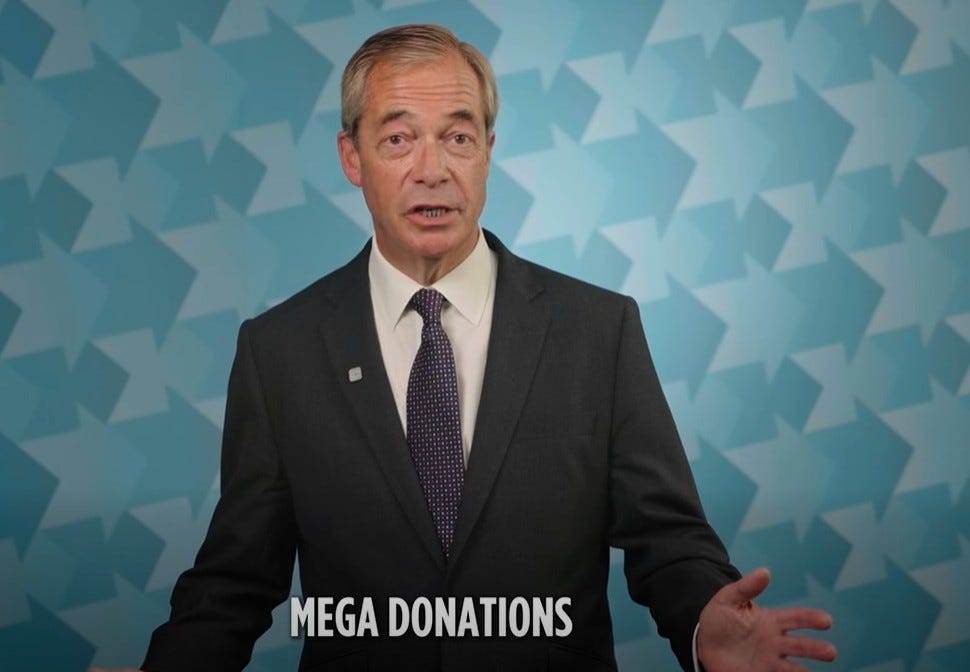
He’s got a point; something has to change. When two hyper rich men can on the face of it appear to buy into a political party (albeit one registered as a company), then the function of democracy is at stake. The £72m that Farage has received from former offshore crypto investors Christopher Harbourne and Ben Delo may be deemed unlawful if the government’s own legislation is passed capping ex-pat and overseas donations at £100,000.
Farage objects to a clause in the bill that means it will be applied retrospectively, leaving him at risk of being forced to pay back some of the sums.
The debate has been injected with rocket fuel by the sheer size of the gifts involved this time, but the principles behind the race for donor funding remains the same, whatever the ceiling.
Farage’s political paint-by-numbers response is to claim that major windfalls from single individuals exert no different level of influence than those representing thousands of individual members coordinated through a handful of union leaders.
That might not pass the sniff test, but it does explain why more than two decades ago Gordon Brown got cold feet over significantly capping donations to political parties. If Labour can’t survive the tussle of Westminster without the money of the unions, can it really afford to take a moralistic tone over major gifts elsewhere?
Labour also has to grapple with another growing problem. The argument for membership as a funding mechanism looks unsustainable in a political world that has become increasingly fragmented. It would be naïve for Labour to assume that union funding will mean so much, and be so easily available, in another decade’s time.
There are other options for removing the power of private money from British democracy. One is to ban big donors, capping gifts at a relatively low figure such as £100,000, and replacing the immediate gap that would emerge in our political system with public funding.
Perhaps in time public funding could be reduced as the number of people participating in gifting into our political system was increased, but the initial financial upheaval would be worth the cost to the public purse. It’s not so radical a suggestion: a small-scale system like this is already in place with the allocation of “short money”, funding for opposition parties to help them meet their parliamentary responsibilities.
This is a plan endorsed by the Electoral Reform Society, and would prevent the creeping privatisation of political influence. Today, major donations over £1m account for 35 per cent of all private donations. Just a decade ago they made up 1%. A radical shift is needed to stop that process from accelerating, a process which is disenfranchising ordinary voters.
Another suggestion is to offer tax relief on political donations, similar to the ‘gift aid’ mechanism that grants tax back on charitable donations or the tax free childcare scheme. This would mean that, for example, a donation of £100 would only cost the donor £80. Combined with an overall cap on donations, it could introduce more people to get involved in party politics and take responsibility for co-funding our democracy.
A similar alternative could be for the government to give all individual voters a small annual political credit (say, £20) which they could then allocate to any registered political party of their choice. This shifts the onus of the party from donor hunting, courting influence, to the engagement of millions of ordinary people, fostering participation.
The Electoral Commission has analysed the strengths and weaknesses of all these approaches. But none of these suggestions overcome the biggest problem that is raised by the existence of political donations, whatever their size - and that of fairness. The principle of our democracy is one adult citizen, one vote. In order to participate fairly we should all have equal ability to influence, and the core structures of our democratic practice should not rely on the whims of private wealth and the fluctuations of the world economy to remain stable and functional.
If all political parties became part-public funded institutions that would allow the Treasury to allocate taxpayers’ money from general taxation, according to a formula based on votes received or the share of seats won in the House of Commons. We would all have a stake in how the democratic system works, representing fairly the most recent political will of the country. It is, fundamentally, a fair and democratic solution.
But this costs money, and the latest polling shows that attitudes towards welfare are hardening even though social support through benefits and public services are relied upon by a growing percentage of the population. Making the case for raising tax just to keep politics moving is a very tough sell. Dale Vince describes the rise as the equivalent to the cost of a packet of crisps, per person per year: small, but still potentially unpalatable. But how does timidity taste?
Retrospective caps on overseas or ex-pat donors might force Farage, the most destabilising political influence of our times, to hand money back. It won’t affect the relationship he has with those donors of the power they arguably hold over him. And it certainly won’t prevent future wealthy individuals engaging in a cash in/control out relationship with politics.
An overhaul of the political funding system is overdue, but the strength to wrestle with that question also appears to be in short supply. ■
About the author: Hannah Fearn is a freelance journalist specialising in social affairs. She was comment editor of The Independent for seven years, and has previously worked for The Guardian, Times Higher Education and Inside Housing.
👫Agree with Hannah? Share this story with your friends, family and colleagues to help us reach more people with our independent journalism, always with a focus on people, policy and place.
We keep a watchful eye on Reform, and others, as we’ve unpacked how it’s the end of Reform as we know it, reported in-depth from the streets of Clacton during the sham by-election and dug into what’s next for Nigel Farage. The more supporters we have for The Lead, the more we can expose what Reform and co are up to - and how they are spending that mega money too.
Editor’s note: Zoë Grünewald is away, having recently got married and is enjoying some well earned time off. All of us at The Lead wish her and her husband many many congratulations!

The simple answer is to ban donations over £1000. All donations must be registered with the electoral commission, no company may donate and no one person may donate any more than twice a year. You must be resident in the UK to donate. At an election every parry gets allocated exactly the same amount for campaigning and that is the only money they can use. They all get 1 tv broadcast of 5 mins. That is it, they actually have to get members out on the streets. Level the playing field by law, but none of them will do it of course.