


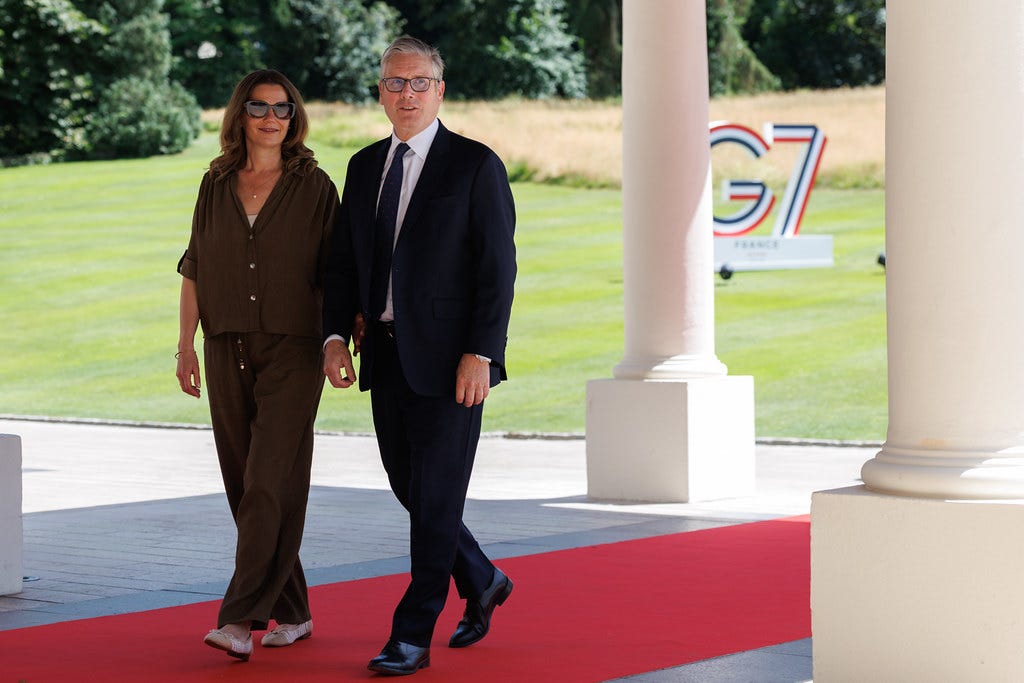
What was Keir Starmer’s original sin?
Was it winter fuel? The freebies ‘scandal’? His unambitious tax and spend plans? Peter Mandelson? Was it his dullness, his lack of charisma, his strange refusal to dream?
What if I told you that Starmer’s fate was sealed long before he ever set foot in Downing Street?
Before he crafted his manifesto, before he became Labour leader, perhaps even before he entered frontline politics. What if Starmer’s fatal flaw wasn’t his at all - but one he inherited, refused to confront, and eventually succumbed to?
Today marks 10 years since Britain voted to leave the European Union. Over this month, The Lead is commiserating, with a series of essays and features exploring the long fallout from that decision: its economic consequences, its cultural legacy and the ways it continues to shape our politics.
Later this week, I’ll be writing about how Brexit helped create the conditions for Reform UK’s rise, while our other contributors chart Brexit’s impact on universities, coastal towns and our economy.
But perhaps the most immediate reminder of Brexit’s enduring influence arrived yesterday, almost as if it had been planned. Brexit claimed its latest casualty; after months of pressure, Starmer is stepping down.
Let’s wind back a little, and remind ourselves: we’ve been here before.
‘Starmer refused to look Brexit in the eye.
That may prove to be his defining mistake’
David Cameron gambled his premiership on a referendum he never expected to lose. Theresa May spent three years trying and failing to reconcile the irreconcilable demands of Leave voters, her frothing backbenchers and economic reality.
Boris Johnson succeeded in “getting Brexit done” but struggled to govern the fractious country that emerged afterwards. Liz Truss inherited an economy with little room for error and attempted to grow her way out of Brexit-induced stagnation with catastrophic consequences.
And Rishi Sunak, much like Keir Starmer, struggled to convince a permanently angry electorate that a technocrat could grapple with the challenges of post-Brexit Britain. Now, for the first time, a Labour leader joins the list.
Of course, Starmer’s downfall was not caused solely by Brexit. His premiership was damaged by entirely predictable internal Labour rebellions and growing public frustration that the promise of change had not translated into anything meaningful.
He seemed committed to governing as though he were permanently campaigning for the next election, pursuing a lost tribe of voters who barely existed in the first place while alienating much of his core support in the process. It was a masterclass in poor political management. Ultimately, he had to go.
Yet all of those problems existed within the political and economic landscape Brexit helped create.
Labour under Starmer did have achievements; some modest, some genuinely significant. The Employment Rights Bill and Renters’ Rights Bill immediately reduced insecurity for millions of workers and tenants. The government began the process of renationalising the railways. It introduced breakfast clubs for hungry children across the country. It eventually abolished the two-child benefit cap, lifting hundreds of thousands of children out of poverty overnight.
The problem is that the political landscape in which these stories existed had been permanently altered by Brexit. The turmoil, anger and intrigue unleashed by the referendum fundamentally changed our politics; forever altering the media ecosystem, and our public expectations of politicians, and creating a political environment in which incremental progress struggles to cut through. Good news rarely survives the news cycle because, ultimately, editors want psychodrama.
On the day the Health Secretary resigned, it was announced that NHS waiting lists fell by 110,000 in March — the biggest monthly drop outside of Covid since 2008. But this fact was barely acknowledged; it was the cutting words of Wes Streeting’s resignation letter that made the front pages.
The irony is, of course, that Starmer had the opportunity to break the cycle. He was the first prime minister not tied to a fundamentally pro-Brexit project and had spent years arguing against withdrawal.
He was surrounded by advisers and colleagues that knew about the huge elephant in the room: the economic self-harm, the diminished influence, the vulnerabilities Britain had imposed upon itself. Instead, Starmer chose to cosy up to an increasingly erratic US president after distancing ourselves from our closest European allies, and allowed his premiership to be haunted by small boats and immigration – issues that Brexit was supposed to solve but instead elevated to the centre of political life.
Ultimately, Starmer refused to look Brexit in the eye. That may prove to be his defining mistake.
That is not to say every problem Britain has faced over the past decade stems from Brexit. The pandemic happened, Russia invaded Ukraine, all of this was set in the backdrop of thirteen years of austerity. Governments made mistakes entirely unrelated to leaving the EU.
But Brexit damaged Britain on two fronts. First, it left the UK economy around 6-8 per cent smaller than it would have been had we remained. Trade became more difficult, labour shortages emerged across key sectors, business investment lagged behind comparable economies, growth weakened and public finances suffered. Those consequences matter because politics ultimately depends on delivery. Governments survive when people feel their lives are improving. That is the defining story of our last decade.
But Brexit also changed our national psyche. It normalised a deep suspicion of elites, from Brussels to Westminster. It reinforced the idea that experts, institutions and politicians were conspiring against the public will. Immigration became not simply a policy issue but a symbol of unfairness, decline and grievance, and we became more isolated, more distrustful and more cynical at precisely the moment Britain needed confidence and cooperation.
The rise of Reform did not happen in a vacuum. It was built on the same frustrations, resentments and unfulfilled promises that powered Brexit itself. And Starmer too often chose to engage with Brexit’s assumptions rather than challenge them. He rarely confronted the architects of Brexit over their promises, their failures or the damage they had inflicted. Instead, he positioned his premiership in the framework they had created.
Starmer’s government made plenty of errors. But 10 years on from the referendum, it is worth asking whether any were quite as consequential as his refusal to confront the defining political event of his generation. ■
About the author: Zoë Grünewald is Westminster Editor at The Lead and a freelance political journalist and broadcaster.
👫Agree with Zoë? Share this story with your friends, family and colleagues to help us reach more people with our independent journalism, always with a focus on people, policy and place.
🇪🇺 This story is the next part in our series examining the impact voting to Leave the European Union had on the UK since June 2016. We’ve dug into the numbers around the economy, immigration and more since the EU Referendum and also heard how Brexit has left our universities in a bleak position. And this morning we welcomed Naomi Smith from Best For Britain as she argues why the time is now re-joining based on the public mood.
Next we’ll be exploring what life’s been like for EU migrants living here and how Brexit paved the way for Reform. Sign up now to make sure you receive it first.
Plus take advantage of our special offer and get 30 per cent off an annual subscription (usually £49, use this link to get it for £34.30 instead) to help us write more in-depth original series like this, going deep into the issues affecting people, policy and place in the UK right now.
Great read , but what finished Starmer for me was his approach to Israel, well peaceful protests against them to be specific, his treatment of disabled people, incapacity to tax the wealthy, whilst going after small businesses (they don't seem to get small business!) and his reluctance to say controlled immigration is good for the country. he may well have been doing great things as well, but did we know about it, no......